
John Hawley
Jul 26, 2026
JTA at a Crossroads — Part 3:
For Jacksonville bus riders, another quarter may not sound like much.
JTA is proposing to raise its regular bus fare from $1.75 to $2 beginning January 1, 2027. But the 25-cent increase is only one piece of a much larger financial reset involving higher costs for some riders, reduced service for others and questions about where JTA should be looking for savings.
So the real question isn't simply whether $2 is a reasonable bus fare.
It's how much another quarter actually solves.
JTA has a much bigger financial problem
JTA entered its FY2027 budget process confronting a projected $17.5 million deficit and has proposed significant service reductions along with fare changes.
This follows another round of belt-tightening earlier this year, when JTA approved $14.2 million in expense reductions after sales-tax revenue was projected to fall nearly $11 million below expectations. Those measures included administrative reductions and a 15% compensation cut for Ford and other senior executives.
The important point is scale: JTA isn't dealing with a 25-cent problem.
How much can another quarter really generate?
JTA says passenger fares currently represent only about 6% of its budget, compared with roughly 10% among peer transit agencies in the Southeast.
Going from $1.75 to $2 is a 14.3% increase in the regular cash fare.
Using roughly $10 million in annual passenger-fare revenue merely as an illustration, a proportional 14.3% increase would produce somewhere around $1.4 million to $1.5 million.
Actual additional revenue could be considerably different because JTA has discounted fares, passes and multiple services—and ridership itself can change when prices increase.
But the calculation demonstrates the point:
Even $1.5 million would cover less than 10% of a $17.5 million shortfall.
The quarter helps. It doesn't solve the problem.
And Jacksonville just experimented with a $1 fare
The timing makes this even more interesting.
Beginning February 1, JTA temporarily reduced its regular bus fare from $1.75 to $1 and Connexion paratransit fares from $3 to $2.
JTA said the six-month experiment would help determine whether cheaper fares increased ridership and would provide data to help guide future fares and services.
That makes the results extremely relevant now.
Did $1 fares significantly increase ridership?
How much revenue was lost?
Did increased ridership offset any of it?
And most importantly:
What did JTA learn from the experiment before deciding that $2 is now the appropriate fare?
The public should see those numbers.
For some riders, we're talking about much more than a quarter
The regular bus fare gets the headline, but other JTA customers are experiencing considerably larger changes.
Connexion Plus—the premium private-ride option for eligible paratransit customers—now costs $10 for the first 12 miles plus $2.50 for each additional mile.
That means a 20-mile trip can cost $30 one way—or $60 round trip.
JTA says roughly 75% of Connexion Plus customers travel 12 miles or less and says the new pricing was developed as an alternative to eliminating or substantially restricting the service.
That's important context.
But it also means that for some JTA customers, this conversation isn't about finding another quarter.
It's about potentially significant transportation expenses.
Other riders may pay with their time
For some customers, the biggest cost won't appear at the farebox at all.
JTA is proposing reduced frequencies and changes or eliminations affecting several routes.
Routes 11 and 12, for example, could move from service every 30 minutes to once an hour. Other routes face restructuring or elimination.
Route 18 illustrates the tradeoff particularly well. More than 400 riders per day reportedly use the route, while JTA proposes eliminating it and directing customers toward alternative routes and transfers.
For someone depending on transit to get to work, another quarter may matter less than another 30 minutes waiting for a bus. That's a cost too.
Meanwhile, some JTA transportation remains free
NAVI has been fare-free, even as traditional bus riders face a proposed increase and some specialized transportation customers face substantially higher charges.
That doesn't necessarily mean NAVI should charge a fare. JTA may have legitimate reasons for subsidizing an emerging autonomous transit service.
But it raises a useful question:
How much does each passenger trip actually cost taxpayers across JTA's different services?
If Jacksonville is making difficult choices because resources are limited, cost-per-rider comparisons could help the public understand where those resources are going.
A $2 fare itself isn't unreasonable
JTA has a legitimate argument on the other side.
This would be its first regular fare increase since 2019, while inflation has increased labor, fuel, equipment and maintenance costs. JTA also notes that several other major Florida transit systems have charged at least $2 for years. So the issue shouldn't necessarily be framed as:
“JTA shouldn't charge $2.”
A better question is:
“If JTA charges $2, what does that accomplish—and what else needs to change?”
Because both statements can be true:
A $2 fare may be reasonable. And a 25-cent increase may do relatively little to solve JTA's larger financial problem.
Who is carrying the burden?
That's ultimately what Jacksonville should be examining.
Regular bus riders are being asked to pay more.
Some riders could receive less frequent service.
Some routes could disappear.
Connexion Plus customers face distance-based pricing that can become substantially more expensive.
JTA employees and executives have experienced cuts.
And JTA continues deciding how much money should go toward traditional transit versus newer transportation initiatives.
Instead of debating each decision separately, Jacksonville should ask:
Is the financial burden being distributed appropriately—and are taxpayers getting the most transportation value from the dollars JTA already spends?
Before the changes become permanent, show us the numbers
There are several answers JTA could provide that would make this discussion much clearer:
How much additional annual revenue will the 25-cent fare increase actually generate?
What percentage of JTA's budget gap will it close?
What were the complete results of the $1 fare experiment?
How much will each proposed service reduction save?
What is the taxpayer subsidy per passenger trip for bus, Connexion, NAVI and JTA's other major services?
And:
What additional administrative or non-service reductions were considered before reducing service to riders?
Those questions aren't arguments against public transit.
They're questions about how to make public transit financially sustainable.
Another quarter isn't really the issue
Maybe Jacksonville's bus fare should be $2.
But another quarter isn't going to fix a multimillion-dollar financial problem.
And for many riders, the bigger concern may not be paying another quarter anyway.
It's whether their bus still comes—and how long they'll have to wait for it.
That's why Part 3 of “JTA at a Crossroads” isn't really about 25 cents.
It's about something considerably larger:
How did JTA get into this financial position, who is being asked to absorb the consequences—and what actually fixes it?
Related JTA reporting:


Who Is Megan Hayward? Her JTA Warnings, Removal and Jacksonville’s $39 Million Budget Crisis


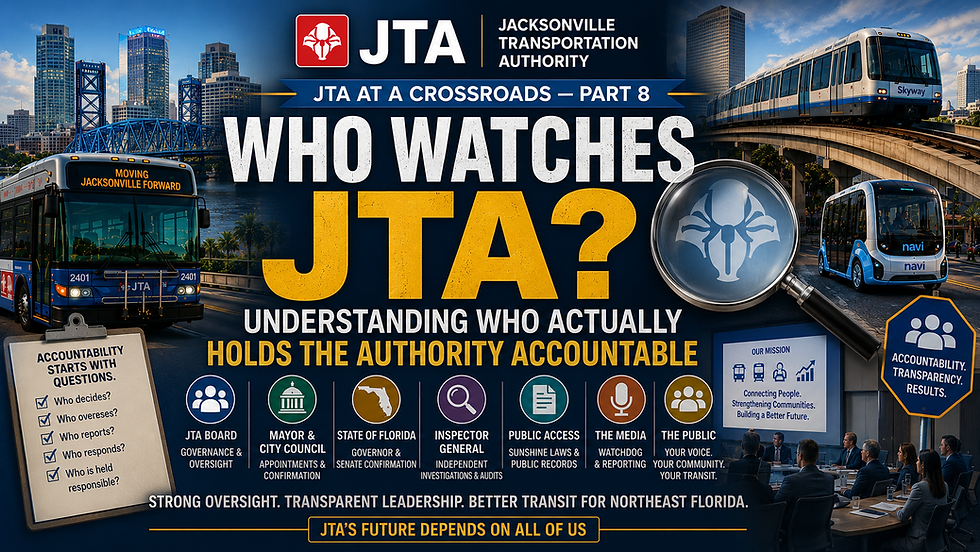
Who Watches JTA? Understanding Who Actually Holds the Authority Accountable
Should the Next JTA CEO’s Pay Be Tied to Performance?

What Should JTA’s Next CEO Actually Be Hired to Fix?

U2C and the Skyway — If We Were Starting Today, Would We Build This?

How Did JTA Get to a $17.5 Million Budget Gap?

JTA Is Raising Fares. How Much Does Another 25 Cents Actually Solve?
How Much Should Jacksonville Pay JTA’s Next CEO?

Will JTA Keep Paying Nat Ford After He Starts Running DART?
