
John Hawley
Jul 28, 2026
JTA at a Crossroads — Part 7:
Jacksonville is about to make two decisions that could shape the Jacksonville Transportation Authority for years: who should lead JTA next, and how should that person be paid?
Earlier in this series, we asked how much Jacksonville should pay JTA’s next CEO, particularly as Nat Ford leaves for Dallas Area Rapid Transit, a substantially larger transit authority, reportedly for less compensation. We’ve also examined what the next CEO should actually be hired to fix: financial stability, service reliability, ridership, the future of U2C and the Skyway, and greater transparency.
That leads naturally to another question:
If Jacksonville knows what it expects the next CEO to accomplish, should some of that CEO’s compensation depend on actually accomplishing it?
Interestingly, JTA already provides a framework for doing exactly that.
JTA Already Has Performance Pay
This isn't an entirely new concept for JTA. Under JTA's executive compensation disclosure, the CEO's annualized salary was listed at $475,904.11, with eligibility for an annual performance bonus of up to 20%. The disclosure also listed a $12,000 vehicle allowance. At that salary, 20% represents potential performance compensation of roughly $95,000.
So the question isn't really whether JTA should introduce performance pay. It already exists.
The better question is what "performance" should mean for the next CEO—and whether taxpayers can clearly see the connection between JTA's results and the compensation its CEO receives.
A performance bonus is only as meaningful as the performance measures behind it.
Define Success Before Negotiating the Contract
JTA's leadership transition provides an opportunity to reverse the normal sequence. Instead of hiring a CEO, negotiating compensation and then establishing broad objectives, the Board could determine the most important objectives before the next contract is signed.
Part 6 identified many of them. JTA needs a sustainable financial model. It needs reliable transportation. It needs to determine the future of the Skyway and U2C. It needs to evaluate NAVI based on measurable results. It needs greater transparency around spending. And ultimately, it needs a transit system useful enough that more people want to ride it.
Those aren't simply aspirations. Many can be measured.
And if Jacksonville is going to offer compensation at the upper end of the public-transit market, there's a reasonable argument that a meaningful portion should depend on producing those results.
Start With Financial Stability
The most obvious performance measure is financial.
JTA is confronting substantial budget pressures, including a projected $17.5 million FY2027 gap, after addressing another significant financial shortfall in FY2026.
The response has included administrative reductions, executive compensation cuts, furloughs, higher fares and substantial service reductions. The next CEO should be expected to determine whether those problems are temporary, structural or some combination of both—and develop a sustainable solution.
But simply balancing the annual budget shouldn't automatically earn a bonus. A CEO can balance a budget by eliminating routes, reducing frequencies, raising fares or postponing expenses.
The better measure is whether JTA develops a sustainable multi-year operating model in which recurring revenues support recurring expenses without repeated emergency cuts.
Don't Reward Cuts for the Sake of Cuts
This illustrates one of the dangers of poorly designed performance incentives.
Tell a CEO that a bonus depends heavily on reducing operating expenses and there's an easy way to achieve it: cut service.
Routes disappear. Buses run less frequently. Positions remain vacant. Maintenance can be deferred. The spreadsheet improves while the transportation system gets worse.
That's why financial performance can't stand alone.
The objective isn't to create the cheapest possible JTA. It's to create the most effective transportation system Jacksonville can sustainably afford.
Financial performance has to be balanced with service performance.
Reliability Should Matter
If JTA tells riders a bus will arrive every 30 minutes, how often does it?
How many scheduled trips are missed? How frequently do equipment problems disrupt service? How long do Connexion customers wait? How consistently does JTA deliver what its schedules promise?
Those are measurable outcomes that directly affect whether people trust public transportation.
The next CEO's evaluation could include specific reliability targets established at the beginning of each year and publicly reported afterward.
If reliability substantially improves, that's a meaningful accomplishment. If reliability deteriorates while the CEO receives the maximum performance award, taxpayers should reasonably ask how "performance" is being defined.
Ridership Matters—With Some Context
A transportation authority ultimately exists to move people, so ridership should also matter.
But it shouldn't be considered in isolation. Gasoline prices, employment patterns, economic conditions, Downtown development and other factors outside JTA's control can affect transit usage.
The better approach would establish ridership objectives alongside service frequency, reliability and customer retention.
NAVI provides a good example. The measure shouldn't simply be how many autonomous miles the vehicles travel. Jacksonville should know how many people use the service, what each passenger trip costs and whether ridership justifies continued investment.
Moving vehicles isn't the objective. Moving people is.
The Rider Experience Should Count
Some important performance measures don't involve multimillion-dollar budgets.
Are buses clean? Do passengers feel safe? Is real-time information accurate? Are complaints resolved? Are transfers practical? Would customers recommend the system?
Regular customer surveys could produce measurable year-to-year results and become another component of the CEO's evaluation.
That creates an important connection between the executive suite and the person waiting at the bus stop.
The CEO wouldn't simply be evaluated by the Board. The people JTA exists to serve would help determine whether the agency is actually improving.
Major Projects Need Accountability Too
The next CEO will inherit major decisions involving U2C, the Skyway and other capital investments.
Those projects should have measurable expectations from the beginning: approved cost, expected outside funding, local taxpayer contribution, schedule and projected annual operating costs.
Then compare those expectations with what actually happens.
Projects change. Construction costs rise. Federal funding can change. Unexpected problems occur. A CEO shouldn't be penalized for every development outside management's control.
But repeated delays, unexplained cost increases or major failures to deliver promised benefits should be part of the performance discussion.
The objective isn't punishment. It's accountability.
DART Offers an Interesting Comparison
Ford's move to Dallas provides another relevant example because DART has used performance-based compensation for its CEO.
DART Board documents show its previous CEO was evaluated against strategic objectives that included organizational effectiveness, agency culture, service quality, seamless mobility, facility quality and relationships with communities and regional partners.
That's notable because DART wasn't simply asking whether its CEO balanced the budget.
It evaluated the broader performance of the organization.
Jacksonville doesn't need to copy Dallas, but the principle is useful: decide what matters, measure it and connect executive evaluation to those results.
Make the CEO Scorecard Public
This may be the most important improvement Jacksonville could make.
If the next CEO is eligible for a substantial performance bonus funded with public money, taxpayers should be able to understand exactly why it was earned.
Imagine a simple annual CEO scorecard covering financial sustainability, service reliability, ridership, customer satisfaction, major-project delivery and transparency.
For each category, show:
Target. Actual result. Board evaluation.
Then show the performance compensation awarded.
If the CEO earns the maximum bonus because JTA dramatically improves, Jacksonville should be able to look at the results and say:
Good. That's what we paid for.
If most objectives aren't achieved, taxpayers should be able to understand why maximum performance compensation wasn't awarded.
Performance Pay Should Be Meaningful, Not Automatic
JTA still needs to offer enough guaranteed compensation to attract qualified candidates. Running a transportation authority involves substantial operational, financial, regulatory and political responsibilities.
But a meaningful portion of compensation can still depend on results.
JTA's existing structure allowing a performance bonus of up to 20% provides one possible starting point.
Whether the final number is 10%, 15% or 20% matters less than how the award is determined.
A 20% bonus based on vague or subjective criteria isn't necessarily meaningful accountability. A smaller bonus based on clearly defined, publicly reported results could be considerably stronger.
Establish the Goals Before the Year Begins
Performance objectives should also be established before the performance period begins.
If Jacksonville wants ridership growth, establish the target. If reliability needs improvement, establish the baseline and goal. If administrative costs need to decline, define what counts as administrative spending. If a decision on U2C needs to be completed by a particular date, put it in writing.
Otherwise, performance evaluations can become exercises in looking backward, identifying whatever went well and declaring those accomplishments evidence of success.
Setting the goals first protects both taxpayers and the CEO.
Everyone knows what success looks like before the game starts.
Some Things Aren't Bonus-Worthy
There should also be a distinction between exceptional performance and simply doing the job.
Following the law shouldn't earn a bonus. Maintaining ethical standards shouldn't earn a bonus. Providing accurate information to the Board shouldn't earn a bonus. Treating employees appropriately shouldn't earn a bonus.
Those are baseline expectations for any highly compensated public executive.
Performance compensation should reward measurable results beyond simply fulfilling the basic responsibilities of the position.
Think Beyond One-Year Bonuses
Annual incentives can also encourage short-term thinking.
A CEO could postpone maintenance or other expenses to improve one year's financial results while creating a larger problem several years later.
JTA could therefore consider connecting part of performance compensation to longer-term objectives. Some could be based on annual results while another portion reflects progress toward a three-year financial and operational plan.
Jacksonville isn't hiring the next CEO to produce one good budget.
It's hiring someone to position JTA for the next decade.
This Could Also Solve Part of the Salary Debate
This brings the discussion back to an earlier question in this series:
How much should Jacksonville pay JTA's next CEO?
Perhaps the answer doesn't need to be one large guaranteed number.
JTA could establish a competitive base salary based on similarly sized transportation authorities and then provide meaningful additional compensation when clearly defined results are achieved.
That changes the public discussion from:
“Why are we paying the JTA CEO this much?”
to:
“What did the CEO accomplish to earn it?”
That's a much more useful conversation.
But Performance Pay Requires a Performance Board
There's one complication.
A performance compensation system only works if the Board administering it is willing to enforce it.
If goals are vague, evaluations aren't transparent and maximum bonuses become routine regardless of outcomes, performance compensation simply becomes another form of guaranteed salary.
The JTA Board therefore has responsibilities too. It must establish meaningful objectives, monitor them, publish the results and be willing to withhold performance compensation when those objectives aren't achieved.
That requires more than a carefully written employment contract.
It requires governance.
And that leads directly to the final installment of this series.
Pay for the Results Jacksonville Wants
The objective shouldn't be finding the cheapest CEO Jacksonville can hire.
Nor should JTA assume that paying more automatically produces better leadership.
The goal should be finding the right person, offering competitive compensation and establishing unmistakable expectations for what taxpayers receive in return.
JTA already recognizes the principle of performance compensation. The leadership transition provides an opportunity to make that principle far more transparent and meaningful.
Define the goals before the contract is signed. Publish the scorecard. Measure finances and service. Measure ridership and customer experience. Measure major-project delivery. Reward exceptional results—and don't automatically award performance compensation when those results aren't there.
Because if Jacksonville is going to pay a premium for executive leadership, taxpayers should reasonably expect something in return:
Premium performance.
So perhaps the question isn't simply whether the next JTA CEO's pay should be tied to performance.
It's whether Jacksonville taxpayers should be able to clearly see what performance they're paying for.
Related JTA reporting:


Who Is Megan Hayward? Her JTA Warnings, Removal and Jacksonville’s $39 Million Budget Crisis


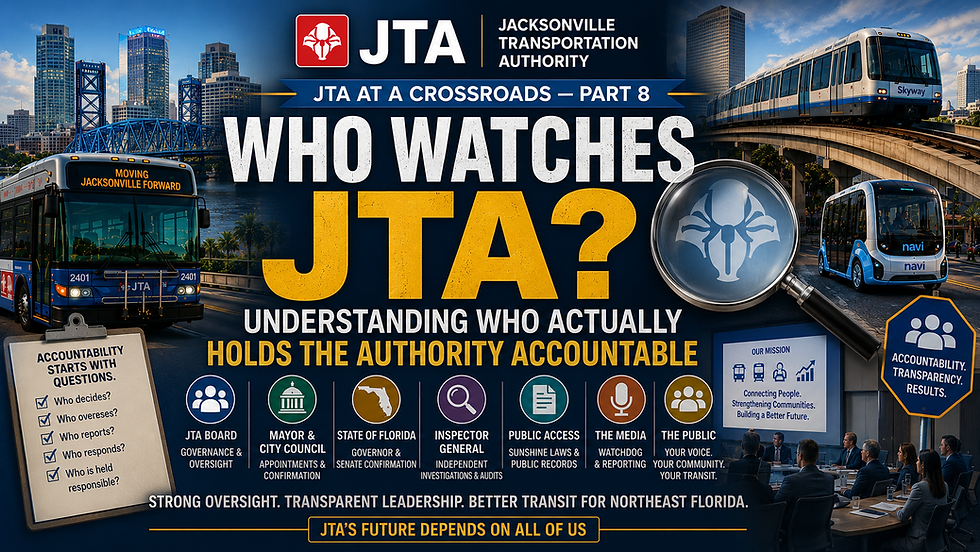
Who Watches JTA? Understanding Who Actually Holds the Authority Accountable
Should the Next JTA CEO’s Pay Be Tied to Performance?
What Should JTA’s Next CEO Actually Be Hired to Fix?

U2C and the Skyway — If We Were Starting Today, Would We Build This?

How Did JTA Get to a $17.5 Million Budget Gap?

JTA Is Raising Fares. How Much Does Another 25 Cents Actually Solve?

How Much Should Jacksonville Pay JTA’s Next CEO?

Will JTA Keep Paying Nat Ford After He Starts Running DART?
