
John Hawley
Sep 20, 2026
JTA at a Crossroads - Part 10
Jacksonville Transportation Authority's financial problems did not suddenly appear when JTA announced nearly 200 potential job losses, major service reductions and a $39 million budget shortfall in September 2026.
The financial trail stretches back much further. JTA had experienced substantial budget variances the previous year, changed chief financial officers, reduced administrative and financial positions, revised financial reports and implemented a $14.2 million midyear correction that management said would stabilize FY2026 without reducing transit service.
That raises a different question than simply asking how JTA ended up $39 million apart between current-year expenses and projected FY2027 revenues.
Who was responsible for watching the money, what were they reporting—and when did JTA know the problem was becoming much larger?
JTA Had Four CFOs Across a Relatively Short Period
One of the least discussed elements of JTA's financial problems is the turnover at the top of its Finance operation.
JTA once had considerably more continuity. Greg Hayes became interim CFO in 2017 before being formally promoted to vice president of Finance and CFO, and he remained publicly identified in that position years later.
Then came a faster succession:
Greg Hayes → Raj Srinath → Heather Obora → Randall Barnes.
Turnover alone does not explain JTA's current financial problems. But in an organization managing complicated operating budgets, grants, tax revenues, contracts, debt, employee benefits and multiyear capital programs, continuity in financial leadership matters.
Raj Srinath Arrived With Decades of Transit Finance Experience
JTA hired Raj Srinath as CFO effective October 16, 2023. He came to Jacksonville after serving as CFO at MARTA and previously spending more than six years at Santa Clara Valley Transportation Authority, eventually serving there as Deputy General Manager/CFO.
Srinath's responsibilities at JTA included financial planning and analysis, accounting, budgeting, treasury, grants and revenue management. His JTA tenure, however, lasted less than two years before his retirement effective June 30, 2025.
That timing matters because Srinath headed JTA Finance during much of the period producing FY2025's financial results.
JTA’s FY2025 Budget Problems Were Already on Paper
By the end of FY2025, JTA was already dealing with substantial unfavorable expense variances.
JTA's own year-end submission said Bus Fund expenses exceeded budget projections by approximately $20.7 million, although higher-than-budgeted federal and state reimbursements and Local Option Gas Tax revenues offset more than $13 million of that amount. JTA also reported Connexion expenses approximately $9.7 million over budget, driven by increased paratransit and Connexion+ contract costs.
Those numbers matter because FY2026 didn't begin in a vacuum. Management entered the new fiscal year already knowing that important operating categories had exceeded the previous year's budget.
Who Is Heather Obora? From Chicago and Washington to JTA Finance
When Srinath retired, JTA did not immediately bring in another outside CFO. CEO Nat Ford moved Heather Obora, JTA's Chief Procurement Officer, into the job on an interim basis.
Obora had joined JTA in June 2021 as Director of Contracts, Procurement and Inventory before moving into higher-level administrative and procurement positions. Ford told the Board that she brought more than 30 years of experience across finance, procurement and supply-chain management and described her qualifications for the assignment as “exceptional.”
Her background was substantial. Before JTA, Obora spent approximately nine years at Chicago Public Schools in positions that included Deputy Comptroller–Accounts Payable, Deputy CFO, Chief Procurement Officer and Chief Operating Officer, and another five years as Chief Procurement Officer at Washington Metropolitan Area Transit Authority. She also spent more than six years in public accounting and holds an MBA and a bachelor's degree in Business Administration with an accounting concentration.
Obora Went From Interim CFO to Being Publicly Identified Simply as CFO
Obora's status changed in JTA's public documents.
On July 1, 2025, Ford explicitly announced her as interim Chief Financial Officer. But by JTA's FY2026 organizational materials and subsequent public communications, she was being identified simply as Senior Vice President/Chief Financial Officer.
That distinction is important. Obora wasn't merely filling the chair for a few weeks—she headed JTA's financial organization through much of the fiscal period now under examination.
Public professional records indicate she subsequently returned to procurement and contract administration around summer 2026. The available JTA records reviewed by The 101 Report do not establish that her move was disciplinary or connected to JTA's developing financial problems.
JTA Was Also Reducing Financial and Administrative Positions
The CFO turnover was occurring while JTA was attempting to reduce administrative costs.
As part of its FY2026 budgeting, JTA eliminated vacant Corporate positions touching functions including Payroll, Financial Analysis, Fixed Assets Accounting and Controllership.
There is no evidence establishing that those position eliminations caused the subsequent budget problems. But their timing raises a legitimate management question: Was JTA reducing financial-management capacity at the same time deteriorating finances required greater monitoring and forecasting?
That question becomes more significant when placed against JTA's earlier history.
JTA Had Already Experienced a Controllership Staffing Problem
JTA's FY2022 independent financial audit contains a finding that deserves renewed attention.
JTA acknowledged a “weakness in the Controllership Department” resulting from staff turnover and a transition of key leadership responsible for financial-statement reporting and closing the year-end books. The authority said the situation had created an operational inefficiency in year-end reporting and promised corrective actions including detailed reconciliations, updated procedures and an assessment of staff skills and training.
That finding dates to 2022, and JTA's FY2024 independent audit subsequently reported no prior-year findings or recommendations requiring corrective action. It would therefore be inappropriate to claim the 2022 weakness persisted into 2026.
But the history establishes something important: JTA itself had previously recognized how staff turnover and leadership transitions inside Controllership could affect financial reporting.
Where Were the CPAs in JTA’s Financial Management Structure?
That leads to another question: Where were the Certified Public Accountants?
A CFO does not have to be a CPA. CFO responsibilities frequently extend beyond technical accounting into budgeting, treasury, debt management, capital markets, investments, grants, forecasting and financial strategy.
Obora had substantial accounting experience and an accounting-focused bachelor's degree, but the public biographical information reviewed by The 101 Report does not identify her as a CPA. Current CFO Randall Barnes is identified by JTA as a Certified Treasury Professional, or CTP, rather than a CPA.
That does not mean CPA-level review was absent from JTA's finances.
JTA’s Annual Financial Statements Receive Independent Professional Audits
JTA's annual financial statements are independently audited under generally accepted auditing standards, Government Auditing Standards and other applicable federal and Florida requirements.
The FY2024 independent auditor reported no findings or recommendations from the preceding annual financial audit and said JTA did not meet the statutory conditions associated with a financial emergency. The auditor also reported no recommendations for improving financial management arising from that audit.
That's an important distinction. An annual financial-statement audit looks backward at whether financial statements fairly present the authority's financial position under applicable accounting rules.
The crisis now facing JTA involves another question as well: Were budgets and forecasts accurately anticipating what was going to happen next?
Accounting for an Expense Is Different From Budgeting for It
An organization can properly record an expense after it occurs and still have budgeted that expense poorly.
Employee benefits provide an easy example. JTA could correctly record every dollar it ultimately paid in benefits while still having underestimated those costs when constructing its budget.
The same applies to Connexion. Contract expenses can be correctly recorded in JTA's accounting system while having been inadequately incorporated into the original operating budget.
That distinction is critical because much of the evidence emerging from JTA concerns budgeting, forecasting and financial assumptions, not necessarily improper bookkeeping.
The Council Auditor Provides Another Layer of Financial Scrutiny
JTA's own Finance organization is not the last stop.
Jacksonville's Charter charges the Council Auditor with examining the accounting systems of City departments and independent agencies, determining whether those systems provide adequate financial information and conducting continuous internal audits of fiscal operations.
Independent agencies also submit quarterly financial reports. Importantly, those reports are prepared by the agencies themselves and are unaudited; the Council Auditor reviews them for reasonableness rather than performing a formal Government Auditing Standards audit every quarter.
That creates an important reporting chain:
JTA financial staff → CFO → executive management → JTA Board → quarterly reporting → Council Auditor → City Council oversight.
February 2026: The Council Auditor Was Already Raising Questions
Council Auditor Report #900 was issued February 13, 2026, covering the first three months of FY2026.
The report questioned assumptions involving revenue, employee costs and Connexion and highlighted areas where actual financial performance was diverging from budget expectations. JTA's first-quarter submission also required correction.
That means the September crisis cannot simply be characterized as a problem nobody was watching.
The financial-monitoring system was already producing warnings.
February 26: JTA Says $14.2 Million in Cuts Can Stabilize the Budget
Less than two weeks later, Obora presented JTA's FY2026 budget amendment to the Board.
The Board minutes say staff would eliminate $14,197,590 in expenses with no reduction to transit services. That consisted of approximately $6.77 million in salaries, wages and fringe benefits and another $7.43 million in other expenses.
The plan included leaving vacancies unfilled, realigning administrative staff, reducing salaries for the remainder of FY2026, freezing performance increases and reducing contracted and Connexion-related expenses. JTA separately said sales-tax revenue was projected to come in nearly $11 million below expectations.
CEO Nat Ford publicly said the changes were intended to ensure JTA ended FY2026 with a balanced budget while preserving transportation services.
That statement provides an important benchmark.
May 2026: JTA Still Wasn’t Projecting What Jacksonville Would Hear in September
By May, the financial situation remained serious, and Council Auditor Report #905 provided another checkpoint. Report #905 was issued May 15 and covered the six months ending March 31.
JTA was also preparing its FY2027 operating budget and confronting weaker revenue expectations.
Yet the picture being presented publicly still did not resemble what Jacksonville would hear only a few months later. That gap between the spring projections and late-summer reality is one of the most important questions in the entire JTA story.
Then JTA Changed CFOs Again
Around this period, Obora transitioned out of the CFO role and back toward procurement and contract administration.
Then JTA hired Randall Barnes.
Barnes brought more than 25 years of financial experience, including more than 16 years at Tennessee Valley Authority and later service as Treasurer for both the City of Jacksonville and JEA. Immediately before JTA, he was Director of Finance, Rates and Treasury at Georgia Transmission Corporation, where JTA says he managed treasury operations, a $3.3 billion debt portfolio and development of a $500 million operating budget.
He also holds the Certified Treasury Professional designation.
Randall Barnes Inherited the Books—and the Hot Seat
Barnes arrived in late July 2026.
That timing matters because most of the fiscal periods producing the numbers Jacksonville is now questioning had already occurred.
Barnes didn't run JTA Finance during FY2025. He didn't construct the original FY2026 budget. And he wasn't CFO when management determined in February that $14.2 million in corrective action could balance the fiscal year without reducing transit service.
Yet he is now the CFO being asked to help explain—and repair—the financial situation.
Nat Ford Was the Constant While JTA’s CFOs Changed
There was one executive who remained in place through most of these financial-management transitions: CEO Nat Ford.
Ford headed JTA while CFO responsibility moved from Hayes to Srinath to Obora. He headed the authority while the FY2025 and FY2026 budgets were developed and while management presented the February corrective plan.
Then Ford announced his own departure in summer 2026, before the full September restructuring was publicly announced.
There is no evidence establishing that Ford's departure resulted from JTA's financial problems. But from an institutional-continuity standpoint, his departure matters because both the CEO and CFO positions overseeing much of the period under examination have now changed hands.
August 2026: The Financial Picture Gets Much Worse
Council Auditor Report #908 was issued August 14 and covered the nine months ending June 30.
By this point, the projected financial problem had deteriorated dramatically from what JTA had been discussing only months earlier.
That creates the central analytical question:
What changed between the February corrective plan, the spring financial projections and the June 30 results?
Was the deterioration driven primarily by new economic developments, inaccurate original assumptions, expenses that had been underestimated, corrective measures that didn't produce expected savings—or some combination of those factors?
September 2026: JTA Announces a $39 Million Shortfall
On September 17, JTA announced that current-year expenses were approximately $178 million, while projected revenues for the fiscal year beginning October 1 were approximately $139 million.
JTA described the difference as a $39 million budget shortfall.
The response included approximately $25 million in professional-services and other contract reductions, elimination of 44 administrative positions, potential elimination of as many as 150 operational positions and significant changes to transit service.
The February promise that the authority could stabilize its finances without reducing transit service had been overtaken by a substantially different financial reality.
Administrative Costs Are Easy Targets—Until Administration Is the Control System
Government administrative expenses are easy political targets. Sometimes criticism of those costs is warranted.
But payroll, accounting, controllership and financial analysis aren't simply overhead. Those functions are part of the internal control system that tells management whether revenue is arriving as expected, employee costs are properly budgeted, contracts are affordable and actual spending is departing from projections.
That's why the combination of financial-position reductions, CFO turnover and JTA's previous experience with Controllership staffing problems deserves examination.
The evidence does not establish that those changes caused the current crisis. But they make financial-management capacity an appropriate part of any serious investigation into what happened.
Cutting Staff Can Save Money While Increasing Institutional Risk
There's another side to administrative reductions that receives less attention.
Every employee who leaves takes some institutional knowledge with them. That can include knowledge of contracts, forecasting assumptions, grant reimbursements, accounting procedures and explanations for why particular budget decisions were originally made.
That makes continuing turnover potentially expensive even when reducing headcount produces immediate savings.
JTA now needs to cut expenses while simultaneously retaining enough financial and operational expertise to reconstruct what happened and build more reliable budgets going forward.
Keeping Randall Barnes May Matter as Much as Hiring Him
That makes Barnes' position particularly important. He has inherited the responsibility for explaining financial decisions largely made before his arrival while also being expected to establish a more sustainable financial structure. There is no evidence Barnes intends to leave JTA, and his previous career includes lengthy periods with major institutions. It would therefore be inappropriate to speculate about his plans. But JTA's recent CFO turnover illustrates the larger management challenge: stabilizing the finances may require stabilizing the people responsible for managing them.
Who Actually Watches JTA’s Money?
The evergreen part of this story is understanding that JTA does not sit directly underneath Jacksonville's mayor.
JTA describes itself as an independent state agency. Its seven-member Board includes four gubernatorial appointees and three mayoral appointees confirmed by City Council. The Board governs JTA. Management operates it. That creates several different oversight “swim lanes,” rather than one simple chain of command.
JTA Finance, the CFO and CEO Are the First Financial Control Lane
The first responsibility lies inside JTA. Financial staff prepare and maintain the underlying information. The CFO oversees financial management. Executive management uses that information to develop budgets, forecasts and corrective actions. The CEO ultimately manages the organization and presents major recommendations to the Board. That means the financial information reaching outside oversight bodies begins largely with information generated inside JTA.
The JTA Board Governs—but Does Not Keep the Books
JTA's seven-member Board approves budgets, major amendments and significant policy decisions.
Board members aren't personally reconciling accounts or calculating employee-benefit projections.
They depend upon management and financial professionals to provide accurate and sufficiently complete information on which to base those decisions. That makes the quality of information flowing to the Board just as important as whether Board members ask questions once they receive it.
The Council Auditor Is an Independent Financial Check
Jacksonville's Council Auditor occupies another lane.
The City Charter directs the office to examine the accounting systems of independent agencies and determine whether they provide adequate financial information. The office also conducts continuous internal auditing of fiscal operations and reports its findings to City Council.
The Council Auditor's Office itself includes professional auditing expertise, including CPAs.
But its quarterly JTA review still depends initially upon financial information supplied by JTA.
That distinction is central to understanding the current controversy.
City Council Has Financial and Legislative Oversight
Jacksonville City Council has another role. Its Finance Committee considers budgets, appropriations, audits, performance measurement and audits involving independent agencies. Council therefore has substantial oversight authority, but it doesn't function as JTA's accounting department or executive management.
The question for Council becomes whether the information reaching it and the Council Auditor adequately reflected JTA's developing financial condition—and what actions were taken when warnings appeared.
The Mayor Has Influence—but Does Not Run JTA Finance
Jacksonville's mayor appoints three of JTA's seven Board members, subject to City Council confirmation. Four other directors are appointed by Florida's governor and confirmed by the Florida Senate. The Mayor also participates in City budget and funding decisions affecting JTA. But JTA is not simply another department within the Mayor's Office. That means determining “who knew what and when” requires examining what information actually traveled from JTA management to its Board, the Council Auditor, City Council and other City officials not assuming everyone had access to the same information at the same time.
People Were Watching JTA—So What Were They Being Told?
That may ultimately be the most important finding in Part 10 of JTA at a Crossroads.
The evidence doesn't show a complete absence of financial oversight.
JTA had financial professionals.
It had a CFO.
It had a CEO.
It had a governing Board.
It submitted quarterly reports.
The Council Auditor reviewed them.
City Council received financial information.
JTA's annual financial statements were independently audited.
And yet the projected financial condition changed dramatically.
The Central JTA Question May Be Forecasting, Not Accounting
That brings the investigation back to the distinction between accounting and forecasting.
The question isn't simply whether JTA eventually recorded what it spent.
It is whether management was forecasting what it was going to spend accurately enough, early enough, for the Board and outside oversight bodies to respond.
In February, management believed approximately $14.2 million in corrective reductions could stabilize FY2026 without reducing transit service.
Seven months later, JTA was eliminating positions, reducing contracts and cutting transit service to confront a $39 million difference between current-year expenses and projected FY2027 revenues.
That's a major change in the financial picture.
Who Knew What—and When Did JTA’s Financial Picture Change?
Jacksonville's investigation should therefore work backward through the reporting chain.
What did Finance know as FY2025 closed?
What did Raj Srinath know before his retirement?
What did Heather Obora inherit?
What did Obora and her financial staff know when FY2026 began?
What assumptions went into the first-quarter report?
Why did that report require correction?
What did CEO Nat Ford receive from Finance?
What was presented to the JTA Board?
Why did management believe the February correction was sufficient?
What changed between March 31 and June 30?
And what did Randall Barnes discover when he arrived in late July?
Those questions don't presume misconduct by any individual.
They are the questions necessary to reconstruct how financial responsibility moved through an organization whose leadership and staffing were themselves changing.
JTA’s Financial Crisis Is Also a Test of Institutional Continuity
Jacksonville may ultimately find that the problem wasn't that nobody was watching.
The more consequential question may be whether the information moving through the oversight system was complete, realistic and timely enough for the people watching to understand what was coming.
That is why the CFO turnover matters.
It's why the Finance staffing matters.
It's why the earlier Controllership weakness matters.
It's why the Council Auditor reports matter.
And it's why the distinction between the executives who built these budgets and the executives now being asked to repair them matters.
Accountability requires identifying who was responsible for decisions when they were made.
But fixing JTA will require something else as well: Keeping enough qualified people in place long enough to make sure the same questions don't have to be asked again.

Who Is Megan Hayward? Her JTA Warnings, Removal and Jacksonville’s $39 Million Budget Crisis


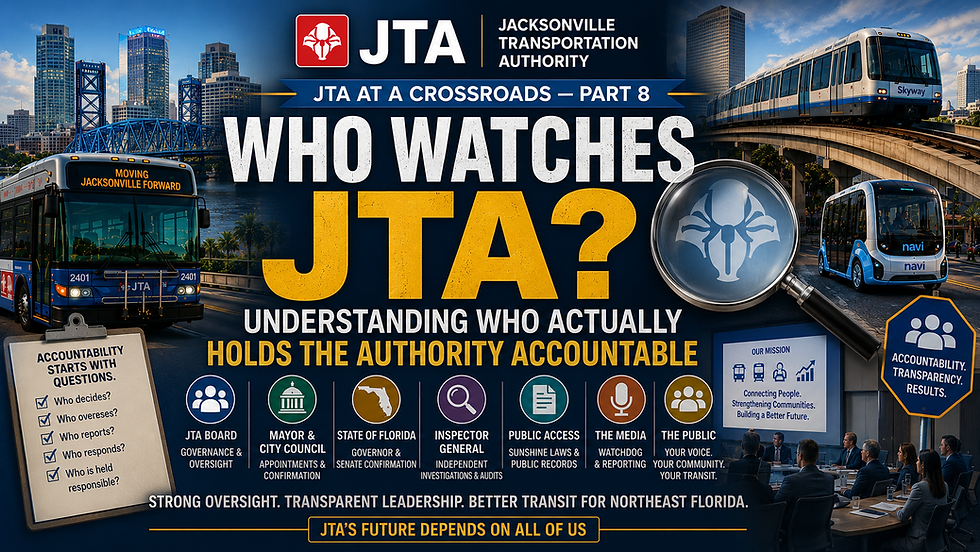
Who Watches JTA? Understanding Who Actually Holds the Authority Accountable
Should the Next JTA CEO’s Pay Be Tied to Performance?

What Should JTA’s Next CEO Actually Be Hired to Fix?

U2C and the Skyway — If We Were Starting Today, Would We Build This?

How Did JTA Get to a $17.5 Million Budget Gap?

JTA Is Raising Fares. How Much Does Another 25 Cents Actually Solve?

How Much Should Jacksonville Pay JTA’s Next CEO?

Will JTA Keep Paying Nat Ford After He Starts Running DART?
