John Hawley
Jul 29, 2026
JTA at a Crossroads — Part 8:
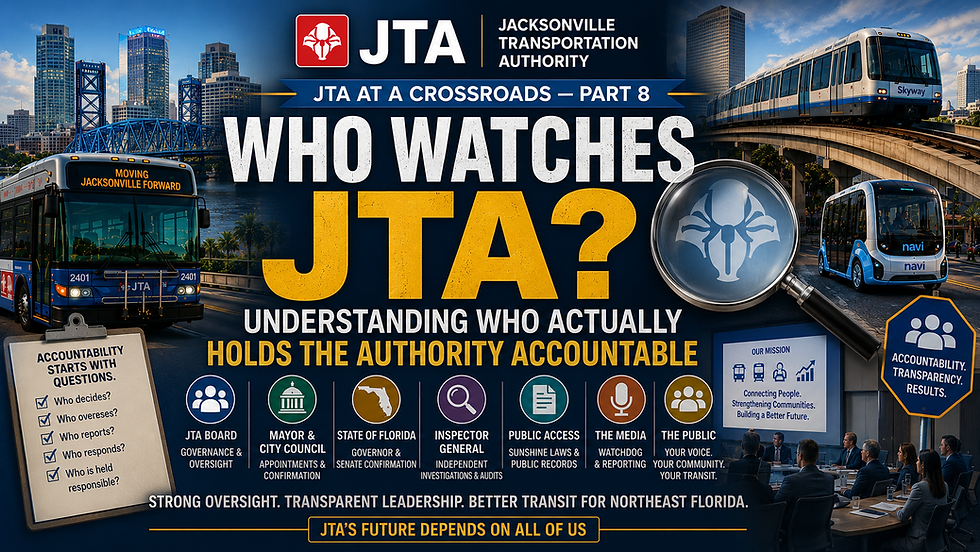
After seven parts examining JTA's leadership, executive compensation, financial pressures, fare increases, service reductions, U2C and the Skyway, this series arrives at perhaps the most important question of all: Who actually holds the Jacksonville Transportation Authority accountable?
The answer isn't as simple as saying the mayor, City Council or governor. JTA isn't a normal City of Jacksonville department. Under Florida law, it is a separate agency of the state governed by its own Board of Directors. That independence has a purpose. Transportation authorities make long-term decisions, manage federal and state funding, enter major contracts and oversee projects that can extend across multiple political administrations.
But independence creates another challenge. When an authority controls substantial public resources, employs highly compensated executives and makes decisions affecting thousands of riders, independence can't mean insulation from accountability. With JTA preparing for its first CEO transition in more than a decade, this is an ideal time for Jacksonville to understand how that accountability is supposed to work.
It Starts With the JTA Board
The first and most direct answer is the JTA Board of Directors. Under Florida law, JTA is governed by seven members. Four are appointed by Florida's governor and confirmed by the Florida Senate, with representation from Duval, Clay, St. Johns and Nassau counties. Three are appointed by Jacksonville's mayor and confirmed by City Council.
That makes the Board the primary institutional checkpoint between JTA management and the public. When people ask who should oversee the CEO, challenge financial assumptions, scrutinize major projects and demand explanations when performance falls short, the answer starts there. The Board isn't simply advising JTA management. It governs JTA.
That responsibility becomes especially important as Nat Ford prepares to leave. The next CEO will inherit many of the challenges examined throughout this series: financial pressures, service reductions, higher fares, an unresolved U2C and Skyway strategy, questions about NAVI and the need for a more sustainable financial model.
The Board will determine who receives that assignment and under what terms. Will JTA conduct a broad national search? Will finalists be publicly identified? Will Jacksonville residents hear from them? Will compensation be benchmarked against transit authorities of comparable size? Will performance objectives be established before the contract is approved? And will taxpayers know what results could trigger performance bonuses?
As Parts 6 and 7 argued, Jacksonville should define what it expects from the next CEO before deciding what exceptional performance is worth. That's ultimately a Board responsibility.
The Mayor and City Council Have Influence—But They Don't Run JTA
Jacksonville's mayor has significant influence because the mayor appoints three of the seven JTA Board members, subject to City Council confirmation. But that doesn't make JTA part of the mayor's administration. A mayor can influence the authority's direction through appointments and public policy, but can't simply operate JTA as though it were a City department.
That distinction can get lost when residents are unhappy with JTA and expect the mayor to order a change. One of the mayor's strongest accountability tools is deciding who should sit on the Board. That makes those appointments consequential. Board members oversee a complicated transportation organization controlling substantial public resources, so the qualifications and independence of those appointees matter.
City Council also has influence, but it doesn't function as JTA's day-to-day governing body. Council confirms the mayor's Board appointments and can ask questions publicly, seek information and scrutinize city policies or funding relationships involving JTA. But the existence of City Council shouldn't allow JTA's own Board to outsource its oversight responsibilities. JTA's Board remains responsible for governing JTA.
Tallahassee Has Considerable Influence Too
The current structure also means Tallahassee has substantial influence over Jacksonville's transportation authority. Four of seven Board members are gubernatorial appointees. There is a reasonable argument for regional representation because JTA operates within a Northeast Florida transportation environment that extends well beyond Duval County.
But Jacksonville residents should understand what that means for accountability: a majority of JTA's governing Board is appointed by Florida's governor. Accountability therefore doesn't reside exclusively in Jacksonville City Hall. State appointments and Florida Senate confirmation are part of the oversight structure as well.
Oversight Extends Beyond the Board
The Board isn't the only watchdog. Jacksonville's Office of Inspector General has jurisdiction extending to independent agencies including JTA. Its responsibilities include investigating fraud, waste, mismanagement and misconduct, along with auditing and contract oversight.
That's an important safeguard. The Inspector General isn't there to decide whether Jacksonville should build U2C or increase bus frequency. Those are policy decisions. But when concerns involve contracting, waste, management practices or possible misconduct, an oversight entity exists outside JTA's management structure. Jacksonville's ethics framework also extends to officers and employees of independent agencies.
JTA maintains its own internal auditing function as well. Internal audit is intended to independently evaluate areas such as risk management, internal controls and governance. Effective auditors shouldn't simply confirm that procedures were followed. They should help determine whether controls are adequate, contracts are properly administered, risks are being recognized and programs are producing what management says they're producing. Significant findings should reach the Board and result in appropriate follow-up.
Federal Oversight Doesn't Answer Every Question
JTA also operates in an environment heavily influenced by federal transportation funding. Federal dollars bring requirements involving procurement, civil rights, safety, financial management, grant compliance and project delivery. Agencies such as the Federal Transit Administration therefore provide another layer of oversight.
But federal oversight generally answers a particular kind of question: Did JTA comply with the requirements governing federal money? It doesn't necessarily answer the question Jacksonville taxpayers may care about more: Was this the best transportation investment to make?
A project can comply with federal requirements and still be debatable as a local priority. That's why local governance remains so important.
Public Meetings, Public Records and the Media Matter
Florida provides another powerful accountability mechanism: public access. JTA Board meetings are publicly noticed, and residents have opportunities to attend and participate through established public-comment procedures. That matters because Board meetings allow taxpayers, riders and journalists to hear what Board members ask—and sometimes what they don't ask.
Florida's public-records laws provide another window into the organization. Budgets, contracts, emails, project documents, compensation records and other public information can help residents and journalists reconstruct how decisions were made. Some of the strongest government accountability doesn't originate inside government. It starts when somebody asks for the records.
Jacksonville's media plays an important role for the same reason. Journalists can uncover spending patterns, executive compensation, procurement decisions, project delays and internal records that otherwise might receive little attention. But reporters can't govern JTA. They can't vote against a CEO contract, reject a project, restructure a budget or remove management.
Journalism can expose a problem. Eventually, someone with authority has to act on the information. And that brings the accountability discussion right back to the Board.
Then There's the Public
The final layer of accountability is Jacksonville residents themselves, and that becomes particularly relevant now. Ford is leaving. JTA is preparing for a CEO search. The authority is working through significant financial pressures. Fare and service changes are being debated. And the future of U2C and the Skyway remains unsettled.
This is precisely when public participation matters. But there's an important distinction: public comment isn't automatically public accountability. Giving someone a few minutes at a microphone only matters if legitimate questions eventually receive answers.
Does the Board request the information? Does management respond? Does someone follow up? Does the answer become part of the public record? And when a genuine problem is identified, does anything actually change? That's where accountability succeeds or fails.
The Board Should Ask Before the Public Has To
Throughout this series, we've raised questions JTA's own governing Board should be asking. How much should Jacksonville pay the next CEO? Should compensation be tied to measurable performance? Why did JTA experience significant financial gaps in consecutive budget cycles? How much do higher fares actually solve? What does each JTA transportation mode cost per passenger? What have we learned from NAVI? What should happen to the Skyway? And if Jacksonville were starting U2C today, would we make the same decisions?
The public shouldn't have to become transportation experts to force these questions onto the agenda. A strong Board asks them first. That's what governance is supposed to provide.
The leadership transition also provides an opportunity to make that accountability routine rather than reactive. Before hiring the next CEO, JTA could establish clear multi-year objectives and publicly report progress toward them. As Part 7 proposed, performance compensation could be connected to measurable results involving financial sustainability, reliability, ridership, customer satisfaction, major-project delivery and transparency.
The Board could publish a simple annual CEO scorecard built around three questions: What did we expect? What happened? What did the Board do about it? Those questions would tell Jacksonville a great deal about both the CEO and the Board overseeing that person.
Independence Only Works When Oversight Works
There are good reasons for JTA to be independent. Transportation investments span political administrations. Infrastructure projects can take years. Federal grants require specialized expertise. Transit planning shouldn't completely change every time Jacksonville elects a mayor.
Independence provides continuity. But there's a tradeoff: the further an agency sits from voters, the more important strong governance becomes.
JTA's CEO isn't elected. JTA's Board isn't elected. Voters can't directly remove either at the next election. Instead, accountability runs through the governor, mayor, Florida Senate, City Council, JTA Board, inspectors, auditors, federal agencies, journalists and ultimately the public.
That's substantial oversight on paper. The question is how effectively those layers work in practice.
Maybe That's the Real Crossroads
This series began with Nat Ford's departure for Dallas and questions about his compensation and transition. That led to another question: How much should Jacksonville pay his replacement? From there, we examined fare increases, the $17.5 million budget gap, U2C and the Skyway, what the next CEO should actually be hired to fix and whether executive compensation should be tied more directly to measurable performance.
Eventually, every one of those subjects leads back to governance. Who challenges the financial assumptions? Who asks whether a project still makes sense? Who measures whether riders are receiving better service? Who determines whether executive compensation is justified? Who asks whether taxpayers received what they were promised? And when the answer is no, who does something about it?
The answer can't always be somebody else.
A Crossroads—and an Opportunity
JTA's leadership transition gives Jacksonville a rare opportunity. The authority can hire a new CEO without simply recreating the previous arrangement. It can benchmark compensation against comparable transit systems, establish measurable expectations before the contract is signed, publicly evaluate performance and reconsider major investments using current information rather than defending past decisions.
And JTA's Board can make its own role more visible.
None of that requires assuming JTA has failed. It simply recognizes a fundamental principle of public administration: public institutions become stronger when accountability is clear.
After eight parts examining JTA at a Crossroads, perhaps that's the most important conclusion of the entire series.
Jacksonville doesn't simply need to decide who will run JTA next. It needs to decide what that person is expected to accomplish, how we'll measure whether they accomplished it—and who will hold them accountable if they don't.
Ultimately, the most important watchdog over JTA shouldn't be one mayor, one governor, one council member, one inspector, one journalist or one citizen. It should be a system in which all of them can see enough, ask enough and act when necessary.
That's how independence and accountability are supposed to coexist.
And as Jacksonville chooses JTA's next leader and determines the future of its transportation system, this is the moment to make sure they actually do.
Related JTA reporting:


Who Is Megan Hayward? Her JTA Warnings, Removal and Jacksonville’s $39 Million Budget Crisis


Who Watches JTA? Understanding Who Actually Holds the Authority Accountable
Should the Next JTA CEO’s Pay Be Tied to Performance?

What Should JTA’s Next CEO Actually Be Hired to Fix?

U2C and the Skyway — If We Were Starting Today, Would We Build This?

How Did JTA Get to a $17.5 Million Budget Gap?

JTA Is Raising Fares. How Much Does Another 25 Cents Actually Solve?

How Much Should Jacksonville Pay JTA’s Next CEO?

Will JTA Keep Paying Nat Ford After He Starts Running DART?
