
John Hawley
Jul 28, 2026
JTA at a Crossroads — Part 6:
Jacksonville will soon have something it hasn't had in more than a decade: a new CEO leading the Jacksonville Transportation Authority.
Nat Ford has led JTA since 2012 and is leaving to become president and CEO of Dallas Area Rapid Transit. His departure naturally creates a search for a successor, but before JTA decides who should get the job—or how much Jacksonville should pay that person—the Board might want to answer a more fundamental question:
What exactly are we hiring the next CEO to fix?
Because this isn't an ordinary leadership transition.
JTA is dealing with significant financial pressures, including a projected $17.5 million FY2027 budget gap. Fares are increasing. Some bus frequencies and services are being reduced. The future of the Skyway and U2C is being reconsidered. NAVI is providing Jacksonville with its first real-world experience with autonomous public transportation. And all of this is happening while Jacksonville continues to grow.
The next CEO shouldn't simply be hired to run JTA.
Jacksonville should decide what it expects that person to change.
Start With the Financial Problem
Part 4 of this series examined perhaps the most immediate challenge facing JTA: how an agency with a roughly $139 million FY2027 operating budget arrived at a projected $17.5 million gap after confronting substantial financial pressures the previous year as well.
JTA has attributed a significant portion of its recent problems to sales-tax revenues coming in below expectations. The authority has responded with administrative reductions, executive compensation cuts, furloughs, contract changes and other savings. But those measures haven't been enough. Much of the next round of savings is coming from transportation service itself.
That makes the first assignment for the next CEO relatively straightforward:
Build a sustainable operating model.
The goal shouldn't simply be balancing one budget. The next CEO should determine whether JTA's financial difficulties are temporary, structural or some combination of both and develop a multi-year plan that doesn't require another emergency round of service reductions every time revenues underperform.
A balanced FY2027 budget shouldn't be the finish line. It should be the starting point.
Protect the Transportation People Actually Depend On
Financial stability matters because when the budget doesn't balance, eventually the consequences reach riders.
Reduced frequencies aren't simply numbers on a spreadsheet. For someone depending on public transportation to get to work, school, a medical appointment or the grocery store, moving from a bus every 30 minutes to one every 60 minutes can fundamentally change whether transit remains practical.
The next CEO therefore shouldn't be judged solely on whether expenses remain within budget. Jacksonville should also be asking whether JTA is providing reliable transportation where people actually need it.
That means examining the bus network based on current population patterns, employment centers, ridership and Jacksonville's changing development. The city in 2026 isn't the Jacksonville that existed when Ford arrived in 2012. The transportation network shouldn't operate as though it is.
A new CEO has an opportunity to examine which routes are working, which aren't, where Jacksonville's population and jobs are moving and whether resources are being directed toward the transportation services producing the greatest public value.
Resolve the Skyway and U2C Question
Then comes perhaps the most visible strategic issue facing JTA's next leader: What exactly should Jacksonville do with the Skyway and U2C?
As we examined in Part 5, JTA itself is reconsidering the answer. Alternatives now include rehabilitating existing Skyway vehicles, purchasing modern automated people-mover trains, converting the elevated structure for autonomous vehicles, operating autonomous vehicles at street level or potentially repurposing the Skyway structure as a multiuse trail.
That's a significant change from simply assuming the original U2C concept will move forward as envisioned.
The next CEO shouldn't arrive with instructions to defend a predetermined outcome. The assignment should be to finish the analysis and recommend the best transportation solution based upon what Jacksonville knows today, not what it expected autonomous transportation to become years ago.
If U2C remains the best answer, demonstrate why. If modern people-mover trains provide better value, show the numbers. If autonomous vehicles work better on Downtown streets than on an elevated structure, explain that. And if another traditional transportation alternative can move more people for less money, Jacksonville deserves to know that too.
Changing direction after receiving new information isn't necessarily failure. It can be responsible management.
Turn NAVI Into Useful Data
NAVI provides the next CEO with something Jacksonville didn't have when U2C was originally conceived: actual experience operating autonomous public transportation.
That's valuable.
But the next stage should move beyond demonstrating that an autonomous shuttle can travel through Downtown Jacksonville. The question now is whether autonomous transportation provides enough benefits to justify expanding it.
How much does NAVI cost per passenger? How does that compare with operating a conventional shuttle or bus over the same area? How reliable is the service? How many passengers can it realistically move during busy periods? What are the long-term maintenance and technology costs? And what happens to those economics if Jacksonville expands the system?
The next CEO shouldn't be asked to prove NAVI works.
The CEO should be asked to determine where NAVI works better than the alternatives.
That's a considerably more useful test.
Make Transit Something More People Want to Use
JTA also needs riders.
Public transportation obviously serves people who don't have another transportation option, and maintaining mobility for those residents is an essential part of its mission. But a healthy transit system should also try to attract people who do have alternatives.
Jacksonville is sprawling and automobile-oriented, so JTA faces geographic challenges that transit systems in denser cities don't. That makes reliability, frequency and convenience even more important.
The next CEO should be able to answer a deceptively simple question:
Why should someone who owns a car choose JTA for a particular trip?
If the answer is that the bus takes significantly longer, requires multiple transfers and might only arrive once an hour, increasing ridership becomes extremely difficult regardless of the fare.
So improving JTA can't simply mean operating buses more efficiently. It should mean making public transportation more useful.
Establish What JTA Should Be
JTA today is much more than a bus company. It operates traditional buses, First Coast Flyer, paratransit, ReadiRide, the St. Johns River Ferry, the Skyway and NAVI while managing significant transportation infrastructure and pursuing emerging technologies.
That breadth can create opportunity, but it can also create mission creep.
One of the next CEO's most important assignments should therefore be working with the Board to establish a clear hierarchy of priorities. What does JTA absolutely have to do well? What should it do if resources allow? And which programs should be reconsidered if they aren't producing enough public benefit to justify their ongoing cost?
Every interesting transportation idea can't automatically become another permanent operating obligation.
When resources are limited, priorities matter.
Make Spending and Results Easier to Understand
JTA also has an opportunity to make accountability much simpler.
Taxpayers shouldn't need to dig through hundreds of pages of budget documents to understand what they're buying.
For major transportation services, JTA could regularly publish understandable measures such as operating cost, ridership, taxpayer subsidy per passenger, reliability, frequency and customer satisfaction. For major capital projects, it could show the original budget, current budget, local taxpayer contribution, outside funding, completion schedule and projected annual operating cost once the project is finished.
The concept is simple:
Here's what we spent. Here's what we promised. Here's what happened.
That kind of transparency would also make debates over buses, NAVI, U2C and other services much more productive because taxpayers could compare outcomes instead of arguing primarily from impressions.
Define Success Before Hiring the Person
This connects directly to Part 2 of our series: How much should Jacksonville pay JTA's next CEO?
Compensation becomes easier to evaluate when expectations are clear.
Instead of starting with Ford's previous compensation and asking what Jacksonville must pay to replace him, the Board could first establish measurable objectives for the next CEO's first three years:
Produce structurally balanced operating budgets without recurring emergency service reductions.
Improve service reliability and customer satisfaction.
Establish measurable ridership goals.
Publish meaningful cost-per-passenger comparisons across JTA's major transportation modes.
Complete an updated analysis and recommendation for the future of the Skyway and U2C.
Establish transparent performance reporting for major projects and services.
Develop a long-term financial plan based on realistic revenue assumptions.
Improve opportunities for meaningful public participation and accountability.
Then hire the candidate best equipped to accomplish those objectives.
And as we'll examine in the next part of this series, perhaps a portion of CEO compensation should be connected to actually achieving some of them.
Let Jacksonville Meet the Finalists
Ford's move to Dallas also provides an interesting comparison.
DART conducted a national search, publicly identified three finalists and held a public meet-and-greet where riders, residents and stakeholders could interact with the candidates before the Board made its final selection.
Jacksonville doesn't have to copy Dallas, but the idea is worth considering.
The next JTA CEO will oversee substantial public resources and make decisions affecting transportation throughout the region. Why shouldn't Jacksonville residents have an opportunity to hear from the finalists before the contract is signed?
Ask them how they would address the financial situation. Ask what they think of U2C. Ask how they would improve bus service. Ask what they believe JTA should stop doing.
Transparency shouldn't begin after someone gets the job.
Don't Hire the Next Nat Ford
That isn't intended as criticism of Ford.
After more than 14 years, he leaves a significant imprint on JTA. His tenure included major infrastructure investments, expansion of First Coast Flyer, development of autonomous transportation initiatives and the opening of the Jacksonville Regional Transportation Center.
But leadership transitions are opportunities precisely because the next leader doesn't have to be the previous one.
Jacksonville shouldn't search for another Nat Ford.
It should search for the CEO JTA needs for its next chapter.
The challenges of 2026 are different from those Ford inherited in 2012. The job description should reflect that.
Ask the Question That Really Matters
When finalists eventually sit before the JTA Board, there will undoubtedly be questions about executive experience, management philosophy, federal funding, technology and organizational leadership.
But perhaps one question should come before all of them:
“You've studied JTA. What are the three things you believe we're doing wrong—and what would you change?”
The best candidate shouldn't simply tell the Board what Jacksonville has accomplished.
That person should be willing to identify what needs fixing.
Because JTA's next CEO will inherit an organization facing financial pressures, service reductions, fare increases, an unresolved debate over the future of one of its signature transportation initiatives and increased public scrutiny.
That's not necessarily a problem for recruiting the right executive.
That is the job.
Jacksonville doesn't simply need a caretaker. It needs someone willing to evaluate what works, reconsider what doesn't and explain those decisions publicly.
The assignment can be summarized fairly simply:
Stabilize the finances. Protect essential transportation. Improve service. Measure performance. Resolve the Skyway and U2C question. Strengthen accountability. And build a transportation system Jacksonville can sustainably afford—and more people actually want to use.
If the JTA Board defines those expectations before choosing the person and negotiating the compensation package, Jacksonville will have a much better way to answer the question several years from now:
Was the next CEO worth what we paid?
Related JTA reporting:

Who Is Megan Hayward? Her JTA Warnings, Removal and Jacksonville’s $39 Million Budget Crisis


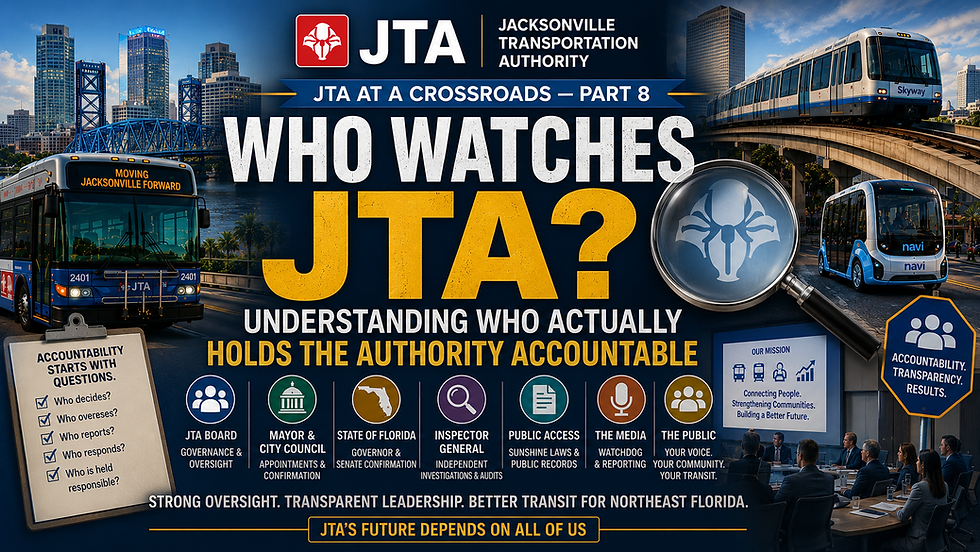
Who Watches JTA? Understanding Who Actually Holds the Authority Accountable
Should the Next JTA CEO’s Pay Be Tied to Performance?

What Should JTA’s Next CEO Actually Be Hired to Fix?
U2C and the Skyway — If We Were Starting Today, Would We Build This?

How Did JTA Get to a $17.5 Million Budget Gap?

JTA Is Raising Fares. How Much Does Another 25 Cents Actually Solve?

How Much Should Jacksonville Pay JTA’s Next CEO?

Will JTA Keep Paying Nat Ford After He Starts Running DART?
