
John Hawley
Jul 23, 2026
JTA at a Crossroads — Part 2
The Jacksonville Transportation Authority is about to get something public agencies rarely receive: a clean slate at the top.
Nat Ford is leaving JTA after more than a decade to become President and CEO of Dallas Area Rapid Transit. DART says Ford begins October 26.
That raises an important question Jacksonville should answer before, not after, the next CEO contract is negotiated:
How much should taxpayers actually pay to run JTA?
The timing couldn't be better for that discussion, because Ford's move to Dallas provides Jacksonville with an unusually revealing real-world comparison.
Ford is moving up in agency size — while reportedly taking a pay cut
DART isn't some smaller transit operation offering Ford an easier retirement job.
It's a major regional transit authority serving 13 member cities in the Dallas area, operating light rail, commuter rail, buses, paratransit and other transportation services.
Financially, the difference is substantial.
JTA's FY2026 budget includes approximately $162.4 million in operating expenditures and $39.5 million in capital spending — roughly $202 million combined.
DART's FY2026 financial operation is around $1.5 billion in operating and capital expenditures before debt service.
Put those figures beside each other and DART is roughly seven times the size of JTA financially, using operating and capital budgets as the comparison.
And Ford is reportedly taking less money to run it.
Dallas reporting following Ford's selection says DART Board Chair Randall Bryant confirmed Ford will take a pay cut to move to Dallas. Bryant has not disclosed Ford's precise base salary but said it is similar to what DART's previous CEO received. Former CEO Nadine Lee was earning more than $400,000 annually in base salary when she departed.
That's quite a comparison.
A CEO leaves Jacksonville to manage a transit organization roughly seven times larger financially—and takes a pay cut.
Jacksonville taxpayers should probably pay attention to what that says about the market value of the JTA position.
What was Jacksonville paying Ford?
There's been considerable confusion surrounding Ford's compensation because different reports measure different things.
Some reports have placed Ford's total compensation considerably above $600,000. D Magazine, for example, reports total JTA compensation of $626,475.29 in 2023.
But more recent public payroll data gives us a cleaner number.
For 2025, Ford was JTA's highest-paid employee at approximately $504,887. JTA had 860 employees in that payroll data.
That works out to roughly:
$42,000 per month.
Or:
$9,700 per week.
The distinction between salary and total compensation is important. Retirement contributions, deferred compensation and other benefits can push the taxpayer cost of an executive well beyond the number appearing on a payroll report.
That's why JTA's next CEO contract should be discussed publicly in terms of total potential compensation, not merely advertised salary.
JTA itself recently decided executive compensation needed to come down
There's another reason Jacksonville shouldn't simply use Ford's previous compensation as the starting point.
JTA recently confronted significant financial pressures and responded with cost reductions that included a 15% compensation reduction for Ford and other senior executives.
That matters.
The Board has effectively already acknowledged that executive compensation can and should be reconsidered when the agency's financial circumstances require it.
So Ford's departure provides an opportunity to do something more permanent:
Reset the position rather than automatically resetting the paycheck.
A new CEO doesn't inherit Ford's salary simply because Ford occupied the office before them.
DART just conducted the kind of national search JTA is about to conduct
There's another useful piece of evidence.
DART didn't simply hire Ford away privately.
It conducted a national CEO search and announced three finalists: Ford; Dee Leggett, a former DART executive; and Monica Tellez-Fowler, President and CEO of the Central Ohio Transit Authority.
In other words, DART recently tested the national executive transit market.
And the eventual compensation was apparently sufficient to attract an executive with Ford's experience running MARTA, San Francisco's Muni and JTA—even though DART's chairman acknowledges Ford is taking a pay cut.
That doesn't prove Jacksonville has been overpaying its CEO.
But it certainly gives the JTA Board a reason to investigate whether it has.
So what should Jacksonville pay?
The answer shouldn't be picked arbitrarily.
Maybe it's $300,000.
Maybe it's $350,000.
Maybe it's $400,000.
Maybe the national market really does require JTA to spend $500,000 or more to attract the executive it wants.
But the Board should demonstrate that with comparable data.
Before establishing the next compensation package, JTA should publicly compare itself with similarly situated transportation authorities based upon operating budget, capital budget, employees, ridership, service area and executive responsibilities.
Then show taxpayers the results.
If comparable agencies are paying their CEOs $350,000, Jacksonville shouldn't automatically pay $500,000 because that's approximately what Ford previously received.
Conversely, if the market analysis demonstrates that $500,000 is necessary to attract the right executive, the Board should be able to explain why.
And don't hide compensation in the benefits
This is where public-sector executive contracts can become difficult for ordinary taxpayers to evaluate.
The advertised salary might be one number.
Then come retirement contributions, deferred compensation, automobile allowances, bonuses, leave, insurance, severance and other benefits.
That's how a $400,000 salary can potentially become a substantially larger compensation package.
So when JTA advertises or negotiates its next CEO position, Jacksonville should be asking about the maximum taxpayer exposure under the entire contract.
Not just salary.
Performance should be part of the conversation too
There's another possibility worth considering.
Instead of guaranteeing an exceptionally large compensation package from Day One, JTA could structure part of the next CEO's compensation around clearly defined performance objectives.
Those could include financial stability, ridership, service reliability, customer satisfaction, project delivery and other measurable outcomes.
That doesn't necessarily mean paying the next CEO less.
It means taxpayers should know what they're paying for.
And that could become particularly important as JTA works through financial challenges, service decisions and major questions surrounding the future of its transit investments.
The July 29 Board meeting is a good place to start asking
Jacksonville doesn't need to decide what the next CEO should earn from the audience at one board meeting.
But the public can start asking how JTA intends to decide.
Among the questions worth putting to the Board:
Has JTA established a compensation range for the next CEO?
What comparable transit authorities are being used to determine that range?
Will JTA publish that compensation analysis before approving a contract?
Will the public see the complete proposed compensation package—not simply base salary—before the Board votes?
And considering JTA recently reduced executive compensation by 15%, will that reduction influence the compensation offered to Ford's successor?
Those are reasonable questions regardless of whether someone believes Ford was overpaid, underpaid or appropriately compensated.
This isn't really about Nat Ford anymore
That's perhaps the most important distinction.
Ford negotiated his contracts. The JTA Board approved them.
Now he's leaving.
The more useful question isn't whether Jacksonville should continue debating what Ford was worth.
It's whether Jacksonville has learned anything from the experience.
Ford is heading to a substantially larger transit authority, and DART's chairman says he's taking a pay cut to do it.
That gives Jacksonville an extraordinary opportunity to reconsider what running JTA should cost.
Don't start with Nat Ford's paycheck and work backward.
Start with JTA's size, responsibilities and performance expectations.
Look at what comparable agencies are paying.
Look at what the national market just demonstrated in Dallas.
Then determine what the job is actually worth.
Because once another multi-year CEO contract is approved, the opportunity to reset that benchmark may be gone for years.
Jacksonville taxpayers should be asking these questions now—before the next contract is signed.
Related JTA reporting:


Who Is Megan Hayward? Her JTA Warnings, Removal and Jacksonville’s $39 Million Budget Crisis


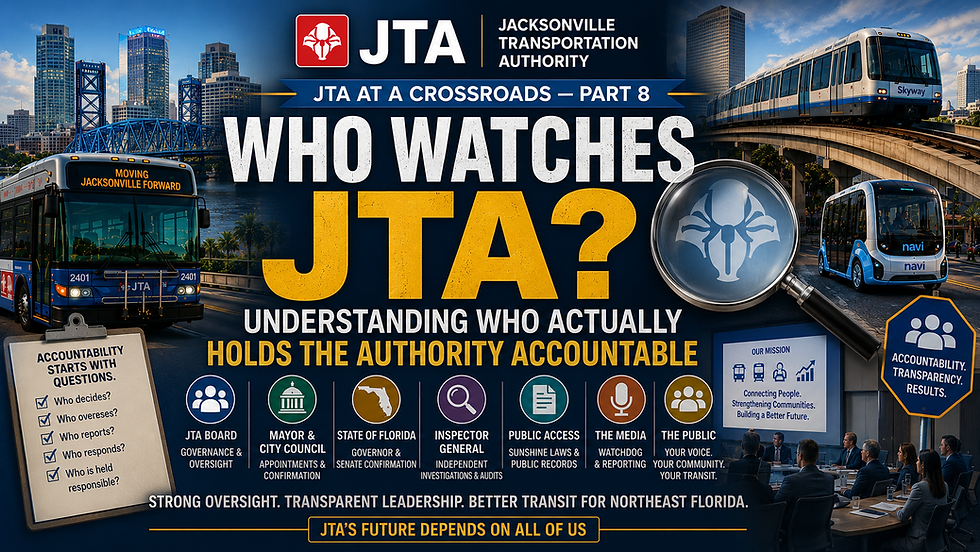
Who Watches JTA? Understanding Who Actually Holds the Authority Accountable
Should the Next JTA CEO’s Pay Be Tied to Performance?

What Should JTA’s Next CEO Actually Be Hired to Fix?

U2C and the Skyway — If We Were Starting Today, Would We Build This?

How Did JTA Get to a $17.5 Million Budget Gap?

JTA Is Raising Fares. How Much Does Another 25 Cents Actually Solve?

How Much Should Jacksonville Pay JTA’s Next CEO?
Will JTA Keep Paying Nat Ford After He Starts Running DART?
