
John Hawley
Sep 24, 2026
JTA at a Crossroads Part 11- Investigation with or without Subpoena Power?
Jacksonville Transportation Authority is already making painful decisions. JTA is eliminating positions, reducing bus service and preparing to suspend Skyway and NAVI operations as it attempts to reconcile roughly $178 million in current expenses with approximately $139 million in projected FY2027 revenue.
Now Jacksonville is turning greater attention toward how JTA reached this point. And there is precedent for going well beyond ordinary oversight hearings.
Tampa investigated its transit CEO. Miami-Dade auditors uncovered multimillion-dollar financial-control failures. Washington built an independent transit watchdog with subpoena power. Jacksonville has investigated JTA executives before.
As JTA confronts a roughly $39 million financial imbalance, the question is no longer simply whether the authority will be reviewed. It is whether the investigation will have enough independence and authority to follow the evidence wherever it leads.
Will the body investigating JTA actually have enough authority to determine what happened?
Jacksonville's Financial Oversight Committee Cannot Issue Subpoenas
Council President Nick Howland chose the forum. After JTA announced its latest financial restructuring, Howland said he would redirect the Financial Audit and Oversight Select Committee he created earlier this year to examine JTA and its Local Option Gas Tax projects.
That choice matters. Jacksonville's own description of the committee expressly states that select committees cannot exercise subpoena power. The committee can hold hearings, seek expert advice, review information provided to it and make recommendations—but it cannot compel testimony through a subpoena.
Jacksonville already has another investigative mechanism with considerably more teeth. The independent Office of Inspector General has jurisdiction over the City's independent agencies and can subpoena witnesses and compel production of records within its authority.
That raises a question separate from whatever investigators may ultimately conclude about JTA: Why did Council leadership choose a review mechanism without subpoena power rather than request—or pair it with—an independent investigation by an office that has it?
Jacksonville Already Has an Independent Office With Subpoena Power
Jacksonville's Office of Inspector General operates under substantially different authority. The OIG can investigate City programs, accounts, records, contracts and transactions and has jurisdiction extending to Jacksonville's independent agencies.
Most importantly, the OIG can subpoena witnesses and require production of documents, records and other information. Its subpoenas are enforceable through the Fourth Judicial Circuit. Jacksonville
The OIG's mandate also extends beyond fraud. Jacksonville specifically authorizes it to investigate waste, mismanagement, misconduct and other abuses. Jacksonville
Could a Review Without Subpoena Power Become a Paper Tiger?
Jacksonville could spend months holding hearings, questioning cooperative witnesses and reviewing documents provided to Council. Eventually, a committee could issue recommendations and officials could say JTA had been investigated.
But what happens if a former executive declines to participate? What happens if investigators need original spreadsheets, emails or other records that haven't been voluntarily supplied?
That's where subpoena authority stops being a procedural footnote. An investigation can only follow the evidence as far as its authority allows.
Could the Investigation Become a Fait Accompli?
There is another potential problem. Once a committee finishes its work, its existence could be cited as evidence that Jacksonville already investigated JTA — regardless of whether investigators possessed the authority to compel all relevant evidence.
That doesn't mean a Council investigation lacks value. It means Jacksonville should distinguish between legislative oversight and an independent investigation with compulsory authority.
Otherwise, a limited review risks becoming a fait accompli: JTA was investigated. The report was issued. Move on.
There Is No Evidence Ford Supporters Selected a Weaker Forum
That distinction also requires restraint. We have not found evidence establishing that supporters of former CEO Nat Ford intentionally directed scrutiny toward a body without subpoena authority to protect Ford or other former executives.
But that doesn't eliminate the structural question. Jacksonville should explain why a potentially consequential investigation would rely solely on a committee without subpoena power when the City already maintains an independent office that has it.
It also creates another records question: Was an OIG investigation discussed, proposed or rejected — and by whom?
Tampa Shows How a Transit Authority Investigated Its Own CEO
Jacksonville doesn't have to invent an investigative model. Hillsborough Area Regional Transit faced its own executive controversy involving then-CEO Benjamin Limmer in 2019.
HART's Board placed Limmer on paid leave, installed an interim CEO and authorized an outside independent investigation. Carlton Fields ultimately conducted the inquiry.
Investigators interviewed 22 witnesses, some more than once, and reviewed thousands of pages involving procurement, purchasing cards, travel, personnel records, policies and emails.
Tampa Didn't Need to Establish a Crime Before Investigating
The HART investigation examined procurement and vendor relationships, travel and purchasing-card practices, and personnel decisions. Investigators substantiated some policy violations while reaching different conclusions on other allegations.
That's important precedent for Jacksonville. HART didn't have to establish criminal conduct before determining that executive decisions warranted independent examination.
The purpose was to establish facts first and determine responsibility afterward.
Miami-Dade Shows Why Financial Controls Matter
Miami-Dade provides a different kind of precedent. Its FY2024 transit audit found approximately $20 million improperly released from construction-in-progress accounting and another roughly $11 million in capital costs that previously had been added to construction in progress twice.
The significance wasn't merely the dollar amount. Auditors concluded that existing procedures hadn't been sufficient to identify the problems and recommended stronger financial controls and closing procedures.
That's directly relevant to JTA. Jacksonville needs to determine whether its current crisis resulted solely from changing revenues and expenses — or whether weaknesses in budgeting, forecasting, review and financial controls contributed.
That Is One of JTA's Central Questions
Some of JTA's financial deterioration clearly resulted from revenues falling below projections. But the Council Auditor also identified expenses that weren't accurately budgeted, including employee benefits and the Connexion service-provider contract.
Those are different kinds of problems. They raise questions about how budgets and forecasts were built and reviewed.
Who prepared the assumptions? Who challenged them? Who approved them? And what information ultimately reached the CEO and Board?
Washington Shows Why Independent Investigative Power Matters
Washington's WMATA provides another model. Its Office of Inspector General independently investigates the transit authority and possesses subpoena authority.
The U.S. Government Accountability Office examined WMATA's OIG and found that it possessed most of the institutional characteristics associated with an independent inspector general. Those included independent investigative and audit authority and the ability to issue subpoenas.
The lesson isn't that WMATA and JTA face identical financial problems. It's that independence means more than putting different people around a conference table — it includes the authority to obtain evidence.
Washington Also Shows Why Independence From Management Matters
GAO nevertheless identified weaknesses in protections surrounding WMATA's Inspector General and recommended additional safeguards for OIG independence.
That's another lesson Jacksonville should consider. An investigation of JTA shouldn't depend upon the approval of executives whose decisions could become part of the investigation.
Investigators need sufficient independence to reach conclusions favorable or unfavorable to current and former leadership based on the evidence.
Jacksonville Has Investigated a Former JTA CEO and CFO Before
Perhaps Jacksonville's strongest precedent is its own history.
In 2015, Jacksonville's Council Auditor examined JTA payroll and executive compensation. The audit concluded that former CEO Michael Blaylock appeared to have been overpaid by approximately $130,000 and identified inadequate payroll procedures.
JTA disputed portions of those conclusions. But Jacksonville didn't decide that former executives were beyond examination simply because they no longer ran the authority.
Nat Ford Was on the Other Side of That Investigation
There is an especially relevant historical connection. Nat Ford was JTA's CEO when the 2015 findings became public.
Ford disputed the Council Auditor's conclusion regarding Blaylock's compensation, arguing that contractual salary increases and Blaylock's transition agreement explained the apparent discrepancies.
The circumstances today are different. But Ford has already experienced retrospective scrutiny of a former JTA CEO — only then he was the sitting CEO defending JTA's actions.
Jacksonville Was Already Debating Independent Oversight in 2015
The 2015 controversy also produced a debate over whether Jacksonville needed stronger independent investigative capacity.
Then-Council member Bill Gulliford argued that an independent Inspector General could do more than uncover wrongdoing. Such an office could identify inefficiencies and inadequate procedures that ordinary oversight might not have the resources to investigate deeply.
More than a decade later, Jacksonville is confronting essentially the same institutional question: How deeply should an outside investigator be empowered to examine JTA?
Jacksonville Followed That Earlier JTA Audit for Years
The earlier investigation wasn't simply issued and forgotten.
Jacksonville's Council Auditor archive identifies the original JTA Payroll Audit as Report #763, issued in March 2015. The archive subsequently lists follow-up reports in 2018, 2021 and 2023.
That history provides another lesson. Accountability isn't complete when investigators publish their findings; somebody also has to determine whether corrective actions were actually implemented.
What Do Tampa, Miami and Washington Tell Jacksonville?
The three outside examples offer different lessons.
Tampa demonstrates independent investigation of executive conduct. Miami-Dade demonstrates forensic examination of financial controls. Washington demonstrates the importance of an institutionally independent watchdog with compulsory investigative authority.
Jacksonville's own history adds a fourth lesson: former JTA executives can be examined after leaving office, findings can be disputed, and corrective actions may require years of follow-up.
Nat Ford's Signature Projects Belong in the Investigation
A JTA investigation shouldn't stop at spreadsheets. It should examine executive priorities and whether those priorities influenced financial decisions.
Ford was one of JTA's most prominent advocates for autonomous transportation, particularly U2C and NAVI. Those initiatives became closely associated with his long-term vision for JTA.
Now, within weeks of Ford leaving day-to-day leadership, interim CEO Cleveland Ferguson is suspending NAVI and Skyway passenger operations as part of JTA's financial restructuring.
Did JTA Protect Ford's Priorities Too Long?
That reversal raises a legitimate question, but not yet a conclusion.
There is no evidence we've found establishing that Ford knowingly protected a “pet project” despite financial warnings. What an independent investigation could establish is whether anyone inside JTA recommended reducing, delaying or abandoning those programs earlier.
Did Finance question their affordability? Did a CFO recommend changes? Did staff model what suspending them would save? Did Ford receive those recommendations, and what decisions followed?
The Difference in Direction Is Striking
Under Ford, autonomous transportation was promoted as part of Jacksonville's transportation future. Under Ferguson, some of those same operations are among the first being suspended as JTA attempts to restore financial stability.
That doesn't establish causation. The financial crisis involves multiple revenue and expense problems extending well beyond autonomous transportation.
But the dramatic change in direction makes one question particularly relevant: Could some of these expenses have been reduced sooner?
Follow Every Version of JTA's Financial Forecast
An independent investigation could start with something straightforward: obtain every significant version of JTA's financial forecast.
Compare January with February. February with March. March with May. Then June, August and September.
When did Connexion expenses become apparent? When did employee-benefit projections change? When did sales-tax expectations deteriorate? When did cash-flow concerns and unpaid obligations appear?
Then ask the most important question: Who received each version?
Follow the Emails Behind the Numbers
Spreadsheets can establish what changed. Communications may explain why.
Investigators could examine emails and other communications among Finance, the CFO, Ford, other executives and Board leadership involving revenue projections, employee costs, Connexion, reserves, unpaid invoices, borrowing, U2C, NAVI and Skyway operations.
Internal drafts could prove particularly important. They could show whether concerns were raised before they appeared in public presentations — or whether Finance itself failed to recognize the developing problems.
Examine Each CFO Separately
JTA moved from Greg Hayes to Raj Srinath to Heather Obora and now Randall Barnes over roughly three years.
Those executives shouldn't be assigned collective responsibility. Their tenures, responsibilities and access to information differed substantially.
Investigators should establish which CFO controlled each budget and forecast, who signed each quarterly submission, what each one reported upward and what happened to those recommendations.
Randall Barnes Inherited Much of This
That distinction is especially important for Barnes.
He arrived only this summer, after many of the budgets and assumptions now under scrutiny had already been developed. Much of what he is currently explaining therefore predates his tenure.
An investigation could help distinguish who inherited the problem from who created, missed or failed to correct particular components of it.
Follow the Unpaid Bills and Borrowing
The $39 million figure shouldn't obscure JTA's liquidity problems.
The authority accumulated millions in delinquent obligations and turned to a line of credit. It is now seeking authority to redirect up to $30 million in Local Option Gas Tax resources, in part to address that borrowing.
That $30 million shouldn't simply be added to $39 million and described as a $69 million deficit. But the two issues together demonstrate why investigators should reconstruct JTA's cash position, unpaid obligations and borrowing decisions alongside its operating forecasts.
What Happened to Money Intended for Transportation Projects?
The gas-tax issue creates another investigative trail.
Those resources were associated with JTA transportation projects, including projects involving the Emerald Trail, U2C, Skyway, ferry and roadway improvements. Jacksonville now has to determine how much remains available, how much has already been contractually committed and whether changing projects could affect outside grants.
That means investigators should follow not simply what JTA budgeted, but what it committed.
Ford's Departure Belongs in the Timeline
Ford's departure doesn't establish wrongdoing.
But an investigation reconstructing JTA's financial deterioration would naturally determine what he knew as the situation developed.
The February corrective action occurred while Ford remained CEO. The financial picture subsequently deteriorated, Ford accepted the DART position, Ferguson assumed day-to-day leadership, and the larger restructuring became public.
The appropriate question isn't whether Ford “fled” the crisis. There is no evidence establishing that.
The appropriate question is: What did Ford know about JTA's financial condition at each stage of that timeline?
Ford's Nearly $40,000-a-Month Advisory Role Deserves Scrutiny Too
Ford also hasn't completely separated from JTA.
He remains employed through Oct. 21 in an advisory capacity even though Ferguson has assumed the CEO's responsibilities. His annual salary of $475,904 equates to approximately $39,659 per month, before considering other compensation or benefits.
That makes his current work relevant. What advice has he provided? What meetings has he attended? What assignments has Ferguson given him? What written work product exists?
“As Needed” Shouldn't End the Inquiry
The underlying agreement should also be produced.
Was Ford's advisory period required by his existing employment agreement? Was it created through an amendment or transition agreement? Who approved it?
At nearly $40,000 a month in salary-equivalent compensation while JTA eliminates jobs and reduces service, taxpayers have a legitimate interest in knowing exactly what “as needed” means.
A Real Investigation Could Clear People as Well as Implicate Them
Subpoena power shouldn't be confused with a presumption of wrongdoing.
An independent investigation could determine that one executive made serious errors while another repeatedly warned management. It could establish that a CFO inherited problems rather than created them.
It might also demonstrate that some projections were reasonable when made and deteriorated because circumstances changed. The purpose is to determine which explanation the evidence supports.
Poor Management Isn't Automatically Criminal
Bad forecasting isn't inherently criminal. Neither is supporting an expensive project, overestimating revenue or making a poor management decision.
Potential legal culpability would require different evidence — such as knowingly falsifying records, deliberately concealing material information, misusing restricted funds, fraud, unlawful expenditures or obstruction.
We haven't established those things. That's precisely why investigation should precede accusation.
Council Oversight and an Independent Investigation Can Happen Together
This doesn't have to be an either-or decision.
City Council can hold public hearings. The Council Auditor can continue analyzing JTA's finances. The JTA Board can demand explanations from management.
At the same time, Jacksonville's independent Inspector General can investigate matters within its jurisdiction using powers Council's select committee simply doesn't possess. Jacksonville's own rules confirm that difference. Jacksonville
Don't Let “We Investigated JTA” Become the End of the Story
Jacksonville has investigated JTA executive decisions before. Tampa has investigated a transit CEO. Miami-Dade has examined multimillion-dollar financial-control failures. Washington has institutionalized independent transit oversight backed by subpoena authority.
Those precedents don't tell Jacksonville what an investigation of JTA would find.
They demonstrate why the structure of the investigation matters.
A $39 million financial crisis, layoffs, service reductions, unpaid obligations, borrowing and potentially $30 million in redirected transportation resources deserve more than an investigation dependent entirely upon voluntary cooperation.
The question isn't simply whether Jacksonville will investigate JTA. It's whether Jacksonville will empower an independent investigator to follow the evidence wherever it leads.

Who Is Megan Hayward? Her JTA Warnings, Removal and Jacksonville’s $39 Million Budget Crisis


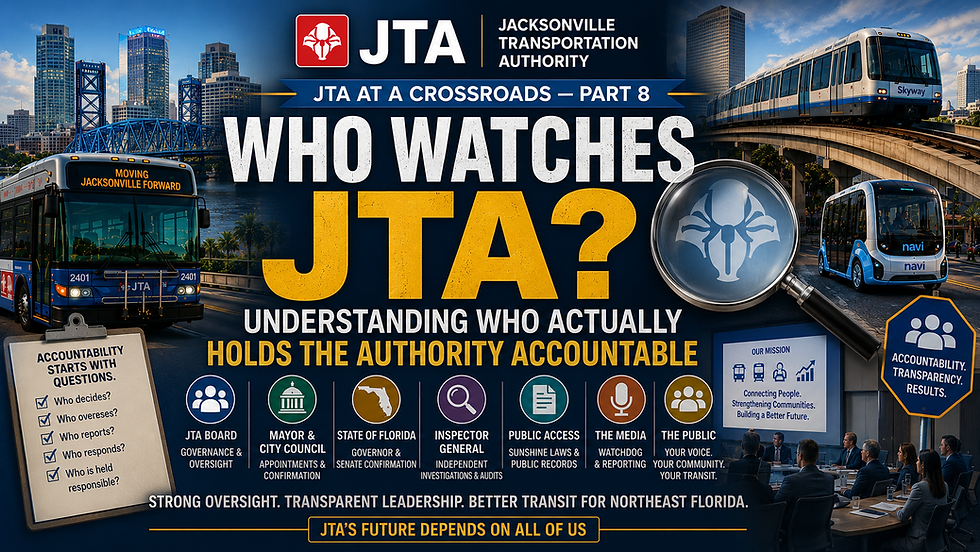
Who Watches JTA? Understanding Who Actually Holds the Authority Accountable
Should the Next JTA CEO’s Pay Be Tied to Performance?

What Should JTA’s Next CEO Actually Be Hired to Fix?

U2C and the Skyway — If We Were Starting Today, Would We Build This?

How Did JTA Get to a $17.5 Million Budget Gap?

JTA Is Raising Fares. How Much Does Another 25 Cents Actually Solve?

How Much Should Jacksonville Pay JTA’s Next CEO?

Will JTA Keep Paying Nat Ford After He Starts Running DART?
