
John Hawley
Jul 27, 2026
JTA at a Crossroads — Part 4:
The Jacksonville Transportation Authority is heading into another challenging fiscal year with a projected $17.5 million budget gap. That's a significant number for an agency whose Board approved a $139.2 million FY2027 operating budget in May. To balance the plan, JTA has proposed a combination of higher fares, reduced bus frequencies, route changes and eliminations, changes to ReadiRide and reduced NAVI service.
But before Jacksonville debates which services should be cut or which riders should pay more, there's a more fundamental question worth answering: How did JTA get here?
Was the problem primarily an unexpected decline in revenue? Did expenses grow faster than revenues? Are newer transportation programs adding operating costs at a time when traditional transit is already under financial pressure? Or is Jacksonville beginning to see evidence of a more structural problem that could return again next year?
The answer appears more complicated than any single explanation.
The Financial Warning Signs Started Earlier
JTA's current financial problems didn't suddenly appear with the FY2027 budget. In February, JTA announced $14.2 million in expense reductions intended to stabilize its FY2026 operating budget through September. The authority identified one major cause: sales-tax collections were projected to come in nearly $11 million below expectations.
That's particularly important because sales-tax revenue represents more than half of JTA's operating revenue. JTA also provided some important context, noting that sales-tax collections had exceeded projections in 11 of the previous 13 years. From JTA's perspective, 2026 represented an unusual revenue miss rather than a long history of consistently overestimating collections.
That's a legitimate explanation for a difficult year. The bigger concern is what happened next.
By May, JTA wasn't simply trying to finish FY2026. It was looking ahead to FY2027 and confronting another projected shortfall—this time approximately $17.5 million. Reporting at the time indicated that this followed a roughly $13 million gap the previous year.
That's where the distinction between a temporary revenue problem and a structural budget problem becomes important. If sales-tax collections unexpectedly fall short for one year, an agency can reduce expenses, adjust forecasts and potentially recover as revenues normalize. But when revenues and expenses don't line up again the following year, taxpayers should reasonably ask whether recurring expenses have moved beyond the recurring revenues available to support them.
JTA Did Cut at the Top
It's important to recognize that JTA didn't immediately respond by cutting bus routes.
The February reductions included a 15% compensation reduction for CEO Nat Ford and senior leadership, reductions in administrative positions, elimination of some professional-services contracts, renegotiation of others and bringing some technology functions in-house. Additional furloughs affecting senior administrative employees were subsequently approved as JTA looked for further savings.
Those reductions matter, particularly in the context of Parts 1 and 2 of this series, where we examined Ford's compensation and what Jacksonville should consider paying JTA's next CEO.
But those administrative savings weren't enough to close the larger financial gap.
That's when the consequences began moving much closer to JTA's riders.
Much of the Next Round Comes From Transportation Service
JTA has identified approximately $13.62 million in service reductions as part of its FY2027 financial response. The largest component is approximately $8.37 million from reducing bus frequencies, with millions more coming from route eliminations and other service changes. Reducing NAVI frequency also contributes to the savings.
That $13.62 million figure deserves more attention because it represents roughly 78% of the $17.5 million projected gap.
In other words, JTA isn't primarily solving this problem through another quarter at the farebox or additional executive compensation reductions.
A substantial portion of the solution is coming from transportation service itself.
For riders, that means a budget deficit is no longer an abstract accounting issue. It can mean a bus arriving every 60 minutes instead of every 30 minutes, a route being eliminated or a trip requiring additional transfers.
That may ultimately be necessary. But Jacksonville should understand why it became necessary.
Higher Fares Help, But They Don't Fix the Problem
As we examined in Part 3, JTA also proposes increasing its regular fare from $1.75 to $2 beginning January 1, 2027. JTA points out that it would be the first base-fare increase since 2019 and that Jacksonville's fare remains competitive with other major Florida transit systems.
There's a reasonable argument for the increase.
But JTA also says passenger fares represent only about 6% of its budget. That means riders simply can't generate enough additional farebox revenue to eliminate a $17.5 million gap without dramatically higher fares.
So while another quarter contributes something, the mathematics make one thing clear: JTA's underlying financial problem is much larger than its fare structure.
Where Do NAVI and U2C Fit Into This?
This is also where Jacksonville's ongoing debate over NAVI and the larger Ultimate Urban Circulator project enters the discussion.
It's too simplistic to say JTA has a $17.5 million operating gap because it spent money on U2C. Capital and operating budgets are different, and federal, state or dedicated local funding for a capital project generally can't simply be moved into ordinary bus operations.
But that doesn't mean these projects should be excluded from financial scrutiny.
NAVI's first phase represented an investment of approximately $65 million, and now JTA is proposing to reduce its operating frequency as part of the FY2027 savings plan. That makes questions about ridership, annual operating expenses and taxpayer subsidy per passenger entirely legitimate.
If Jacksonville is reducing traditional bus service because resources are limited, taxpayers should be able to compare what different forms of JTA transportation cost to operate and how many people they actually move.
That's not an argument against innovation. It's an argument for measuring the results of innovation against the alternatives competing for limited resources.
Building Something and Operating It Are Different Questions
This distinction becomes particularly important as Jacksonville considers the future of U2C and the Skyway.
Public transportation projects frequently attract federal or state capital dollars. That can make a project financially attractive to build because Jacksonville may contribute only a portion of the construction cost.
But receiving outside money to build something doesn't necessarily mean that outside money will pay to operate it indefinitely.
Drivers or attendants, maintenance, electricity, insurance, technology, replacement vehicles and other operating expenses continue year after year.
That's why Jacksonville should evaluate major transportation investments using two separate questions: Can we afford to build it? And can we afford to operate it without weakening the transportation services people already depend upon?
The second question becomes considerably more important when existing bus frequencies are being reduced because the operating budget isn't balancing.
Jacksonville Is Growing While Some Transit Service Is Shrinking
There's another contradiction worth examining.
Jacksonville continues to grow in population, development and geographic reach. Ordinarily, growth would suggest increasing transportation needs.
Yet JTA is responding to its current financial situation by reducing portions of its existing service.
That doesn't automatically mean JTA has done something wrong. It may instead indicate that Jacksonville's expectations for public transportation have grown faster than the revenue structure supporting them.
Perhaps sales-tax forecasts need to become more conservative. Perhaps fares need smaller, more regular adjustments instead of occasional larger increases. Perhaps additional administrative efficiencies are possible. Perhaps the bus network itself needs redesigning around changing population and employment patterns. Or perhaps Jacksonville needs to decide whether it wants a larger transit system and, if so, how it intends to sustainably pay for it.
Those are policy decisions. They shouldn't be made accidentally through annual budget cuts.
The Next CEO Needs to Know What He's Being Hired to Fix
The timing makes this particularly important.
JTA is confronting these financial questions while longtime CEO Nat Ford prepares to leave for Dallas. Jacksonville will soon be selecting a new executive to inherit the agency.
That new CEO shouldn't simply inherit a balanced FY2027 spreadsheet.
The new CEO needs to understand why it became unbalanced in the first place.
Otherwise, Jacksonville risks solving $17.5 million worth of symptoms without addressing the underlying financial problem.
That also connects directly with our earlier question about what Jacksonville should pay JTA's next CEO. Compensation shouldn't simply reflect the title. It should reflect the responsibilities and measurable objectives Jacksonville expects the next leader to accomplish.
Financial sustainability should probably be near the top of that list.
Show Jacksonville How We Got From There to Here
Perhaps the most useful thing JTA could provide taxpayers right now is a relatively simple year-to-year financial explanation.
Show Jacksonville what happened to sales-tax collections. Show how much labor and benefits increased. Show changes in fuel, insurance and maintenance expenses. Show what happened with administrative spending and outside contracts. Show fare revenue and ridership trends. Show the operating costs associated with new or expanded services. And show the annual operating costs and ridership associated with NAVI and JTA's other major transportation modes.
Then taxpayers could see exactly how JTA moved from one fiscal year to a $17.5 million projected gap.
That would make this much less about political arguments over individual projects and much more about understanding the numbers.
The Most Important Question May Be What Happens Next Year
There are reasonable explanations for some of what JTA is experiencing. Sales-tax revenue really did underperform expectations. Inflation has increased transportation costs. Transit agencies around the country face difficult financial pressures. And JTA did make administrative and executive reductions before moving deeper into service cuts.
But the sequence deserves attention.
JTA encountered a substantial FY2026 financial problem and responded with $14.2 million in expense reductions. Then it entered the FY2027 process projecting another $17.5 million gap. Now approximately $13.62 million in service reductions are part of the solution.
That makes one question particularly important:
If sales-tax collections return to normal, does JTA's financial problem largely disappear?
If the answer is yes, Jacksonville may primarily be dealing with an unusually difficult revenue cycle.
If the answer is no, then this discussion becomes considerably more serious.
Because a structural deficit doesn't disappear when a new CEO arrives. It simply gets pushed into another budget year until somebody eventually pays for it through higher fares, fewer services, additional taxpayer funding—or some combination of all three.
So perhaps the most important number in JTA's $17.5 million budget gap isn't $17.5 million.
It's how much of that gap could come back again next year.
That's the number Jacksonville needs to understand before deciding where JTA goes next.
Related JTA reporting:


Who Is Megan Hayward? Her JTA Warnings, Removal and Jacksonville’s $39 Million Budget Crisis


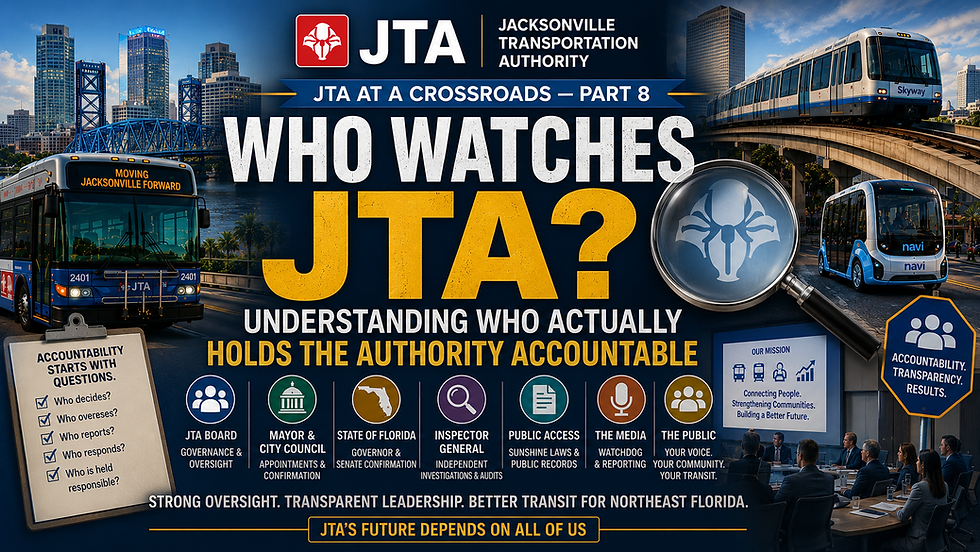
Who Watches JTA? Understanding Who Actually Holds the Authority Accountable
Should the Next JTA CEO’s Pay Be Tied to Performance?

What Should JTA’s Next CEO Actually Be Hired to Fix?

U2C and the Skyway — If We Were Starting Today, Would We Build This?

How Did JTA Get to a $17.5 Million Budget Gap?
JTA Is Raising Fares. How Much Does Another 25 Cents Actually Solve?

How Much Should Jacksonville Pay JTA’s Next CEO?

Will JTA Keep Paying Nat Ford After He Starts Running DART?
