
John Hawley
Oct 20, 2026
JTA at a Crossroads — Part 21
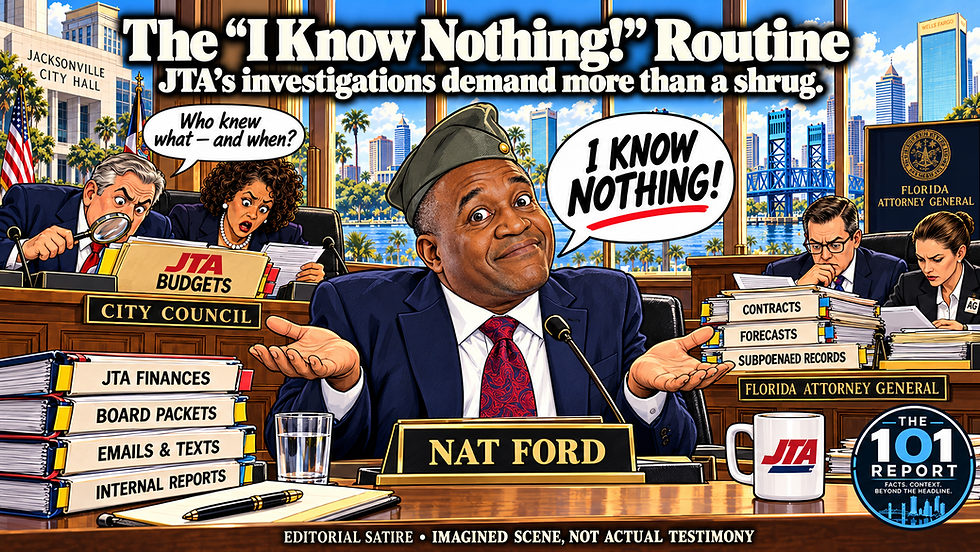
Jacksonville City Council is moving to question Nat Ford before he leaves for Dallas. But JTA’s financial crisis cannot be explained by questioning its former CEO alone. The budgets, forecasts, operating assumptions and accounting records were produced and reviewed across several departments, each with its own leadership responsibilities. Florida’s state subpoenas and Council’s financial inquiry create an opportunity to establish how that system worked—and where it failed.
The chief financial officer belongs near the center of that examination. A CFO leads the finance function: the people, processes and controls intended to give management and directors reliable financial information. Ford remained responsible for executive oversight, while finance leaders had their own responsibilities for the information moving upward. Determining who prepared, checked, approved and disclosed each consequential figure is more useful than making one executive the explanation for everything.
Nat Ford’s City Council Subpoena Opens a Broader JTA Inquiry
The Finance Committee voted 7–1 on October 20 to subpoena Ford for October 23, according to the Jacksonville Daily Record. Members said they would consider an alternative date if he was willing to appear but unavailable then. Howland and Chris Miller reported unanswered outreach in the hours before the vote, while earlier reporting described a voluntary invitation and a separate unanswered media inquiry through JTA communications. Ford should explain when he received the requests and why he had not responded; that account does not establish an earlier violation of the subpoena.
Separately, the attorney general’s Office of Statewide Prosecution is seeking JTA records involving contracts, financial conditions, executive communications and accounting/coding employee terminations. An October 7 subpoena set an October 30 response deadline. Those requests reveal subjects investigators want to examine, without establishing their conclusions or every question they will ask. The framework below follows our existing research rather than claiming access to the state’s investigative strategy.
Why JTA’s Former CFOs Belong in the Financial Investigation
Our investigation of CFO turnover, financial staffing and budget warnings traced JTA’s succession from Greg Hayes to Raj Srinath, Heather Obora and Randall Barnes. The periods of responsibility differ, so the executives should not be assigned a collective explanation for every failed forecast. Ford’s account needs to be tested against the people who prepared the numbers and managed the finance office. Their accounts also need to be checked against his instructions and the records supplied to the board.
The inquiry should follow each material decision. Who built the forecast, supplied the operating assumptions, reviewed the calculations and approved the final submission? Who learned that an assumption was wrong, and what did that person communicate? If Finance relied on Operations for a contract cost, the inquiry should follow that information back to Operations. If Ford approved a response to a warning, the inquiry should establish what he was told and why he chose that response.

Heather Obora’s JTA CFO Role Places Her at a Critical Point in the Timeline
Heather Obora’s background was already part of our CFO investigation. She brought senior procurement and finance experience from Chicago Public Schools and Washington Metropolitan Area Transit Authority, then joined JTA in June 2021. Ford announced her as interim CFO at the July 1, 2025 board meeting following Srinath’s retirement, and subsequent JTA materials identified her as senior vice president/chief financial officer. Her relevant JTA role was CFO; Jeffrey H. Smith held the separate chief operating officer position.
That distinction places Obora directly within the financial-management questions. JTA’s May 28, 2026 agenda assigned her the Finance and Technology report and proposed FY2027 operating and capital budgets. What procedures did she require to validate revenue, contract expenses, benefits and promised savings? Which problems did she inherit, which did her team identify and what did she report to Ford and directors? Her experience makes the substance of her work and supervision worth examining, rather than treating her as a temporary name between two permanent executives.
Heather Obora’s Reported JTA Departure Raises Unanswered Questions
Professional histories place Obora’s return to procurement and contract administration around June 2026. Her newer public LinkedIn listing records her JTA employment ending in September 2026 and identifies her as owner/CEO of Acquisition Corps, LLC. Taken together, those month-level entries suggest roughly three months back in procurement before her employment ended. They do not establish exact personnel-action dates or whether she resigned, was laid off or left under another arrangement.
The terms matter because the finance function was changing leadership while JTA’s outlook was deteriorating. Who approved her return to procurement, what duties and compensation changed, and was a subsequent departure already contemplated? What did she hand over to Barnes or other financial staff, and what unresolved issues did she identify? JTA’s personnel actions, handoff materials and any separation agreement can establish whether the moves were routine, part of restructuring, requested by Obora or initiated by management.
The sequence also raises a question about whether growing financial concerns influenced her decision to leave, if the departure was voluntary. Her profile places the end of employment in September, before Council’s October 20 vote to subpoena Ford; that vote therefore cannot itself explain an earlier departure. Did she anticipate further scrutiny of decisions made during her finance tenure, or were her reasons unrelated to the crisis? No reviewed record establishes her motive or that she knew a subpoena to her was contemplated. The question deserves examination through the departure record and her account, rather than treating the timing as its own answer.
A potential request for Obora’s testimony would follow naturally from the responsibilities investigators are examining. That does not establish that she will be subpoenaed, that she is a target or that leaving JTA reflects wrongdoing. A former executive can explain the assumptions she approved, identify warnings she gave and supply context missing from a successor’s account. The practical question is whether the inquiry will obtain those answers from the officials responsible, wherever they now work.
What Is Heather Obora’s Acquisition Corps Business?
Acquisition Corps was not newly created in response to the crisis, as far as the available professional histories show. An older biographical listing identifies Obora as owner/CEO in Arlington, Virginia, with an April 2015 start date, years before she joined JTA. That is evidence of a longstanding claimed affiliation, not independent confirmation of the entity’s formation date, current legal status or actual business activity. We have not established its present services, clients, revenue or staffing.
The company could have been inactive or generated little economic activity while Obora worked at JTA. A continuing owner/CEO listing does not show how many hours she worked, whether the company received income or whether its activities overlapped with JTA responsibilities. An established business affiliation can also remain on a résumé during a career transition without representing substantial new employment. The listing therefore cannot explain whether she chose to leave JTA, was encouraged to leave or departed through restructuring. Those circumstances must come from personnel records and the participants’ accounts.
If Acquisition Corps was performing substantial work, the focus shifts to its clients, demands on her time and the approvals governing that activity. If it was dormant, the concern about competing work obligations could fall away. Neither possibility answers the separate questions about her financial management at JTA. Investigators and readers need to distinguish corporate ownership, actual business operations and job performance instead of treating them as a single allegation.

JTA’s Outside-Employment Rules Provide a Test for Business Activities
JTA’s currently posted Code of Conduct and Ethics requires prior supervisory and division-head approval for outside employment, services or payments, followed by reporting to the Ethics office. It prohibits conflicting outside employment and requires employees to prioritize their JTA/JTM job. The code also calls for annual conflict forms and supervisory monitoring of outside employment. The review should obtain the policy versions applicable to each period and the associated approvals and disclosures.
Did Obora perform work through Acquisition Corps while employed by JTA, and if so, who approved it? What services, clients, hours and restrictions were disclosed, and were approvals updated when she moved into Finance? Were there any overlapping JTA vendors, public-work obligations or uses of agency resources? If the business was inactive, records may resolve the issue without a finding of improper outside work. We have not obtained evidence establishing a policy violation by Obora.
Former JTA CFO Raj Srinath’s Consulting and Financial Handoff
Srinath became CFO in October 2023 and announced June 30, 2025 as his last day at JTA. His responsibilities included financial planning and analysis, accounting, budgeting, treasury, grants and revenue management. His public professional profile now identifies him with RJSR Consulting in the Ponte Vedra Beach area. The Daily Record reported in August that he started that firm and that JTA described him as available on call during the transition to Barnes.
What budgets, forecasts and cost assumptions did Srinath prepare or approve, and what problems did he identify before leaving? What information did he hand to Obora and Ford? If he advised JTA afterward, what were the assignment, payment terms and advice provided? Retirement and subsequent consulting do not establish wrongdoing, but they make the formal handoff and any continuing advisory role relevant evidence. The August account does not establish whether he remains an adviser today.
Staffing Cuts Need to Be Matched to the Work That Continued—or Stopped
Part 10 documented the elimination of vacant Corporate positions touching Payroll, Financial Analysis, Fixed Assets Accounting and Controllership during FY2026 budgeting. Those changes should be distinguished from later layoffs and the accounting/coding employee terminations identified in the state records request. They do not establish that a named employee was removed for raising a warning. They do establish a basis for examining financial capacity at a time when dependable monitoring mattered.
Who recommended each staffing change, and what assessment showed the remaining team could perform the work? Who took responsibility for reconciliations, current-year forecasts, contract validation and reporting deadlines? Did finance employees warn about inadequate capacity, and what action followed? Original staffing plans, revised assignments and communications can test whether the changes weakened controls or whether the work continued adequately. The causation question remains open.
The Forecasts Give Investigators Something Concrete to Test
Our analysis of what the board saw and which financial forecasts were missing documented a projected $3.94 million FY2025 surplus becoming a reported $18.99 million deficit. It also traced a projected FY2026 deficit changing from $2.25 million in the March-period submission to $31.8 million in the June-period report. These figures describe separate periods and should not be added together. The question is how the assumptions and information changed between submissions.
Each revision should be matched to its preparers, reviewers, approvers and recipients. Which changes reflected new developments, which corrected errors and which abandoned anticipated savings? When did finance leadership and Ford recognize that the earlier outlook would not hold? Original spreadsheets, version histories, supporting schedules and distribution records can resolve the sequence. A general statement about falling tax revenue cannot explain every expense or forecasting failure.
The COO and Administration Executive Have Separate Responsibilities
Our earlier examination of the crisis and warning signs identified concerns about Connexion contract budgeting and benefit estimates. JTA currently identifies Smith as COO, responsible for transit service planning, operations and maintenance, including paratransit. The applicable historical organizational chart and job descriptions should establish his responsibility at the time of each decision. Who supplied operating assumptions to Finance, and who checked those assumptions against contractual obligations and actual service costs?
Our expanded-subpoena investigation separately examined Ferguson’s earlier administration responsibilities. JTA’s FY2026 chart placed Audit & Compliance, Procurement and Risk Management in his division. What warnings reached those functions, what reached Ford and directors, and what corrective actions followed? Barnes can explain what he found after taking over Finance and which records support his conclusions. None of those roles should be treated as interchangeable.
Contracts, Accounting Entries and Ridership Require Their Own Evidence
The state’s requests reach beyond forecasting to transactions and professional relationships examined in our earlier subpoena investigation. For each expenditure, who requested the work, selected the vendor, approved payment and verified delivery? What relationships were disclosed, and what review or recusal occurred? Contracts, proposals, invoices, deliverables and approval trails can establish what the public purchased and received. An industry or family connection alone cannot resolve those questions.
Our report on questioned invoices and NAVI ridership distinguished disputed allegations from established findings. The relevant inquiry includes who classified expenses, when entries changed and how they appeared in subsequent reports. For ridership, instructions, boarding data and service logs can test the competing accounts. Investigators then need to establish which figures were submitted externally and whether they affected funding or oversight decisions. Repeating an accusation does not substitute for that work.
Curry’s Endorsement Adds a Disclosure and Procurement Question
Curry’s July 24 Dallas Morning News column, “DART made the right choice with Nat Ford,” offered a substantial public defense of Ford. The supplied author identification described Curry as Jacksonville’s former mayor without mentioning that he was a Ballard partner and the firm represented JTA. JTA’s March 2023 minutes record a staff recommendation for a Ballard contract before Curry joined the firm that July. Deegan later terminated the city’s separate Ballard contract; the reviewed evidence does not establish that Curry secured JTA’s award.
Who recommended and evaluated the contract and its renewals, and what work supported continued payment? Did Ford or JTA staff request, review or support Curry’s column? Curry and the newspaper should separately account for what business relationship was disclosed to editors. Our Dallas hiring investigation provides the broader hiring context, including Bryant’s account of Deegan’s oral reference.

Council Also Needs to Account for Its Own Oversight
Our investigation of Howland’s earlier oversight examined how Council handled earlier JTA concerns. The current inquiry should establish what financial information reached City Hall and what members did in response. It should compare board packets with internal forecasts and determine whether directors requested further information. The chain of responsibility continues through the governing board and outside oversight, rather than ending inside Finance.
Finance’s October 20 action also updates our earlier examination of subpoena authority. The select committee’s charge says it lacks subpoena power; Finance acted through the standing-committee process. That distinction explains how Council can obtain testimony without claiming the select committee independently gained compulsory authority. Its next test is how thoroughly it follows the answers and obtains supporting records.
Additional Witnesses Should Follow the Evidence
Ford’s testimony can explain executive direction, but it cannot independently establish everything that occurred inside Finance, Operations, Procurement or accounting. Former CFOs, controllers, analysts, operational leaders and directors may hold different parts of the record. Obora and Srinath are relevant potential witnesses because of their roles and tenure. No additional individual subpoena to either is confirmed in the sources reviewed for this article.
The review should identify the people responsible for each disputed decision and determine what interviews, documents or further subpoenas are warranted. If one official attributes an assumption to another department, investigators should follow that source and compare the accounts. An answer supported by contemporaneous records is more useful than either a title-based accusation or a blanket assurance. Evidence may identify fault, establish that warnings were raised or resolve an allegation in an official’s favor.
How the Public Can Measure the Inquiries
Council hearings can be assessed by whether specific questions were asked, answered and supported with records, and whether contradictions received follow-up. State investigative work may remain confidential while it proceeds, so a lack of public discussion does not establish that a subject was ignored. Eventual findings and lawfully released records can be compared with the questions already supported by this series. Previously reported compensation terms need revisiting only where a particular duty, payment or agreement remains unresolved.
The useful outcome is a dated account of what each responsible official knew, prepared, approved, communicated and did. For its own inquiry, Council should identify outstanding evidence, assign responsibility for supplying it and set deadlines. The stakes include competent financial management, compliance with public-employment rules and reliable service for riders. Those questions are bigger than Ford’s departure, and the evidence needed to answer them extends well beyond the CEO’s office.
JTA at a Crossroads Series
