
John Hawley
Aug 15, 2026
The Mayor’s Office: Part I- The 101 Report
Jacksonville Mayor Donna Deegan is describing her proposed budget as lean and fiscally responsible.
There's evidence supporting that argument. Her administration emphasizes that, for the second consecutive year, Jacksonville is proposing no increase in non-public-safety staffing. But that accomplishment raises another question — particularly for the thousands of city employees actually administering Jacksonville government: Has the operation immediately surrounding the mayor been practicing the same restraint?
A review of City budgets and employee reports going back to the final day before Deegan took office reveals a striking disparity. Jacksonville's General Fund has grown substantially. The number of civilian employees actually working throughout most of city government has grown much more slowly. But the number of employees working in the Mayor's Office has grown considerably faster. And with voters potentially approving a larger homestead exemption in November — something the Deegan administration warns could reduce future property-tax revenues — the question of where fiscal restraint is being applied becomes particularly relevant.
Start With the People Actually Doing the Work
Municipal budgets contain something called an employee cap — essentially the number of full-time positions the City authorizes a department to have. That's useful. But for the employee answering a resident's telephone call, reviewing a permit, inspecting a property, maintaining a park or administering a city program, there's a more intuitive measurement: How many people are actually there doing the work?
Jacksonville's quarterly employee reports allow us to answer that question. The City's June 30, 2023 report gives us an unusually useful starting point. That was the final day before Donna Deegan became mayor.
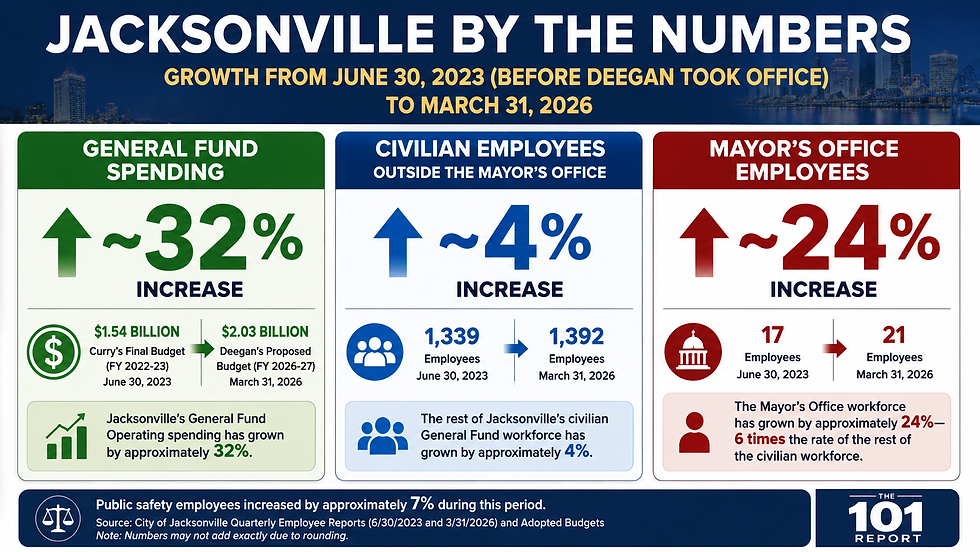
We can compare those numbers with the City's March 31, 2026 employee report using the same reporting methodology. The results are revealing. Across Jacksonville's General Fund, there were approximately 6,067 full-time employees actually occupying positions immediately before Deegan took office. By March 2026, that had increased to approximately 6,456. That's 389 additional employees approximately 6.4 percent growth.
But most of that growth occurred in one area: Public safety.
Public Safety Received Most of the Additional Employees
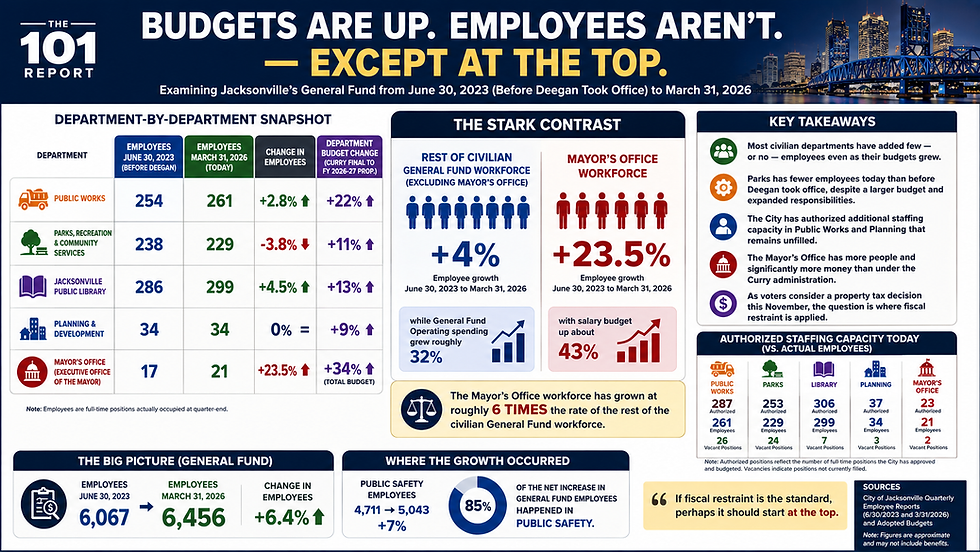
Police and fire represented approximately 4,711 filled General Fund positions immediately before Deegan took office. By March 2026, that had grown to approximately 5,043. That's roughly 332 additional public-safety employees about 7 percent growth. Put another way, approximately 85 percent of the net increase in General Fund employees under Deegan has occurred in public safety. That matters because it changes how we should interpret Jacksonville's overall staffing numbers. A citywide increase can create the impression that departments throughout government have been adding employees. They haven't. Once public safety is removed, the picture looks considerably different.
What Happened to the Rest of City Government?
Immediately before Deegan took office, the civilian General Fund workforce outside the Mayor's Office consisted of approximately 1,339 employees. By March 2026, that number had increased to approximately 1,392. That's 53 additional employees. Or approximately 4 percent growth. Now compare that with the financial growth of Jacksonville government.
Using comparable General Fund Operating budget figures, Jacksonville has gone from roughly $1.54 billion in Curry's final budget to approximately $2.03 billion proposed for FY2026-27. That's approximately 32 percent growth. Those numbers should not be interpreted as meaning every city employee has 32 percent more work. Government doesn't work that way.
A $50 million infrastructure project becoming a $75 million project doesn't automatically require 50 percent more city employees. Technology, automation, improved software and increasingly artificial intelligence can allow organizations to administer more money and process more work without adding employees proportionately. That's exactly what greater government efficiency should accomplish. But much of municipal government remains very human.
Employees still answer residents' calls, process applications, inspect properties, manage contracts, maintain parks and public buildings, oversee construction, administer grants and interact directly with Jacksonville residents. So the comparison remains relevant: General Fund Operating spending: approximately +32 percent. Civilian employees outside the Mayor's Office: approximately +4 percent. That suggests considerable restraint in civilian hiring. And Deegan deserves credit for that. But then consider what's happened immediately around the mayor.

The Mayor's Office: 17 Employees Became 21
On June 30, 2023 — the final day before Deegan took office — the Executive Office of the Mayor had 17 employees occupying its authorized full-time positions. By March 2026, it had 21. That's an increase of four people. It doesn't sound dramatic until you calculate the percentage:
23.5 percent growth.
Compare that with approximately 4 percent growth throughout the rest of the civilian General Fund workforce.
In percentage terms, the number of employees actually working in the Mayor's Office has grown at roughly six times the rate of the rest of Jacksonville's civilian General Fund workforce. And the City's authorized staffing numbers provide additional context. Curry's final budget authorized 21 Mayor's Office positions.
Deegan's first authorized 23.
That's a 9.5 percent increase in authorized staffing capacity immediately upon the change in administrations.
Today, the Mayor's Office remains authorized for 23. So there is currently room for another two employees beyond the 21 working there at the March snapshot. The contrast isn't simply about people. It's also about money.
Mayor's Office Spending Has Increased Even Faster
Curry's final Mayor's Office salary budget was approximately $2.585 million. Deegan's proposed FY2026-27 salary budget is approximately $3.7 million. That's roughly 43 percent growth. Total spending for the Executive Office of the Mayor has gone from approximately $4.14 million in Curry's final budget to a proposed $5.55 million.
That's approximately 34 percent growth. Put the three measurements together: Employees actually working: +23.5 percent. Salary budget: approximately +43 percent. Total Mayor's Office budget: approximately +34 percent. And this year alone, Deegan is proposing to increase the total Executive Office budget from approximately $4.86 million to $5.55 million, 14.1 percent. The entire General Fund, meanwhile, is proposed to increase only about 1.1 percent this year. That's the fiscal contrast.
Another 18-to-18 Comparison
There's another measurement from the transition between administrations that reaches a similar conclusion.
Published salary records in July 2023 compared 18 members of Curry's outgoing executive team with 18 members of Deegan's incoming executive team. Same number of employees. Curry's 18 employees earned approximately $2.59 million annually.
Deegan's 18 were scheduled to earn approximately $3.18 million. That's approximately $590,000 more — or 23 percent greater payroll — for the same number of executive employees. This is a different measurement from the Mayor's Office budget and shouldn't be mathematically mixed with it. But both datasets tell essentially the same story: Deegan entered office willing to spend considerably more on the operation immediately surrounding the mayor.
What About the Departments Serving Residents?
This is where looking at individual departments becomes useful. Not every department has experienced the same staffing situation. And comparing people actually working, authorized staffing capacity and departmental budgets gives us a much better picture than any one number alone.
Public Works
Immediately before Deegan took office: 254 employees.
March 2026:
261 employees.
That's approximately 2.8 percent growth.
The City currently authorizes Public Works to employ 287 people, meaning there were 26 additional authorized positions not occupied at the March snapshot.
Meanwhile, the department's budget has increased from approximately $56.7 million in Curry's final budget to approximately $69.4 million proposed today — roughly 22 percent.
So Public Works presents an interesting picture:
Employees: +2.8 percent.
Departmental spending: +22 percent.
The department does have slightly more people actually working than it did immediately before Deegan.
And the administration has done a better job filling Public Works positions than the vacancy situation it inherited.
But the City has also authorized considerably more staffing capacity than it currently has working.
Given Public Works' responsibility for roads, drainage, sidewalks, public buildings, engineering, construction management and other infrastructure, that's worth watching.
Parks, Recreation and Community Services
Parks may present the clearest potential staffing-pressure signal.
Immediately before Deegan:
238 employees.
March 2026:
229 employees.
That's nine fewer people actually working — a decline of approximately 3.8 percent.
The City nevertheless authorizes approximately 253 positions, meaning another 24 employees could be hired within the existing cap.
Meanwhile, departmental spending has increased by roughly 11 percent compared with Curry's final budget.
So:
Employees: -3.8 percent.
Departmental budget: +11 percent.
And Jacksonville is simultaneously adding and improving parks and recreational assets, including significant new downtown public spaces.
That doesn't prove Parks employees are overworked.
But if we're looking for places where staffing capacity may deserve scrutiny, Parks belongs near the top of the list.
Planning and Development
Planning tells another story.
Immediately before Deegan:
34 employees.
March 2026:
34 employees.
No growth.
The City now authorizes 37 positions, meaning Planning has been given additional staffing capacity.
But as of March, those additional positions hadn't translated into additional people actually doing the work.
So: Employees: 0 percent growth.
Authorized staffing capacity: approximately +9 percent.
That distinction matters in a city experiencing continued development and permitting activity.
Not all permitting employees are located within this particular General Fund department, so it would be misleading to suggest these 34 employees represent Jacksonville's entire permitting operation.
But Planning is another example where City Hall has recognized room for additional employees that hasn't yet materialized in actual staffing.
Jacksonville Public Library
Libraries provide an important counterexample.
Immediately before Deegan:
286 employees.
March 2026:
299 employees.
That's approximately 4.5 percent growth.
The Library currently has authorization for approximately 306 employees, leaving only seven positions unoccupied at the March snapshot.
Its departmental budget has increased roughly 13 percent.
That's a much healthier staffing picture.
The Deegan administration has increased the number of people actually working in the Library system while substantially reducing its vacancy problem.
That deserves acknowledgement.
So Where Has Jacksonville Added People?
The broader picture now becomes much clearer.
From immediately before Deegan took office through March 2026:
Public-safety employees: approximately +7 percent.
Other civilian General Fund employees: approximately +4 percent.
Mayor's Office employees: approximately +24 percent.
Meanwhile, General Fund Operating spending has increased dramatically. That doesn't mean Jacksonville should have hired 32 percent more employees. It probably shouldn't have. But it does tell us where the administration has and hasn't increased its human resources. Public safety has clearly been prioritized. Most civilian government has been comparatively restrained. The Mayor's Office has not followed that same growth pattern.
Why Did Deegan Want a Larger Mayor's Operation?
The administration has offered explanations.
When Deegan took office in 2023, she explicitly emphasized new priorities involving health, transparency, diversity, inclusion and community engagement.
She created a Chief of Diversity and Inclusion.
The City even announced that Deegan was taking “major steps to increase diversity” and published demographic information about her appointments.
One of the people central to that effort was Dr. Parvez Ahmed.
And his story provides an interesting example of how the administration's staffing justification has evolved.

Parvez Ahmed: From Diversity and Inclusion to Analytics
Ahmed originally served as Deegan's Chief of Diversity and Inclusion.
When City Council considered cutting funding associated with the position during the 2023 budget process, Ahmed personally made the case for keeping it.
He argued that a dedicated diversity officer could improve Jacksonville's economic competitiveness, reduce discrimination and harassment problems and help City Hall better serve Jacksonville's population.
He also argued for the importance of the position following Jacksonville's racist Dollar General shooting.
Ahmed further defended the overall cost of Deegan's staff, arguing that when inflation was considered, the administration's salary budget wasn't dramatically out of line with the inflation-adjusted Curry years.
That's relevant context.
But Ahmed's position has since evolved.
Today, the Mayor's official staff directory identifies him as Chief of Analytics.
He's doing analytics work, including involvement with the City's State of Jax initiative and other data-driven programs. But city records have also associated Ahmed with responsibilities involving economic mobility and social belonging, and he has continued working with community and minority advisory initiatives.
That doesn't establish that Jacksonville's diversity officer was simply renamed. But it does establish continuity.
The same person who argued Jacksonville required a dedicated Chief of Diversity and Inclusion remains within the Mayor's operation under a different primary title while retaining involvement in some related social and community priorities. That's relevant from a fiscal perspective. Government functions evolve.
Responsibilities overlap. Jobs get consolidated. Priorities change. And new technology changes how work gets accomplished.
Which raises another question:
When functions evolve and responsibilities become absorbed elsewhere, does the Mayor's Office ever become less expensive?

What Are Some of These Positions Paying?
Based on the latest wages we've been able to verify:
Darnell Smith, Chief of Staff — $277,000.
Michael Weinstein, Chief Administrative Officer — approximately $272,000 to $277,000.
Kelli O'Leary, Deputy Chief Administrative Officer — $211,150.
Charles Griggs — $200,850.
Joe Inderhees — approximately $195,314.
Phil Perry — approximately $195,314.
Melissa Ross — approximately $195,314.
Parvez Ahmed — approximately $195,314.
Tracye Polson — approximately $174,199.
Garrett Dennis — approximately $158,363.
Lynn Sherman — approximately $158,363.
Brittany Norris — approximately $126,690.
Those twelve positions alone represent roughly $2.35 million in annual salaries.
There is an important caveat.
We still don't have Jacksonville's August 2026 payroll export identifying every employee currently charged to the Mayor's Office and Public Affairs cost centers.
So this isn't being presented as the complete current Mayor's Office payroll.
But the official departmental budget totals and employee counts provide plenty to examine without making assumptions about the remaining employees.
And Now Comes the Homestead Exemption Debate
All of this becomes particularly relevant because Jacksonville is discussing the possibility of tighter future revenues. Voters will consider a November referendum involving an increase in the homestead exemption.
Deegan opposes the change and has warned about the potential effect on Jacksonville's property-tax revenues and city services.
That's a legitimate policy position. Cities have recurring obligations.
Police officers, firefighters, roads, parks, libraries and thousands of employees providing everyday services have to be paid for year after year. But warnings about constrained revenues naturally invite scrutiny of spending.
And that's where the workforce numbers become particularly interesting. The administration is effectively making two arguments simultaneously.
First: Jacksonville needs to protect its revenue base because reducing property-tax collections could threaten services.
Second: Holding non-public-safety staffing flat demonstrates that the administration is already exercising fiscal restraint.
Both can be true.
But if restraint throughout ordinary city government is evidence of responsible budgeting, taxpayers can reasonably ask whether the same standard should apply to the operation surrounding the mayor.

Fiscal Restraint — From the Bottom Up or the Top Down?
The Deegan administration deserves credit where the numbers support it.
It has added substantial public-safety staffing.
It has improved staffing in places such as the Library.
Public Works actually has more people working today than immediately before Deegan took office despite having fewer authorized positions.
And civilian staffing overall has been restrained relative to the enormous growth in Jacksonville's budget.
But that makes the Mayor's Office comparison more significant — not less.
From the final day before Deegan took office through March 2026:
The rest of Jacksonville's civilian General Fund workforce grew approximately 4 percent.
The Mayor's Office workforce grew approximately 24 percent.
At the same time:
The Mayor's Office salary budget has grown approximately 43 percent from Curry's final budget to Deegan's current proposal.
The total Mayor's Office budget has grown approximately 34 percent.
And this year alone, Deegan proposes increasing the Executive Office budget approximately 14 percent while the entire General Fund increases only about 1 percent.
Again, none of this proves that Mayor's Office employees aren't working hard.
It doesn't establish that their work lacks value.
And it doesn't mean every additional dollar elsewhere in government requires another employee.
The question is one of priorities.
Jacksonville's civilian workforce is being asked to administer a government that has become substantially larger financially without anything approaching comparable growth in the number of people doing the work.
Parks actually has fewer employees.
Planning has the same number.
Public Works has added only about 3 percent.
Libraries have added about 5 percent.
The Mayor's Office has added about 24 percent.
And now Jacksonville residents are being warned that a reduction in future property-tax revenues could require difficult choices.
That leaves a question worth asking before those choices reach front-line departments, city employees or taxpayers:
If Jacksonville's broader civilian workforce can be expected to serve a growing city with comparatively modest staffing growth, why should the operation surrounding the mayor grow so much faster?
Fiscal restraint shouldn't simply mean asking employees farther down the organizational chart to accomplish more.
And it shouldn't begin only when taxpayers consider keeping more of their own money.
If fiscal restraint is the standard, perhaps it should start at the top.
The Mayors Office Part IX

The Mayors Office Part VIII

The Mayors Office Part VII

The Mayors Office Part VI

Donna The Mayors Office Part V

The Mayors Office Part IV

The Mayors Office Part III

The Mayors Office Part II

The Mayor's Office Part I