
John Hawley
Sep 5, 2026
The Mayors' Office: Part VII- The 101 Report
As Jacksonville prepares to enter another budget year, The 101 Report compared Mayor Donna Deegan's executive staff and City employee pay ranges from the beginning of her administration through the latest available records. The percentages tell part of the story. The actual dollars show something more.
Jacksonville is approaching the start of another budget year, making this a particularly useful point to take stock of what has happened to City salaries during Mayor Donna Deegan's first three years in office.
The City's new fiscal year begins Oct. 1, when FY2026-27 begins. That provides a natural dividing line: before Jacksonville begins spending under another multibillion-dollar City budget—and before another year's compensation changes begin moving the numbers again—what does the salary structure look like today, and how did it get here?
When Deegan took office in July 2023, she assembled an executive team with several salaries at or above $185,000 a year. Three years later, many of those same employees remain in City Hall, their salaries have moved upward through a series of percentage-based wage adjustments, and the top of the administration has changed again.
The most recent addition is Darnell Smith, who returned as Deegan's chief of staff in August 2026 at a reported $277,000 a year.
But determining precisely what every member of the executive operation earns today is surprisingly difficult.
Jacksonville publishes detailed salary schedules for many represented employees. Current individual salaries for appointed Mayor's Office executives aren't presented in the same readily searchable fashion on Jacksonville.gov. The salaries are public records, but reconstructing the executive payroll requires working backward through budgets, payroll records, Council legislation and the less recognizable classifications under which some executives actually appear.
That makes September 2026 a useful benchmark: where does Jacksonville's salary pyramid stand immediately before another fiscal year begins?
And what the records show is more interesting than simply identifying the City's highest-paid employees.
They show how Jacksonville's salary pyramid has changed since Deegan took office—and why percentages alone don't tell the whole story.
The Executive Titles Aren't Always the Payroll Titles
One reason Mayor's Office compensation can be difficult to follow is that the title residents see on the City's website isn't necessarily the title appearing in payroll records.
Senior officials publicly identified as chiefs, deputy chiefs or directors of administration initiatives can appear in payroll records under classifications such as Administrative Aide–MA.
Kelli O'Leary, for example, has appeared under Administrative Aide–MA–IV even though her public-facing role is deputy chief administrative officer. Other senior administration employees have appeared under MA-III and related classifications rather than the titles most residents would recognize.
These MA classifications shouldn't be confused with conventional employee pay grades. We haven't found a City schedule establishing one fixed salary for every MA-III or MA-IV employee. Employees within the classifications can earn different amounts.
But following those classifications gives us a much better trail through Jacksonville's payroll and budget records.
A Remarkably Consistent Pattern Emerges
When we compare executive compensation from the beginning of the administration through the later payroll records, the numbers are strikingly consistent.
Consider an executive who started at $185,000.
A 2.5% adjustment takes that salary to:
$189,625
Another 3% takes it to:
$195,313.75
And that is essentially what appears in the payroll records.
The same progression occurs at other executive salary levels.
A $200,000 salary becomes $205,000 after 2.5%, then $211,150 after another 3%.
A $150,000 salary becomes $153,750 and then approximately $158,363.
The cumulative increase is approximately 5.575%.
City Council records help explain the latter portion of that progression. Ordinance 2025-280-E appropriated $6,057,439 to fund a 3% wage increase for non-public-safety City employees for FY2024-25.
That matters because the records don't support portraying these continuing executive increases as a collection of extraordinary individual raises.
The available evidence instead indicates that many continuing executives were moving with broader City compensation adjustments.
But equal percentages don't produce equal dollars.
And Jacksonville's older Communications Workers of America (CWA) salary schedules finally give us a way to demonstrate that using comparable periods.
What Was the CWA Pay Scale When Deegan Took Office?
This is where the comparison becomes considerably stronger.
Deegan took office in July 2023.
At that moment, CWA employees were still operating under the salary schedule that had taken effect the previous October. The archived 2021-2024 CWA agreement provides those actual historical rates and also provides the next contractual schedule.
That means we can establish the compensation structure actually in place when Deegan became mayor rather than comparing executive salaries from one period with CWA salaries from another.
The subsequent compensation cycles produce a cumulative adjustment of approximately:
1.025 × 1.03 = 1.05575
Or:
5.575%
That is essentially the same cumulative percentage movement we can observe among multiple continuing members of Deegan's executive staff.
This gives us something much more meaningful than a hypothetical example.
We can compare what approximately the same percentage change was worth at different actual Jacksonville compensation levels.
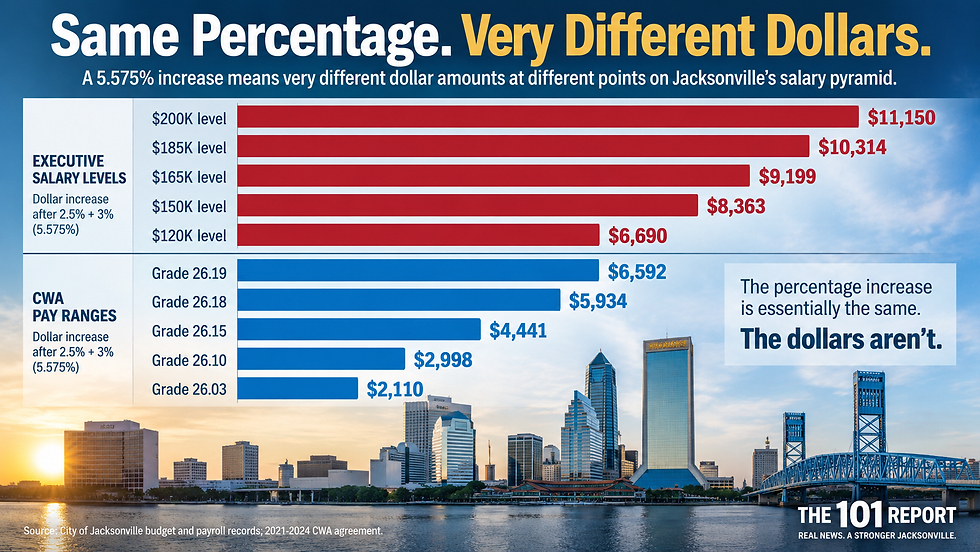
Same Percentage. Very Different Dollars.
The comparison looks like this:
Compensation level | When Deegan took office* | After 2.5% + 3% | Dollar increase | Cumulative increase |
Executive — $200K level | $200,000 | $211,150 | +$11,150 | 5.575% |
Executive — $185K level | $185,000 | $195,314 | +$10,314 | 5.575% |
Executive — $165K level | $165,000 | $174,199 | +$9,199 | 5.575% |
Executive — $150K level | $150,000 | $158,363 | +$8,363 | 5.575% |
Executive — $120K level | $120,000 | $126,690 | +$6,690 | 5.575% |
CWA 26.19 maximum | ~$118,238 | ~$124,830 | +$6,592 | 5.575% |
CWA 26.18 maximum | ~$106,448 | ~$112,382 | +$5,934 | 5.575% |
CWA 26.15 maximum | ~$79,652 | ~$84,092 | +$4,441 | 5.575% |
CWA 26.10 maximum | ~$53,777 | ~$56,775 | +$2,998 | 5.575% |
CWA 26.03 maximum | ~$37,852 | ~$39,963 | +$2,110 | 5.575% |
*For CWA employees, the starting point is the salary schedule in effect when Deegan took office in July 2023. CWA figures are annualized maximum pay-grade rates, not individual employee salaries. Executive figures represent selected actual executive salary levels. The comparison measures the dollar effect of equivalent percentage changes; it does not suggest that the positions carry equivalent responsibilities.
The historical CWA schedule provides, for example, monthly maximums of $3,154.37 for Grade 26.03, $4,481.41 for 26.10, $6,637.64 for 26.15, $8,870.65 for 26.18 and $9,853.17 for 26.19 at the relevant starting point.
The pattern is straightforward.
At the $200,000 executive level, a cumulative 5.575% adds $11,150 to annual salary.
At $150,000, it adds about $8,363.
At the maximum of CWA Grade 26.15, approximately the same cumulative percentage represents about $4,441.
At the maximum of Grade 26.03, it represents approximately $2,110.
The percentages are essentially the same.
The dollars aren't.
The Salary Pyramid Effect
There is nothing mathematically unusual about this.
Percentage increases necessarily produce larger dollar increases when applied to larger salaries.
But that simple fact can disappear when government compensation is discussed almost exclusively in percentages.
A 3% increase sounds the same whether someone earns $40,000 or $200,000.
In dollars, it isn't.
Three percent of $40,000 is $1,200.
Three percent of $200,000 is $6,000.
And once an increase becomes part of base salary, the next percentage adjustment is calculated from the higher number.
That means the difference compounds.
This is the salary-pyramid effect: the farther up the compensation structure an employee starts, the more valuable each percentage point becomes in actual dollars.
That doesn't make percentage-based increases inherently unfair. A chief administrative officer, department director, engineer, maintenance worker and administrative assistant perform very different jobs, operate in different labor markets and carry different responsibilities.
But it does mean that saying everyone received approximately the same percentage doesn't tell taxpayers—or employees—the entire compensation story.
The Comparison Also Cuts Against a Simpler Political Narrative
There's another important conclusion in these numbers.
The evidence we've found does not indicate that Deegan's continuing executive staff received dramatically larger percentage increases than the CWA employees in this comparable period.
In fact, the opposite is more interesting.
The percentage progression lines up remarkably closely.
That makes the dollar differences more—not less—meaningful.
The story isn't:
Executives got raises while everybody else got nothing.
The records don't support that.
The more accurate finding is:
Similar percentage adjustments were applied to a salary structure that already had very different starting points.
Those starting points determine what each percentage point is worth.
Department Directors Form the Middle of the Pyramid
The Mayor's executive operation is only one layer of Jacksonville government.
Below it sit the people responsible for running enormous municipal operations: Public Works, Parks and Recreation, Planning, Technology Solutions, Employee Services, Neighborhoods, Finance and other departments.
Their responsibilities can include hundreds of employees, large operating budgets, construction programs, maintenance operations, technology infrastructure and services Jacksonville residents encounter every day.
That's why our earlier analysis of Jacksonville's departmental budgets produced an important distinction.
Using departmental salary appropriations divided by authorized positions as a measure of budgeted salary dollars per authorized position—not an actual average employee salary—the Mayor's Office sits substantially above many operating departments.
That doesn't mean every Mayor's Office employee earns more than every engineer, manager or department director.
It demonstrates the density of salary dollars near the top of the organization.
Department directors themselves can be highly compensated, and reasonably so. But their departments also contain engineers, planners, inspectors, maintenance workers, administrative employees and other positions spanning a much wider salary range.
That makes department leadership the middle rung between the executive operation and Jacksonville's much broader workforce.
Then Comes FY2026—and the Comparison Changes
This is where we need to draw a line between what can be directly compared and what can't.
Jacksonville's current CWA agreement gives us exact salary schedules beginning Oct. 1, 2025. The published schedule then increases those ranges another 3% for 2026 and another 3% for 2027. For example, the maximum for Grade 26.15 is $87,455.99 in the 2025 schedule and $90,079.67 in 2026. Grade 26.19 moves from $129,822.98 to $133,717.67.
Those are exact published CWA ranges.
The executive side isn't as transparent.
Jacksonville's approved FY2025-26 budget says the Mayor's Office personnel category includes the impact of the FY25 and FY26 wage increases. It also records a Council-imposed $435,000 reduction to Mayor's Office salaries.
What we haven't located is a comparably clear public salary schedule establishing exactly what percentage was applied to each unclassified MA executive position effective Oct. 1, 2025.
That's why this article does not take a 2025 executive salary, apply an assumed percentage and call the result a 2026 salary.
It would make the table look more complete.
It would also make it less reliable.
One Current Executive Number Stands Out: $277,000
There is one major 2026 executive number that doesn't require that reconstruction.
Darnell Smith returned to the administration in August 2026 as Deegan's chief of staff at a reported $277,000 annually.
Smith's compensation shouldn't be characterized as an ordinary raise. He returned to City employment. It's a new appointment at a newly established salary rather than a continuing employee receiving one of the percentage adjustments analyzed above.
It nevertheless provides an important reference point for where compensation at the top of the administration stands as Jacksonville approaches another fiscal year.
It also demonstrates why the distinction between same-job salary growth, promotions and new appointments matters.
Lumping all three together as “raises” can badly distort what actually happened.
Not Every Salary Increase Is a Raise
That distinction applies throughout City government.
A continuing employee receiving a general percentage adjustment is one thing.
An employee being promoted into a department-director position is another.
Hiring a replacement executive at a newly negotiated salary is something else.
When an existing City employee becomes a department director, comparing that person's old salary with the director salary and describing the entire difference as a raise can exaggerate the comparison. Much of the difference may be compensation for taking an entirely different job.
For this analysis, compensation changes are therefore best understood in three categories:
same-job salary growth, promotions or substantial title changes, and new or replacement appointments.
That produces a much cleaner picture of what's actually happening.
The Mayor's Office Budget Has Grown for More Reasons Than Raises
The same caution applies to the overall Mayor's Office salary budget.
A growing salary appropriation doesn't mean every additional dollar represents employee raises.
For FY2025-26, the proposed Mayor's Office salary appropriation rose from approximately $3.147 million to $3.787 million, a $640,792 increase in the proposed budget. The authorized full-time position cap remained 23.
But those budget changes include more than individual salary adjustments. Position funding, vacancy assumptions, part-time staffing and other personnel decisions also affect the total.
Council subsequently imposed the $435,000 salary reduction reflected in the approved FY26 budget.
So the responsible comparison isn't:
The salary budget increased by X, therefore executives received X in raises.
It's:
How much does Jacksonville budget for its executive operation, how many positions does it support, what are those positions paying, and how has that structure changed?
Those are different questions.

Are Jacksonville's Executive Salaries Too High?
The numbers alone don't answer that.
There are legitimate reasons for paying senior government executives competitive salaries.
Senior Jacksonville officials oversee large organizations and budgets, confront complicated regulatory and operational issues, can work long and irregular hours and generally have less employment security than career civil-service employees.
The same applies to department directors. Recruiting experienced engineers, financial executives, technology professionals and administrators can require competing with private-sector compensation.
The fact that someone earns $200,000 therefore doesn't establish that the person is overpaid.
But neither does describing compensation as “competitive” establish that it is justified.
A meaningful compensation analysis needs market comparisons, responsibility, internal equity and results.
Salary is the input.
Performance is what taxpayers purchase with it.
There's Also a Transparency Difference
This research exposed another interesting distinction between the top and bottom of Jacksonville's salary pyramid.
For a CWA position, we can retrieve an agreement and determine exactly what the published minimum and maximum of Grade 26.15 was in one contract and what it is in another.
The City's current CWA agreement provides annual salary ranges all the way from Grade 26.03 through Grade 26.20 for 2025, 2026 and 2027.
Determining the current annual salary of some of Jacksonville's highest-paid appointed executives can be considerably harder.
The City's website identifies who occupies the executive positions. Budget documents tell taxpayers how much money is allocated to personnel. Council legislation reveals some wage adjustments. Historical payroll databases provide earlier individual salaries.
But Jacksonville.gov does not appear to provide a similarly straightforward current employee-by-employee payroll table where a resident can simply look up every appointed executive's annualized salary.
Those salaries aren't secret.
They are public records.
But there is a meaningful difference between information being legally obtainable and government proactively making it easy to find.
For this analysis, where a current salary can be independently established, we use it. Where it can't, we use the latest verified salary and identify the period rather than assume an increase—or assume there wasn't one.
What Happens When the New Budget Year Begins?
The timing makes this more than a historical exercise.
Jacksonville enters another fiscal year Oct. 1.
The current CWA agreement already tells represented employees what happens to their salary ranges next. The City's published schedule shows a 3% increase from the 2025 rates to the 2026 rates, followed by another 3% in the next schedule.
At the maximum of CWA Grade 26.03, for example, the range moves from $39,366.51 to $40,547.51.
Grade 26.10 moves from $57,326.20 to $59,045.98.
Grade 26.15 moves from $87,455.99 to $90,079.67.
Grade 26.18 moves from $116,877.54 to $120,383.87.
Grade 26.19 moves from $129,822.98 to $133,717.67.
Again, those are pay-range changes, not a claim that every employee personally receives the difference between the two maximums.
But they provide a transparent benchmark against which the next year's executive compensation can eventually be measured.
And that makes the current moment particularly useful: September 2026 establishes a baseline before another budget year changes the numbers again.
What Jacksonville's Salary Pyramid Actually Shows
Three years into the Deegan administration, the records tell a more nuanced story than either political side might prefer.
They don't show a Mayor's executive staff uniquely receiving enormous percentage raises while ordinary employees stood still.
During the comparable period we examined, the executive progression and the CWA compensation structure moved by essentially the same cumulative percentage.
That's an important finding.
But it doesn't make the salary pyramid disappear.
It demonstrates how it works.
At the $200,000 executive level, approximately 5.575% represents $11,150.
At the maximum of CWA Grade 26.15, approximately the same percentage represents about $4,441.
At the maximum of Grade 26.03, it's about $2,110.
The percentage can be equal.
The value of that percentage isn't.
And when those increases become part of the base upon which subsequent percentage increases are calculated, the differences continue compounding.
The Question for Taxpayers—and City Employees
The question isn't whether Jacksonville employees should receive raises.
Nor is it whether senior executives should make more than rank-and-file employees. They generally will.
The more useful question is whether Jacksonville can demonstrate that its compensation structure is competitive, internally equitable and tied to the responsibilities and results taxpayers are buying.
That's a question that matters to taxpayers deciding what City government is worth.
But it also matters to thousands of City employees looking at their own place within the organization.
It applies to a maintenance worker.
It applies to an administrative employee.
It applies to a planner or engineer.
It applies to a department director.
And it applies to a $277,000 chief of staff.
As Jacksonville enters another budget year, the current numbers give us a benchmark from which to measure what happens next.
Jacksonville's compensation increases can look remarkably similar when expressed as percentages.
Express them in actual dollars, however, and the salary pyramid looks very different.
The Mayors Office Part IX

The Mayors Office Part VIII

The Mayors Office Part VII
The Mayors Office Part VI

Donna The Mayors Office Part V

The Mayors Office Part IV

The Mayors Office Part III

The Mayors Office Part II

The Mayor's Office Part I
