
John Hawley
Sep 9, 2026
The Mayors' Office: Part VIII- The 101 Report
Jacksonville Mayor Donna Deegan continues to defend her administration's claim that the city's uninsured population fell 34%. It's not the first high-profile statistic from her Executive Office to face questions about methodology. We examined the man behind City Hall's analytics—and the philosophy behind the numbers.
Mayor Donna Deegan has some powerful numbers to make the case that her administration is delivering results.
Jacksonville taxpayers receive about $3 in value for every $1 they contribute to City government.
And the administration's Get Covered Jax initiative reduced Duval County's uninsured population by 34%.
Both numbers have been prominently used to demonstrate the success of Deegan's administration. Both have also faced significant questions after outside examination.
And both lead back inside the Mayor's Office.
At the center of that analytical operation is Dr. Parvez Ahmed, Jacksonville's Chief of Analytics, a finance professor who originally joined Deegan's administration in a very different role: Chief of Diversity and Inclusion.
That raises a larger question than whether either number is simply right or wrong.
Is the Mayor's Office analytics operation independently measuring the administration's performance—or producing measurements that ultimately help the administration promote it?
First Came the Claim: Jacksonville Gets $3 Back for Every $1
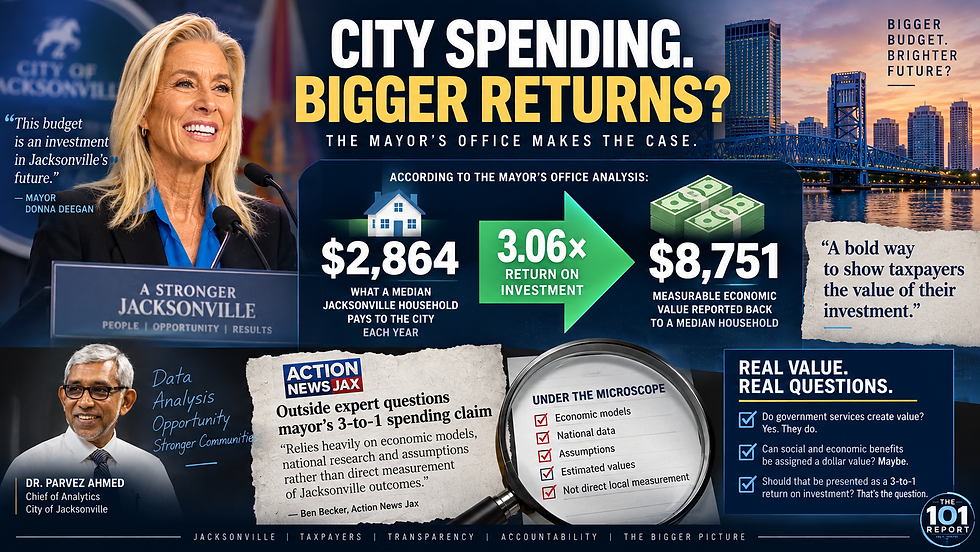
As Deegan defended a record $2.03 billion budget this summer, her administration offered taxpayers an unusually simple way to think about City spending. According to an analysis prepared by Ahmed, a median Jacksonville household contributes approximately $2,864 annually to City government while receiving approximately $8,751 in measurable economic value. That's a claimed 3.06-to-1 return on investment.
It's an attractive statistic, particularly for an administration trying to explain why a growing City budget represents an investment rather than simply more government spending.
But Action News Jax reporter Ben Becker asked an outside expert to examine the analysis. The resulting report found that much of the claimed value wasn't directly measured from Jacksonville outcomes. The calculation relied substantially on economic models, national research and assumptions used to assign dollar values to government services. The outside expert questioned whether the resulting figure should even be described as conventional “return on investment.”
That doesn't mean police protection, parks, roads, libraries or emergency services don't have enormous value. Of course they do. The question is different: Can estimated social and economic benefits be added together, assigned a dollar value and then presented to taxpayers as though they received $3.06 for every $1 they invested? Ahmed says they can. And understanding why requires knowing something about the person constructing the model.

Then Came Another Number: Uninsured Residents Down 34%
The second example is even easier to understand.
In April 2024, the City declared Get Covered Jax a success.
Approximately 120,000 Duval County residents had been uninsured when the initiative began, according to the City. During ACA open enrollment, 40,726 people became new enrollees.
City Hall performed a straightforward calculation:
40,726 new ACA enrollees = approximately 34% of 120,000 uninsured residents.
The City then announced that Jacksonville's uninsured population had declined 34%. Deegan called that reduction a “tremendous first step.”
There's just one major problem.
A new ACA enrollee isn't necessarily a previously uninsured person.
Someone can move from Medicaid to an ACA plan. Someone can leave employer-sponsored insurance and buy Marketplace coverage. Other people can switch forms of insurance.
And during this period, Florida was simultaneously experiencing the Medicaid/CHIP unwinding following the end of pandemic-era continuous coverage.
The administration's own Chief Health Officer, Dr. Sunil Joshi, ultimately acknowledged the problem. It is difficult to determine how many new ACA enrollees were previously uninsured, he said; what the administration actually knows is how many people newly signed up for ACA coverage.
That's an important distinction.
More ACA enrollment may be an accomplishment. It doesn't prove a 34% reduction in uninsured residents.

Independent Numbers Tell a Very Different Story
The discrepancy isn't small.
The Census Bureau's estimate showed Duval County's uninsured population under age 65 actually increased slightly, from 101,121 in 2023 to 102,123 in 2024.
The Health Planning Council of Northeast Florida estimated a decline of less than 1%.
Florida Department of Health data indicated a decline of approximately 2.5%.
City Hall's figure was 34%.
Different datasets can legitimately produce different estimates. Census measurements also involve reporting lags. But none of those considerations solves the fundamental mathematical problem with the City's calculation: ACA enrollment by itself doesn't tell us how many people stopped being uninsured.
A Fellow Journalist Gives Deegan a Chance to Reconsider
That's what made Deegan's recent appearance with Anne Schindler on First Coast Connect particularly revealing. Schindler wasn't simply confronting the Mayor with a competing number. She explained the methodological problem. People newly enrolling in ACA coverage may previously have had other insurance. Therefore, increased ACA enrollment alone doesn't establish that the uninsured population declined by the same amount.
Deegan responded:
“That is not what I have been told by our staff in terms of how we got to those numbers.”
Schindler continued pressing the distinction.
When she asked whether the 34% number itself should be reconsidered, Deegan responded:
“I am told it's accurate.”
That's significant because Deegan spent decades in journalism.
The question Schindler was asking wasn't particularly political. It was the kind of question journalists routinely ask: Does the evidence actually prove the claim?

Deegan Says the Reporting Was “A Little Disappointing”
Deegan also said she found the Florida Times-Union reporter David Bauerlein's reporting “a little disappointing” and eventually characterized the controversy as “much ado about nothing.”
There are several ways to interpret that reaction.
She may believe the reporting underplayed a legitimate accomplishment. ACA enrollment did increase substantially. Get Covered Jax provided outreach without a paid City advertising campaign. Those are favorable facts.
But Deegan did not identify a factual error that resolved Bauerlein's central criticism.
Instead, something interesting happened during her answer.
The original claim— “We reduced the uninsured population by 34%.”
eventually became:
“We were able to get more people signed up for the ACA.”
Those aren't the same claim.
And Bauerlein's reporting wasn't merely contradicted by an outside political opponent. Deegan's own Chief Health Officer acknowledged the limitation at the heart of it.
So Who Is Giving Deegan the Numbers?
That brings us to Parvez Ahmed.
Ahmed isn't an amateur with a spreadsheet. His academic background makes this story more interesting, not less. He is a finance scholar whose published research includes traditional portfolio analysis as well as socially responsible investing.
As far back as 1999, Ahmed co-authored a peer-reviewed paper with a revealing title:
“The Performance of Socially Responsible Mutual Funds: Incorporating Socio Political Information in Portfolio Selection.”
The research examined what happens when investors incorporate social criteria into decisions traditionally driven by risk and financial return. Importantly, the study didn't simply assume socially responsible funds performed better; its results found no clear overall advantage for socially responsible versus conventional funds, although funds using inclusion screens performed better within the study.
Ahmed later studied companies' social responsibility toward employees and whether markets financially rewarded it.
This isn't evidence that Ahmed manipulates statistics. It tells us something much more useful:
Ahmed has spent decades studying how the things we choose to value can change the way we measure an investment.

“People, Profit and the Planet”
Ahmed explained his philosophy particularly clearly years before Donna Deegan became mayor.
In a 2015 interview with the Jacksonville Daily Record, Ahmed discussed the UNF center for sustainable business practices he directed.
He described its philosophy as a three-legged stool:
“people, profit and the planet.”
And he argued that Jacksonville should balance those considerations when making decisions about Downtown redevelopment, port expansion and attracting businesses.
There's nothing inherently wrong with that philosophy.
In fact, governments have to consider benefits that don't produce direct financial profits. Cleaner water has value. Lower crime has value. Faster emergency response has value. Better health has value.
But what an analyst chooses to count as value affects the answer the analysis produces.
That's why methodology matters.
Ahmed Didn't Enter City Hall as Chief of Analytics
There's another piece of history readers should know.
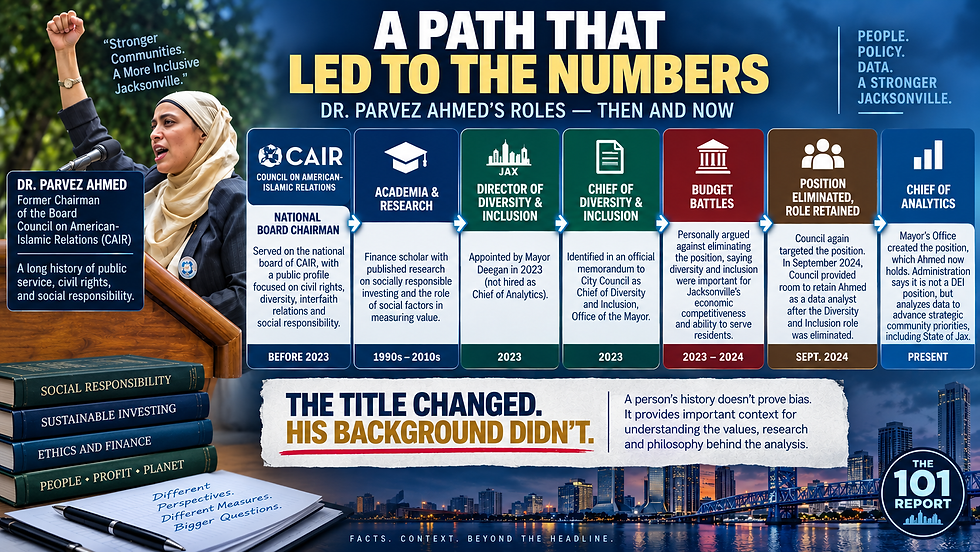
When Deegan entered office in 2023, Ahmed wasn't hired as Chief of Analytics.
He was appointed Director of Diversity and Inclusion.
Ahmed subsequently identified himself in an official memorandum to City Council as Chief of Diversity and Inclusion, Office of the Mayor. When Council moved to eliminate funding for the position, Ahmed personally argued that eliminating it could hurt Jacksonville's economic competitiveness and its ability to serve residents.
The fight didn't end there.
Council again targeted the position during the following budget cycle. In September 2024, Council considered—and ultimately provided room for—retaining Ahmed as a data analyst after the Diversity and Inclusion position was eliminated.
The Mayor's Office subsequently created the Chief of Analytics position, which Ahmed now holds. The administration says the job isn't a DEI position and instead analyzes data to advance strategic community priorities, including State of Jax.
That's an important distinction.
But a title doesn't erase a person's intellectual history—and it shouldn't.
Ahmed brought to the analytics job the same academic background, research interests and philosophy he had before entering City Hall.
The Question Isn't Whether Ahmed Has a Philosophy
Everybody does.
The more relevant question is whether the analytical process tests an administration's desired outcome—or starts with an outcome the administration values and constructs a measurement around it.
Consider the two cases we've now seen.
With taxpayer ROI, the Mayor's Office assigns economic values to government benefits and arrives at a politically powerful conclusion:
$1 in → $3.06 back.
With Get Covered Jax, new ACA enrollments were converted into another politically powerful conclusion:
Uninsured population ↓ 34%.
Both became evidence Deegan could use to demonstrate success.
Both subsequently encountered outside questions about methodology.
That pattern deserves scrutiny.
Analysis or Communications Product?
This may be the most important distinction.
A truly useful analytics operation shouldn't exist simply to tell an executive what she's doing right.
Sometimes its most valuable contribution should be telling her that the evidence doesn't support what she wants to say.
Ahmed's own academic work provides a useful model. His research into socially responsible investing didn't begin and end with the assumption that socially responsible funds must outperform conventional investments. He and his colleagues tested their performance.
City Hall deserves the same standard.
If an internally generated statistic becomes:
analysis → Mayor's talking point → City communications → campaign accomplishment
then the original analysis needs to withstand particularly aggressive scrutiny.
The 34% claim crossed that line. The administration repeatedly promoted it, and Deegan's reelection campaign subsequently used it as evidence of her record.
The Mayor Faces a Management Question, Too
This isn't solely about Ahmed.
Deegan employs both a Chief of Analytics and a Chief Health Officer inside an Executive Office whose staffing and cost we've examined throughout this series.
And here those two functions produced an uncomfortable result.
The Mayor continues saying the 34% figure is accurate because that's what staff tells her.
Yet her Chief Health Officer acknowledges the underlying ACA data cannot establish how many new enrollees were previously uninsured.
That's where Deegan owns the decision.
A mayor doesn't need to personally calculate every statistic her administration publishes. That's why executives hire specialists.
But once credible questions emerge about a major claim, leadership has another responsibility:
Test it.
Deegan could acknowledge that Get Covered Jax substantially increased ACA enrollment while saying the administration is reviewing whether its original 34% uninsured calculation overstated what the data can prove.
Instead, she continues defending the number.

A $5 Million-Plus Executive Office Should Be Able to Check Its Own Work
That's ultimately why this belongs in The Mayor's Office series.
Our previous installments have examined an Executive Office whose staffing, salaries and overall spending have grown substantially under Deegan. We've also examined the administration's argument that taxpayers should judge government spending by the value it produces.
That's a fair standard.
So let's apply it to the Mayor's Office itself.
More executive capacity should produce more than initiatives, presentations and talking points.
It should produce better management, better measurement and better information.
When an administration claims an initiative reduced uninsured residents 34%, taxpayers should be able to see evidence demonstrating that result.
When it says every tax dollar generates approximately three dollars in value, taxpayers should be able to distinguish directly measured returns from modeled or estimated benefits.
And when outside journalists test those claims, scrutiny shouldn't be treated as the problem.
It is part of the process that makes the numbers credible.
The Bigger Question: Who Checks City Hall's Definition of Success?
None of this establishes that Parvez Ahmed deliberately manipulated data. It doesn't establish that Donna Deegan knowingly promoted false statistics. And it doesn't establish that socially conscious economic analysis is illegitimate.
Those would be conclusions the evidence doesn't support.
What the evidence does show is worth examining on its own.
Two of the Deegan administration's most attention-getting numerical claims about its performance came from within the Mayor's Office. Both became useful evidence for promoting the administration's record. Both subsequently encountered significant methodological questions.
And in one case, the Mayor's own health expert acknowledged the very limitation at the center of the outside criticism.
That leaves taxpayers with a simpler question than any statistical model: Is the Mayor's Office measuring success—or defining success in ways that produce the numbers it wants to promote?
That is a question an analytics office should welcome.
Because if the numbers are strong, they should survive the test.
The Mayors Office Part IX

The Mayors Office Part VIII
The Mayors Office Part VII

The Mayors Office Part VI

Donna The Mayors Office Part V

The Mayors Office Part IV

The Mayors Office Part III

The Mayors Office Part II

The Mayor's Office Part I
