John Hawley
Oct 12, 2026
UF Jacksonville: The Science & Technology Frontier — Part III
Artificial intelligence may appear to work instantly when someone asks a chatbot a question, generates an image or analyzes a spreadsheet. Behind those seemingly simple interactions are enormous computing systems capable of performing mathematical calculations at extraordinary speeds. Building and improving those systems requires specialized processors, sophisticated software and researchers who understand how to put both to work.
The University of Florida made a major commitment to that infrastructure in 2020 through a partnership with NVIDIA, the technology company whose graphics processors have become central to modern artificial intelligence. That relationship helped expand UF's HiPerGator supercomputing capabilities and supported a university-wide effort to introduce AI into education and scientific research. What began as a computing investment has developed into a broader academic strategy involving engineering, medicine, agriculture, business and other disciplines.
Now, with UF Jacksonville's graduate campus opening in 2026, the partnership takes on additional significance for Northeast Florida. The new campus offers graduate education in artificial intelligence, computer science, data analytics and related fields, while Gainesville houses the university's established high-performance computing infrastructure. The important question is how these capabilities will connect—and whether Jacksonville's students and researchers will participate in the scientific work that the technology makes possible.
This third installment of UF Jacksonville: The Science & Technology Frontier examines how the NVIDIA partnership began, what HiPerGator actually does, why supercomputing matters to scientific discovery and which developments deserve attention as the Jacksonville campus expands.
How Did UF's $70 Million NVIDIA Partnership Begin?
In July 2020, UF announced a $70 million artificial intelligence initiative built around contributions from NVIDIA, university alumnus Chris Malachowsky and UF itself. Malachowsky, an NVIDIA co-founder, committed $25 million, while NVIDIA provided another $25 million in hardware, software, training and services. The university committed an additional $20 million to support the initiative.
The partnership was designed to accomplish more than installing a powerful computer. UF intended to expand AI education across academic disciplines, recruit specialized faculty and provide researchers with tools capable of addressing complex scientific problems. NVIDIA also committed technical expertise and educational resources, including collaboration through its Deep Learning Institute.
An important part of the agreement was the creation of an NVIDIA AI Technology Center at UF, described by the university as the first of its kind in North America. The center connected university researchers with NVIDIA specialists who could help develop and optimize advanced AI applications. That relationship gave UF access not only to computing hardware but also to expertise in how the hardware could be used effectively.
The original $70 million commitment established the foundation for the university's AI initiative, but it should not be confused with the total amount UF has invested in computing since 2020. Later purchases, infrastructure upgrades and research investments represent additional developments. Separating those expenditures is important when evaluating how the partnership has grown.
What Is HiPerGator, and Why Does a University Need a Supercomputer?
HiPerGator is UF's high-performance computing system, operated by UF Information Technology's Research Computing organization. Unlike an ordinary computer, which performs tasks using a relatively small number of processors, HiPerGator combines thousands of processing components, specialized accelerators, high-speed networking and large storage systems. Researchers use these resources to solve problems that would take impractically long on conventional computers.
Consider a scientist studying how hurricanes interact with coastal environments. A detailed simulation may need to account for atmospheric conditions, ocean temperatures, wind patterns and changes in geography across millions of calculations. Supercomputers distribute that work across many processors, allowing researchers to examine scenarios at a scale that ordinary desktop equipment cannot handle efficiently.
Artificial intelligence creates similar demands. Training a sophisticated neural network involves repeatedly processing enormous amounts of information and adjusting mathematical parameters. The process can require extensive parallel computation, especially when researchers experiment with large models or multiple training configurations.
HiPerGator supports both traditional scientific computing and AI-intensive workloads. That distinction matters because not every research project uses the same hardware or software. Some scientists need conventional processors for simulations, while others require GPUs optimized for machine learning, and still others depend on substantial memory or fast access to enormous datasets.
HiPerGator 4: What Changed With UF's Blackwell Supercomputer Upgrade?
HIPERGATOR 4 | CORE AI INFRASTRUCTURE
UF unveiled the fourth generation of HiPerGator in October 2025, marking a substantial upgrade to its artificial intelligence computing infrastructure. The new system replaced its earlier NVIDIA A100-based AI SuperPOD with 63 NVIDIA DGX B200 systems. Each system contains eight Blackwell GPUs, producing a total of 504 GPUs dedicated to the upgraded AI SuperPOD.
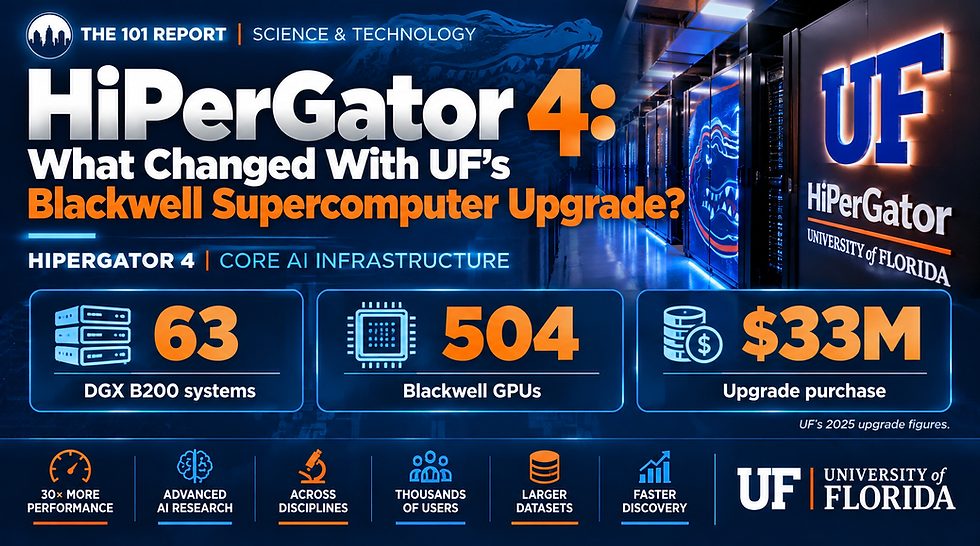
The upgrade represented a $33 million purchase, separate from the original 2020 partnership announcement. UF reported that the new generation offered approximately 30 times the performance of the previous HiPerGator generation in the comparison cited at its unveiling. Performance comparisons, however, depend on the specific workloads and benchmarks being measured.
Blackwell GPUs are specialized processors designed to accelerate operations commonly used in AI training and inference. Training refers to the process of developing a model from data, while inference is the process of using a trained model to generate predictions or responses. Improvements in either capability can affect how quickly researchers complete experiments and how many projects a computing system can support.
HiPerGator also depends on equipment beyond its GPUs. Its infrastructure includes conventional processors, high-speed storage and NVIDIA networking technology that moves information between computing nodes. Without those supporting systems, even the most powerful individual processors could spend too much time waiting for data instead of performing useful calculations.
What Makes NVIDIA GPUs So Important to Artificial Intelligence?
Graphics processing units were originally developed to handle the parallel calculations required for computer graphics. Their architecture also makes them effective at performing many of the mathematical operations involved in machine learning. As researchers developed increasingly complex neural networks, GPUs became essential tools for accelerating training and inference.
A central processing unit, or CPU, is designed to handle a wide range of computing tasks, including those requiring complicated sequences of instructions. GPUs are optimized for performing large numbers of similar calculations simultaneously. AI applications often involve mathematical operations on large arrays of numbers, making parallel processing particularly valuable.
NVIDIA's contribution extends beyond the physical processors. Its CUDA software ecosystem allows developers to write programs that use GPU acceleration, while specialized libraries support machine learning, scientific computing and data analysis. This combination of hardware and software helps researchers turn theoretical algorithms into practical computational tools.
For graduate students, understanding GPU computing can become an important part of advanced AI education. Developing a model involves more than writing code that produces a prediction. Researchers must also consider how efficiently that code uses computing resources, how data moves through the system and whether a particular experiment justifies the computational cost.
How Does HiPerGator Support Research Beyond Artificial Intelligence?
HiPerGator serves researchers across disciplines that extend well beyond computer science. UF identifies applications involving medicine, agriculture, coastal resilience, transportation, data security and other scientific challenges. The underlying connection is that these fields increasingly depend on analyzing complex information or simulating systems that cannot be studied easily through direct observation alone.
In agriculture, computational tools can help researchers analyze crop characteristics, environmental conditions and disease patterns. Biomedical researchers can use advanced computing to study molecular interactions, analyze imaging data and investigate relationships within large biological datasets. Environmental scientists can model changing conditions and compare potential outcomes across different scenarios.
The university has also highlighted Florida's Digital Twin initiative as an example of research supported by HiPerGator. A digital twin is a computational representation of a physical system that can be updated using measurements and other data. Such models may help researchers study how environmental, infrastructure or operational changes affect the real-world systems they represent.
These applications demonstrate why high-performance computing has become an important part of modern research universities. The same underlying infrastructure can support scientists investigating very different problems, even when their research methods and objectives are unrelated. Shared computing resources allow universities to support specialized research without requiring every department to operate an independent supercomputer.
What Is the NVIDIA AI Technology Center at UF?
The NVIDIA AI Technology Center was established as part of the university's 2020 partnership to connect UF researchers with NVIDIA's technical expertise. The collaboration involves specialists who help researchers develop, improve and accelerate AI applications. This work can include evaluating algorithms, optimizing software and adapting computational methods to specialized research problems.
A researcher may have a scientifically valuable idea without possessing extensive experience in GPU programming. Working with computing specialists can help determine how to implement that idea efficiently and whether existing tools can reduce development time. These collaborations are particularly valuable when scientific teams combine expertise from several disciplines.
The center also reflects a broader change in how advanced computing companies work with universities. Hardware manufacturers benefit when researchers discover new applications for their technologies, while universities gain access to specialized expertise and emerging tools. The resulting relationship can support education and research, although individual projects still require independent scientific evaluation.
For UF Jacksonville, the center raises a practical question about how university-wide resources will support the new campus. Its existence in Gainesville does not automatically establish a permanent NVIDIA research presence in Jacksonville. Documented collaborations, participating faculty and identifiable research projects will be more meaningful indicators than the partnership's name alone.
How Many Researchers and Students Are Using HiPerGator?
At its October 2025 unveiling, UF reported that HiPerGator had nearly 7,000 users and had processed approximately 33 million research requests during the preceding year. Those figures illustrate the scale of activity supported by the university's computing infrastructure. They do not mean that 7,000 people were simultaneously operating the system or that every request represented a separate scientific discovery.
UF's broader AI initiative reports more than 300 AI-focused faculty members and over 14,000 annual enrollments in AI-related courses. The university also identifies hundreds of AI-related internships as part of its educational activities. These university-wide figures provide context for the investment in computing, but they should not be attributed to Jacksonville's newly established campus.
The distinction between available computing capacity and actual research output is important. A powerful supercomputer may support thousands of users, but its scientific value depends on the questions those users investigate and the results they produce. Published studies, validated discoveries, external research funding and practical applications offer additional measures of its contribution.
As the Jacksonville campus develops, its participation in that research activity will become a useful measure of progress. Enrollment alone cannot establish whether students are gaining access to advanced research experiences. Tracking faculty-sponsored computing projects, student publications and collaborations with established UF laboratories will help determine how effectively the campuses are connected.
Can UF Jacksonville Graduate Students Use HiPerGator?
UF has established pathways that allow students to use HiPerGator for coursework and research. According to the university, students enrolled in UF credit courses may obtain access when an instructor or faculty adviser requests an appropriate teaching account. UF also operates a library sponsorship program that can support selected student research projects without requiring students to provide their own computing funding.
These policies provide a potential pathway for Jacksonville graduate students, but they do not establish that every student automatically receives unrestricted supercomputer access. Research allocations, faculty sponsorship, available capacity and project requirements can determine which resources are available. UF's Research Computing office also maintains rules governing how faculty and other users obtain computing allocations.
Jacksonville's Master of Science in Computer Science launched in fall 2026 with concentrations in artificial intelligence and cybersecurity. UF identified Daisy Zhe Wang as director of the Jacksonville computer science program, with an academic model designed primarily for working professionals. The program creates an educational connection to UF's broader computing expertise, but the extent of its initial HiPerGator-supported coursework and research remains an important question.
The distinction matters for prospective students comparing graduate programs. Access to a supercomputer may be valuable when a course or research project requires large-scale computation, but students also need faculty guidance, suitable datasets and opportunities to apply their knowledge. A meaningful evaluation should therefore examine how the computing resources are incorporated into actual academic work.
Chris Malachowsky: How a UF Graduate Helped Build the University's AI Strategy
Chris Malachowsky occupies an unusual position in the development of UF's artificial intelligence initiative. He is both a UF alumnus and a co-founder of NVIDIA, a company whose computing technology has become central to modern AI research. His $25 million contribution helped establish the original partnership and linked the university's educational ambitions with one of the industry's most influential technology companies.
The partnership also reflects a larger trend in which universities increasingly rely on collaborations with technology companies, alumni and private donors to support expensive research infrastructure. Advanced computing systems require substantial capital investment, specialized expertise and recurring upgrades as technology changes. Philanthropy and industry contributions can accelerate those investments, although universities must continue to evaluate their academic priorities independently.
Malachowsky's involvement extends beyond the original financial contribution. UF has expanded its AI education strategy, developed new computing resources and created facilities associated with its broader engineering and technology ambitions. These developments help explain why the university views AI as a cross-disciplinary capability rather than a subject limited to one academic department.
The Jacksonville campus introduces a new geographic dimension to that strategy. Whether the university develops major research laboratories, attracts specialized faculty or establishes additional industry partnerships in Northeast Florida will depend on future decisions and investments. The existing NVIDIA relationship provides a foundation, but the local outcomes remain to be documented.
What Does UF's NVIDIA Partnership Mean for Jacksonville's Technology Industry?
Jacksonville's economy includes healthcare, financial services, logistics, transportation, defense-related activities and other industries that increasingly rely on advanced computing. These sectors present opportunities for applied research involving predictive analytics, cybersecurity, automation and the management of complex information. UF Jacksonville's graduate programs are intended to connect advanced education with regional professional needs.
For a healthcare organization, the relevant opportunity might involve analyzing clinical data or improving operational planning. A logistics company may be interested in forecasting demand, optimizing transportation networks or monitoring equipment performance. Financial institutions may focus on detecting suspicious transactions, evaluating risks or securing digital systems.
The existence of these potential applications does not mean that UF Jacksonville has established research partnerships with every major regional employer. That distinction will be central to evaluating the campus's progress. Announced collaborations should be examined for their actual commitments, participating researchers, funding arrangements and measurable results.
There is also a difference between training employees to use existing AI products and developing new technologies. Both activities can provide value, but they require different expertise and may produce different economic outcomes. A university capable of supporting original research, advanced engineering and commercialization could contribute to a broader range of opportunities than one focused exclusively on professional training.
How Could HiPerGator Support UF Jacksonville's Planned National Security Research?
UF Jacksonville's long-term plans include an Applied Research for National Security laboratory intended to support work involving AI, semiconductors, microelectronics, space technologies and other strategic fields. University officials have described the initiative as an emerging effort to bring together research, workforce development and industry collaboration. Its development remains separate from the established HiPerGator infrastructure in Gainesville.
National security research frequently requires sophisticated computing methods. Applications may include analyzing sensor information, evaluating complex systems, developing secure software and studying advanced electronic technologies. Some projects can benefit from AI acceleration, large-scale simulation and high-performance data processing.
However, research involving sensitive or classified information introduces additional requirements that ordinary academic computing facilities may not satisfy. Security controls, authorized access, specialized networks and contractual restrictions can determine where particular projects are performed. HiPerGator's existing capabilities should not be interpreted as evidence that it is authorized for every category of national security research.
The Jacksonville laboratory's eventual computing requirements will therefore deserve close attention. UF may be able to use existing university resources for some research while requiring separate facilities or infrastructure for other projects. The university's future announcements about laboratories, security capabilities, faculty appointments and research agreements will help clarify that division.
How Will We Measure the Success of UF's NVIDIA Partnership?
The NVIDIA partnership has produced identifiable infrastructure investments, including the original 2020 initiative and the 2025 HiPerGator 4 upgrade. It has also contributed to UF's expansion of AI education and research activity. Those are measurable accomplishments, but they represent different categories of progress and should not be combined into a single claim about scientific or economic impact.
The next level of evaluation involves research outcomes. How many externally funded projects use HiPerGator, and what discoveries have resulted from that work? How many students participate in computing-intensive research, and how often do those experiences lead to publications, employment or further scientific development?
UF's research computing organization provides information about access, technical capabilities and system configuration. The university also publishes research announcements and descriptions of individual projects. Comparing these records over time can help distinguish increases in computing capacity from increases in scientific productivity.
For Jacksonville, we will track several specific developments: whether graduate courses incorporate HiPerGator, whether local faculty receive research allocations, whether Jacksonville students participate in published projects and whether regional employers establish substantive research collaborations. These indicators will provide a more reliable measure of the campus's integration into UF's AI research infrastructure than promotional descriptions alone.
From Supercomputing to Cybersecurity: What Comes Next?
HiPerGator demonstrates how modern scientific research depends on powerful computing infrastructure, but greater computational capability also introduces new security challenges. AI systems rely on large datasets, specialized software and interconnected equipment that must be protected from unauthorized access and manipulation. As organizations integrate AI into essential operations, cybersecurity becomes an increasingly important part of technology development.
The connection is particularly relevant to UF Jacksonville because its computer science graduate program includes both artificial intelligence and cybersecurity concentrations. Students studying these fields will encounter overlapping questions involving software vulnerabilities, data protection, model reliability and the security of automated systems. Understanding those relationships can help explain why advanced computing and digital defense are increasingly studied together.
Next in the series — Part IV: Cybersecurity at UF Jacksonville: How Artificial Intelligence Is Changing Digital Defense. We will examine how AI is used to detect cyber threats, how attackers can exploit intelligent systems and why protecting AI models introduces challenges beyond traditional computer security. The episode will also explore the skills graduate students need to work at the intersection of artificial intelligence and cybersecurity.
Continue Exploring the Series
Previous episode: Part II — Artificial Intelligence at UF Jacksonville: What Graduate Students Will Study and Why It Matters.
Explore the Complete Series: UF Jacksonville: The Science & Technology Frontier — All 12 Episodes