
John Hawley
Oct 12, 2026
UF Jacksonville: The Science & Technology Frontier — Part II
Artificial intelligence is moving beyond the experimental stage and becoming part of how businesses operate, researchers investigate complex problems and professionals make decisions. At the University of Florida's new graduate campus in Downtown Jacksonville, AI is a central part of an academic expansion intended to prepare students for a rapidly changing technological environment. But what does studying artificial intelligence actually involve, and how does that education translate into scientific research and professional opportunities?
UF Jacksonville opened in August 2026 with graduate programs spanning computer science, engineering, data analytics, business, law and other disciplines. The campus enters a university system that has already made substantial investments in artificial intelligence education and high-performance computing, including its NVIDIA partnership and HiPerGator supercomputer in Gainesville. The Jacksonville expansion creates an opportunity to connect advanced technical education with the region's existing industries while introducing students to technologies that increasingly influence their work.
This second installment of UF Jacksonville: The Science & Technology Frontier examines what graduate students can expect to learn about artificial intelligence, how the underlying technology works, and where those skills may lead. It also explores the difference between using AI tools and understanding the mathematics, computer science and engineering principles required to develop and evaluate them.
What Artificial Intelligence Programs Are Available at UF Jacksonville?
UF Jacksonville's initial academic offerings include a Master of Science in Computer Science with concentrations in artificial intelligence and cybersecurity. The program is designed to accommodate working professionals who want to develop advanced computing skills without relocating to Gainesville. Its graduate-level focus distinguishes it from introductory courses that teach people how to use commercially available AI applications.
Students pursuing advanced computer science education typically encounter algorithms, software engineering, data structures, mathematical modeling and methods for building intelligent systems. AI specialization can involve machine learning, neural networks, optimization and techniques for analyzing large datasets. The specific courses available to Jacksonville students depend on UF's approved curriculum, faculty assignments and course schedules, which should be distinguished from the university's broader AI offerings in Gainesville.
Artificial intelligence also appears in UF Jacksonville's interdisciplinary programs, including management and data analytics. These programs approach the technology from different perspectives, emphasizing how organizations evaluate information, implement automated systems and manage the risks associated with their use. The distinction matters because an engineer developing an AI model requires different preparation from a business executive responsible for deciding whether to deploy it.
What Is Artificial Intelligence, and How Does It Actually Work?
Artificial intelligence refers to computer systems designed to perform tasks commonly associated with human intelligence, including recognizing patterns, understanding language, making predictions and solving problems. Some AI systems follow explicitly programmed rules, while others learn statistical relationships from examples. Modern advances have largely been driven by machine learning, increased computing power and the availability of large amounts of digital information.
Machine learning allows computers to identify patterns in data and use those patterns to make predictions about information they have not previously encountered. A model trained on thousands of labeled medical images, for example, might learn to identify visual features associated with particular conditions. Its predictions would still require careful validation before the system could be trusted in a clinical environment.
Generative AI takes a different approach by learning patterns that allow it to produce new text, images, computer code and other content. Large language models, including those used in conversational AI systems, predict sequences of tokens based on relationships learned during training. Their ability to produce fluent responses does not guarantee factual accuracy, which is why verification remains important in research, medicine, law and other high-stakes applications.
Machine Learning: How Computers Learn From Data
Machine learning is one of the foundational subjects in advanced AI education. Instead of writing instructions for every possible situation, developers use mathematical algorithms to identify relationships within training data. Those relationships allow a trained model to classify information, estimate probabilities or predict outcomes when presented with new examples.
In supervised learning, researchers provide examples containing both input information and known answers. A model might examine historical financial transactions labeled as legitimate or fraudulent, then learn patterns associated with suspicious activity. Unsupervised learning works differently, searching for structures or groupings in information without predefined answers.
Reinforcement learning introduces another approach in which a system learns through feedback from its actions. Researchers use it in robotics, automated control systems and other environments where decisions influence subsequent outcomes. Each method involves different mathematical assumptions, computational requirements and risks.
For students, understanding these distinctions is essential because no single AI method is appropriate for every problem. A technique that works well for identifying objects in photographs may be unsuitable for evaluating financial risk or controlling industrial equipment. Selecting the right approach requires understanding the data, the objective and the consequences of an incorrect prediction.
Neural Networks and Deep Learning: The Technology Behind Modern AI
Artificial neural networks are computational models built from connected layers of mathematical operations. During training, the system adjusts numerical parameters to reduce the difference between its predictions and the desired results. This process allows networks to learn increasingly complex relationships within text, images, audio and other forms of information.
Deep learning refers to neural networks with multiple processing layers capable of representing sophisticated patterns. These systems underpin many advances in image recognition, speech processing, natural language processing and generative AI. Their capabilities have expanded alongside improvements in computing hardware, training methods and the availability of large datasets.
One important training technique is gradient descent, which helps determine how a model's parameters should change to reduce prediction errors. Rather than manually adjusting millions or billions of values, researchers use mathematical calculations to guide successive updates. This is one reason advanced AI education requires a foundation in calculus, linear algebra, probability and computer programming.
Deep learning also introduces challenges involving computational cost, interpretability and reliability. A model may perform exceptionally well on familiar examples while struggling with unusual situations or data that differ from its training material. Researchers must therefore evaluate not only accuracy but also robustness, fairness, security and the conditions under which a model should be trusted.
Natural Language Processing: How AI Understands and Generates Human Language
Natural language processing, commonly called NLP, focuses on how computers analyze, interpret and generate human language. It supports applications such as translation, document classification, information retrieval, speech recognition and conversational assistants. UF Jacksonville identifies natural language processing among the subjects associated with its AI concentration.
Modern language models use numerical representations of words and other text elements to identify statistical relationships across large collections of information. Transformer architectures, which use attention mechanisms to evaluate relationships within sequences, have become central to many contemporary systems. These models can summarize documents, answer questions and generate computer code, although their outputs may contain errors or unsupported claims.
The distinction between generating plausible language and establishing factual truth is especially important. A language model can produce a convincing explanation without independently verifying the underlying information. Professionals using these systems must understand how to evaluate sources, protect confidential information and determine when human review is required.
In a university setting, NLP provides opportunities for research involving scientific literature, medical records, legal documents and technical information. Each application presents its own challenges involving privacy, terminology, accuracy and accountability. Graduate students studying NLP therefore need both computational expertise and an understanding of the environments in which their systems will operate.
Trustworthy AI: Why Accuracy, Security and Human Oversight Matter
UF Jacksonville specifically identifies trustworthy AI systems as a subject within its computer science concentration. This area of study examines whether intelligent systems can operate reliably, securely and responsibly under real-world conditions. It goes beyond producing technically impressive results to consider what happens when a system fails.
An AI system used to recommend movies creates relatively limited consequences when it makes an incorrect prediction. A system involved in medical diagnosis, financial decisions or critical infrastructure may create much greater risks. Researchers must evaluate performance across different populations, identify potential biases and determine whether a model can be manipulated.
Trustworthy AI also involves transparency about a system's limitations. Developers may need to document training data, test results, known failure modes and procedures for human intervention. These practices are especially important when automated decisions affect individuals who cannot easily inspect or challenge the technology.
The relationship between AI and cybersecurity is particularly significant for UF Jacksonville. As organizations deploy increasingly sophisticated AI tools, they must protect the systems from unauthorized access, manipulated inputs and the exposure of sensitive information. Professionals who understand both AI development and cybersecurity may be better equipped to address these overlapping challenges.
AI in Healthcare: A Second Graduate Pathway at UF Jacksonville
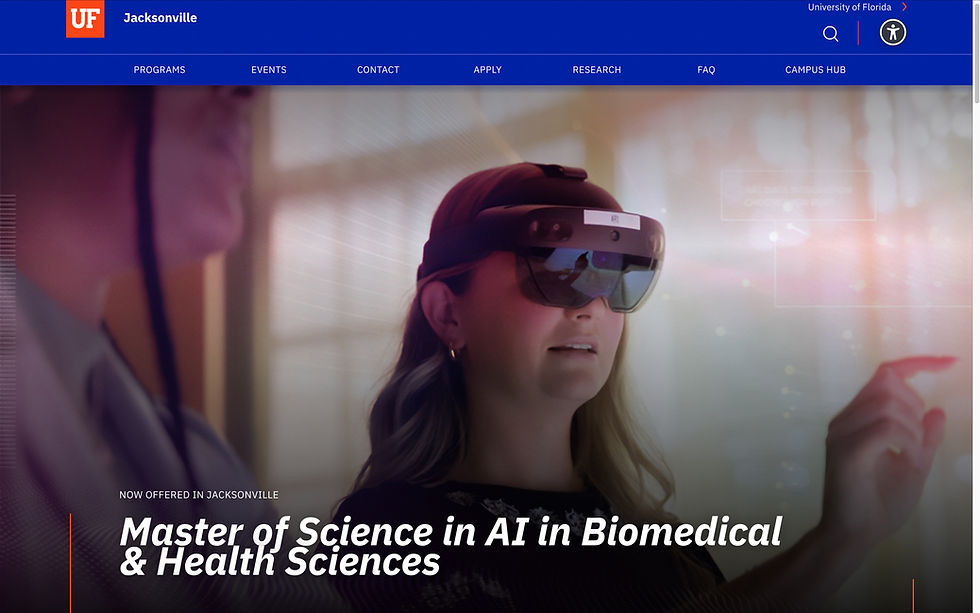
UF Jacksonville also offers a Master of Science in Artificial Intelligence in Biomedical and Health Sciences through the College of Medicine. This 30-credit program is designed to prepare professionals to develop and apply AI technologies in clinical care, biomedical research and healthcare management. Its curriculum includes AI fundamentals in medicine, ethical design, applied generative AI and hands-on design projects.
Medical AI presents challenges that differ substantially from ordinary consumer applications. Researchers may work with electronic health records, diagnostic images, wearable-device measurements and biomedical information that require specialized interpretation. Protecting patient privacy, validating results and understanding the clinical consequences of incorrect predictions are essential parts of the process.
The program's AI and Clinical Design Studios are intended to connect classroom education with practical healthcare problems. UF describes collaboration involving faculty from Gainesville and Jacksonville, giving students opportunities to work across technical and clinical disciplines. These experiences may help participants understand how promising computational methods must be adapted before they can be used responsibly in medical settings.
Jacksonville already has a substantial UF Health presence, creating a local environment in which medical education, clinical practice and advanced computing can intersect. In September 2026, UF's Jacksonville health sciences community also organized AI Scholar Days, bringing together faculty, students and healthcare professionals to discuss AI-related projects and ideas. These activities provide tangible opportunities to follow how the university's broader AI ambitions are developing locally.
AI in Business and Engineering Management: Applying Technology Beyond the Laboratory
Artificial intelligence education is not limited to students planning careers as software developers. UF Jacksonville's Master of Science in Engineering Management includes a concentration in Data Analytics, combining analytical techniques with management and organizational decision-making. The university also lists a Master of Science in Management with an AI concentration among its Jacksonville offerings.
These programs address the challenge of applying advanced technology within organizations that already have established systems, employees and financial responsibilities. A company may possess enormous amounts of operational information without knowing how to use it effectively. AI and data analytics can help identify patterns, but implementation also requires appropriate infrastructure, employee training and realistic expectations.
Consider a logistics company attempting to improve delivery efficiency. Engineers might develop predictive models using shipment histories, traffic patterns and equipment performance, while managers evaluate implementation costs and operational changes. A technically accurate model may still produce limited benefits if the organization cannot integrate it into everyday decisions.
The engineering management program addresses this intersection of technical knowledge and practical leadership. UF identifies data analytics algorithms, project management, communication and evaluation of technology investments as important components. The broader lesson is that scientific innovation depends not only on discovering what technology can do, but also on determining when and how it should be used.
UF's NVIDIA Partnership: How Supercomputing Supports Advanced AI Education
UF Jacksonville's graduate programs are developing within a university system that has already invested in large-scale AI computing. In 2020, UF established a partnership with NVIDIA that expanded its ability to conduct computationally intensive research and integrate artificial intelligence into university education. The partnership also created an NVIDIA AI Technology Center at UF.
The university's HiPerGator supercomputer provides the computational resources needed for research involving large datasets, complex simulations and advanced AI models. Its fourth-generation infrastructure includes 63 NVIDIA DGX B200 systems containing 504 Blackwell GPUs. These processors are designed to accelerate the mathematical operations required by machine learning and other demanding computational workloads.
Graphics processing units, or GPUs, can perform many calculations in parallel, making them particularly useful for training neural networks. A large AI model may require enormous numbers of mathematical operations as its parameters are repeatedly adjusted during training. High-performance computing systems distribute those calculations across specialized processors and connect them through fast networking infrastructure.
UF reports more than 300 AI-focused faculty members across the university and approximately 14,000 annual enrollments in AI-related courses. Those figures describe university-wide activity rather than the Jacksonville campus alone. They nevertheless establish the scale of the existing academic and technical infrastructure into which Jacksonville's graduate programs are being introduced.
Will UF Jacksonville Students Have Access to HiPerGator?
The connection between Jacksonville graduate education and Gainesville's computing infrastructure is an important question for prospective students and researchers. UF says its Jacksonville computer science program follows the established Gainesville curriculum while providing opportunities for local internships, cooperative education and industry engagement. That creates academic continuity between the campuses, although it does not establish identical access to every research resource.
UF's separate Master of Science in Artificial Intelligence Systems program explicitly describes student access to HiPerGator for hands-on projects. That program demonstrates how the university incorporates supercomputing into graduate education, but it should not be confused with the Jacksonville computer science degree. The precise arrangements for Jacksonville students, including computing allocations, research access and project supervision, deserve separate confirmation.
For students developing AI models, access to high-performance computing can make a substantial difference. It may allow experiments with larger datasets, more complex algorithms and computational techniques that would be impractical on personal computers. However, many valuable AI projects can also be completed using smaller models, commercial cloud services or ordinary computing equipment.
As UF Jacksonville grows, access to shared computing infrastructure will be one of the useful benchmarks for evaluating the campus's scientific capabilities. Future reporting will examine whether Jacksonville students are participating in HiPerGator-supported research, which faculty supervise those projects and whether the campus develops additional specialized computing facilities of its own.
What Careers Can UF Jacksonville's AI Graduates Pursue?
UF Jacksonville identifies software engineering, AI systems development, data engineering, cybersecurity engineering and technology project management among the potential career paths associated with its computer science degree. These occupations involve different responsibilities, but they increasingly share a need for understanding how intelligent systems process information and interact with existing technology.
An AI systems developer may design software that incorporates machine learning models, while a data engineer builds the infrastructure used to collect, organize and deliver information. Cybersecurity engineers focus on protecting systems and investigating vulnerabilities, including those introduced by AI applications. Research-oriented positions may require additional graduate education, specialized expertise or experience developing and evaluating new computational methods.
The employment opportunities extend beyond companies traditionally identified as technology businesses. Financial institutions use predictive analytics, healthcare organizations analyze clinical and operational information, and manufacturers increasingly rely on automated monitoring and control systems. Logistics companies, insurance providers and public agencies also have growing reasons to understand AI, although their specific hiring needs and technical requirements vary.
UF's program page cites national labor-market estimates showing substantial demand for graduate-level computer science skills. Those figures should not be interpreted as guaranteed salaries or job placements for Jacksonville graduates. More meaningful local benchmarks will emerge as the university reports internship participation, employer partnerships, graduate employment and career outcomes.
What Does It Cost to Study Artificial Intelligence at UF Jacksonville?
The Master of Science in Computer Science is a 30-credit program that UF estimates students can complete in approximately 18 months to two years. The university currently lists estimated program costs of $16,191 for Florida residents and $39,836 for out-of-state students. Actual expenses may vary depending on fees, enrollment arrangements and individual circumstances.
The biomedical and health sciences AI master's program also requires 30 credits and lists a typical completion period of approximately 18 months. UF publishes the same estimated resident and nonresident program costs for that degree, although its curriculum and professional focus differ substantially from computer science. Prospective students should review current tuition, prerequisites, admissions requirements and delivery formats directly with the university.
For working professionals, the cost of graduate education extends beyond tuition. Students must consider time commitments, possible changes in employment schedules and the skills they expect to acquire. An advanced degree may provide valuable preparation, but its financial return depends on an individual's career path, prior experience and opportunities after graduation.
The availability of these programs in Downtown Jacksonville may reduce the need for local students to relocate or travel regularly to Gainesville. That geographic advantage is one of the practical distinctions of the new campus. Whether it produces measurable increases in regional graduate education and workforce development will become clearer as enrollment and graduation data accumulate.
How Will We Measure UF Jacksonville's Artificial Intelligence Progress?
UF Jacksonville opened in fall 2026 with nearly 160 students enrolled across eight graduate programs and five colleges. That initial enrollment provides a campus-wide baseline, but it does not reveal how many students are specializing in artificial intelligence. UF's September engineering announcement confirmed the launch of the computer science and engineering management programs, establishing the first academic milestones for tracking their development.
The next measures should include AI enrollment by degree and concentration, course offerings, faculty appointments, research projects, internships and graduation rates. We will also look for evidence of collaboration between Jacksonville students and researchers working with Gainesville's established AI infrastructure. Documented employer partnerships, research publications and student projects will provide a more detailed picture of the campus's actual activities.
The university's ambitions also create questions about the future direction of AI education. As generative AI systems become easier to use, graduate programs must continue distinguishing foundational computer science knowledge from training focused on particular commercial products. Students who understand algorithms, mathematics, data engineering and system security may be better prepared to adapt as individual AI tools change.
Those distinctions will matter to prospective students, faculty members, businesses and investors following UF Jacksonville's development. The campus's success in artificial intelligence education will ultimately be reflected in what students learn, what researchers produce and how those capabilities contribute to real-world problems.
From AI Education to Scientific Discovery: What Comes Next for UF Jacksonville?
Artificial intelligence provides a common thread connecting many of UF Jacksonville's initial academic programs. Computer science students can investigate how intelligent systems are built, biomedical students can explore their use in healthcare, and management students can examine how organizations implement them. These different perspectives reflect a broader change in higher education as AI becomes relevant to an increasing number of professional disciplines.
The next question is how the university's computing infrastructure supports the research behind those technologies. Training advanced AI models, simulating scientific processes and analyzing enormous datasets require computational resources far beyond those available in a typical classroom. UF's NVIDIA partnership and HiPerGator supercomputer provide an established foundation for examining that relationship.
Next in the series — Part III: Inside UF's NVIDIA Partnership: How HiPerGator Supports the Next Generation of Research. We will examine the history of the partnership, the technology behind UF's supercomputing infrastructure and the research fields that depend on its capabilities. The episode will also explore how those resources may connect with Jacksonville's developing graduate campus and the university's broader scientific ambitions.
UF Jacksonville: The Science & Technology Frontier Series
