
John Hawley
Sep 13, 2026
NVIDIA, AI & the University of Florida — Part II
When the University of Florida announced a major artificial-intelligence partnership with NVIDIA in 2020, the centerpiece was one of higher education’s most powerful supercomputers.
But installing an advanced computer did not automatically make UF an “AI university.” That required something much larger: new faculty, hundreds of courses, technical support, research investment and a strategy for introducing artificial intelligence across every academic discipline.
Six years later, UF reports more than 300 AI-focused faculty, more than 200 AI courses and approximately 14,000 students enrolling in AI courses annually. Seventy-one percent of students graduating during the spring 2026 commencement cycle had taken at least one AI course.
The transformation began with UF alumnus and NVIDIA co-founder Chris Malachowsky. It received the institutional backing of NVIDIA and its co-founder and CEO, Jensen Huang. At the center of the strategy is HiPerGator, a university supercomputer that now supports hundreds of millions of dollars in research.
The result offers a national model for AI education—and raises important questions about how deeply universities may come to depend on one company’s technology.
NVIDIA, AI & the University of Florida
Part I — Chris Malachowsky, NVIDIA and UF’s AI Partnership
Part II — How the University of Florida Became an AI University—and NVIDIA Helped Build It
Coming next: NVIDIA Built the Infrastructure Behind the AI Boom. How Much Depends on One Company?
Later in the series: The Cost of the AI Race: Who Pays for All This Computing Power?

How did the University of Florida’s NVIDIA partnership begin?
The partnership grew from Malachowsky’s connection to UF, where he earned a bachelor’s degree in electrical engineering before beginning a career in Silicon Valley.
While working at Sun Microsystems, Malachowsky met Jensen Huang and Curtis Priem. The three founded NVIDIA in 1993. Huang became the company’s president and CEO, while Malachowsky assumed major technical and engineering responsibilities and eventually became an NVIDIA Fellow.
Their different roles help explain how the UF partnership developed.
Malachowsky provided the personal connection, philanthropic support and initial bridge between the university and NVIDIA. Huang led the company whose hardware, software and technical ecosystem made the initiative possible.
In July 2020, UF announced a $70 million public-private AI partnership. It included a $25 million donation from Malachowsky, $25 million from NVIDIA in hardware, software, training and services, and a $20 million investment from UF.
The initiative added an NVIDIA DGX SuperPOD to UF’s existing HiPerGator computing system. It also supported an AI-focused data center and a plan to hire 100 additional faculty members specializing in artificial intelligence.
UF then made its most consequential commitment: It would pursue “AI Across the Curriculum” rather than restrict the technology to engineering and computer science.

What roles did Chris Malachowsky and Jensen Huang play at UF?
Malachowsky has remained UF’s most visible connection to NVIDIA.
He helped shape the university’s AI strategy, supported its computing infrastructure and participated in designing the exterior of Malachowsky Hall for Data Science & Information Technology. The seven-story, 263,440-square-foot building opened in November 2023 as a multidisciplinary home for computing, engineering, pharmacy, medicine and cybersecurity.
The $150 million building received $110 million in state support, supplemented by private and college funding.
Huang personally joined Malachowsky in Gainesville for the Malachowsky Hall opening. Huang participated in the celebration and appeared with then-UF President Ben Sasse in a student fireside discussion.
His presence demonstrated that the UF initiative had grown beyond one alumnus’s donation. It had become an institutional partnership with the public backing of NVIDIA’s longtime chief executive.
When the original partnership was announced, Huang credited Malachowsky and UF with creating a foundation that students and researchers could use to advance scientific discovery. NVIDIA also committed engineers, solution architects, curriculum assistance and technical training—not only computing equipment.

What is HiPerGator 4, and why is it important?
HiPerGator has undergone several generations of upgrades as the computing requirements of artificial intelligence have increased.
Its fourth generation replaced UF’s NVIDIA DGX A100 “Ampere” SuperPOD with 63 NVIDIA DGX B200 nodes. Each node contains eight Blackwell graphics processing units, producing a total of 504 NVIDIA Blackwell GPUs.
GPUs were developed for computer graphics, but their ability to perform many calculations simultaneously made them essential to modern AI. They now provide the computing power needed to train large models and operate—or perform inference with—those models after training.
UF says HiPerGator 4 is approximately 30 times faster than the previous generation. When UF officially unveiled the system in October 2025, it described HiPerGator as the fastest university-owned supercomputercomputer in the United States based on industry benchmarks.
The upgrade was also expensive. UF initially identified the acquisition of the NVIDIA computing systems as a $24 million purchase and later described the completed upgrade as a $33 million investment.
That illustrates a central reality of the AI economy: A university cannot purchase one supercomputer and assume it will remain competitive indefinitely. New AI models require more processing capacity, storage, networking, electricity, cooling and specialized expertise.

How is UF using artificial intelligence across its curriculum?
UF’s strategy extends AI education beyond students preparing for technology careers.
The university has developed courses examining how artificial intelligence applies to agriculture, medicine, business, law, astronomy, engineering, history and other fields. It classifies courses according to whether students learn how AI works, use AI, build AI systems or examine ethical considerations.
UF also offers an undergraduate AI certificate, AI Scholars research opportunities and an AI medallion for students who complete designated coursework and experiential requirements.
According to UF’s 2025–26 AI Year in Review, the university now has more than 300 AI-focused faculty, more than 200 AI courses and approximately 14,000 annual enrollments in those courses.
Its NaviGator AI platform provides students, faculty and staff with controlled access to more than 70 large language and image-generation models. Those offerings include commercial and open-source systems from several AI companies, some of which operate through NVIDIA infrastructure on HiPerGator.
The objective is not simply to teach students how to use a chatbot. A comprehensive AI education must also address accuracy, privacy, bias, transparency, intellectual property, academic integrity and the limits of automated decision-making.

How does HiPerGator support University of Florida research?
HiPerGator has grown from a specialized technology asset into part of UF’s broader research infrastructure.
The university says the system has processed approximately 33 million research requests in a year and served thousands of users across Florida and the Southeast. Projects relying on HiPerGator account for more than 60% of UF’s approximately $1.33 billion research budget.
During the 2025–26 academic year, UF reported that HiPerGator enabled $566 million in externally funded research awards.
Projects supported by the system involve medicine, agriculture, coastal resilience, environmental modeling and Florida’s Digital Twin. GatorTron, developed through a partnership involving UF Health and NVIDIA, has used de-identified clinical information to advance medical-language research.
Access to that computing capacity can help UF recruit faculty, compete for research funding and pursue projects that would otherwise require commercial cloud platforms or federal computing resources.
Why does Malachowsky consider UF a national AI model?
Malachowsky returned to UF in May 2026 to deliver the university-wide commencement address.
He told graduates that he had spent much of the previous year traveling nationally and discussing why UF’s strategy should become a model for higher education in every state. His argument was that UF did not treat AI as a narrow specialty. It built computing infrastructure, expanded AI literacy and attempted to establish an institutional culture around the technology.
Malachowsky also advised graduates to use AI as an amplifier of human ability rather than a replacement for judgment, values, creativity and critical thinking.
That distinction will become increasingly important as universities decide whether AI education means teaching students to operate particular products—or giving them the broader knowledge needed to evaluate and challenge automated systems.
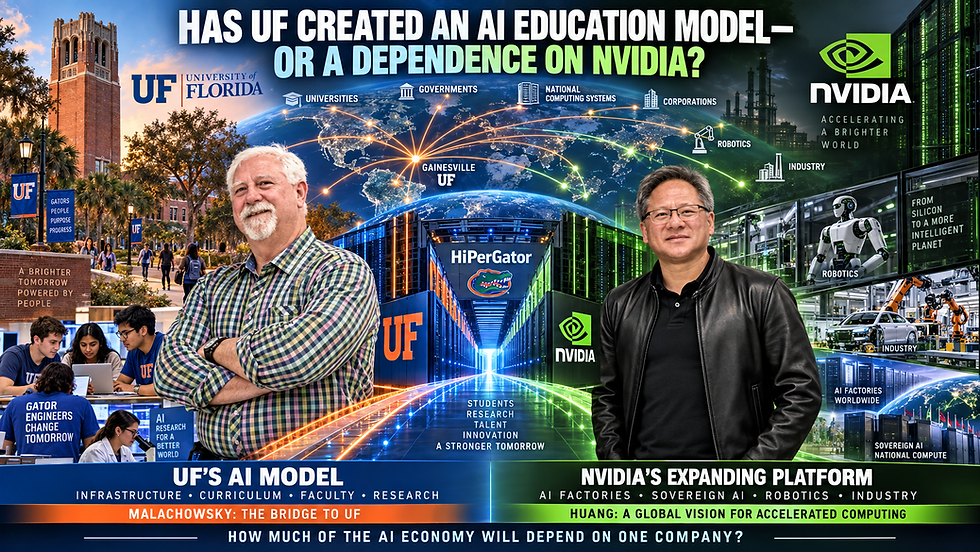
Has UF created an AI education model—or a dependence on NVIDIA?
UF’s experience demonstrates what a university can accomplish when it connects advanced computing infrastructure to curriculum, faculty recruitment and research.
But its success introduces another question: How much of the model now depends on NVIDIA?
HiPerGator relies extensively on NVIDIA processors, computing systems, networking and software. Maintaining a leading position will require continuing upgrades as NVIDIA introduces new chip architectures and AI applications demand more computing power.
That does not make the partnership inappropriate. It means the relationship should be understood as more than a philanthropic success story.
Malachowsky helped bring NVIDIA’s technology to one university. Huang now presents similar computing infrastructure as essential to companies, governments and entire countries. His priorities include American AI leadership, “AI factories,” sovereign national computing systems, robotics and the expansion of accelerated computing into nearly every industry.
UF provides a local example of that much larger vision.
The university turned a technology gift into a broad educational and research strategy. NVIDIA gained a prominent demonstration of what institutions can build around its technology.
The next question extends far beyond Gainesville: If universities, technology companies and governments increasingly depend on the same computing platform, how much of the AI economy will depend on one company?
Next in the series: NVIDIA Built the Infrastructure Behind the AI Boom. How Much Depends on One Company?