
John Hawley
Jul 1, 2026
Public Money Pipeline: Following Jacksonville Taxpayer Dollars
Jacksonville government moves hundreds of millions of taxpayer dollars each year through contracts, grants, development incentives, nonprofit funding, public-private partnerships and other spending programs. Public Money Pipeline follows that money beyond the headline number.
Each installment examines a different piece of the funding network: who receives public money, how the recipient was selected, what taxpayers are purchasing, who made the decision, and what measurable results are expected in return. The series also looks at the relationships among government agencies, elected officials, contractors, developers and nonprofit organizations when those connections are relevant to understanding how public dollars move.
The goal is not to assume that public spending is good or bad simply because of its size. A large contract may deliver substantial public value, while a relatively small expenditure can raise important questions about procurement, oversight or accountability. The documents, contracts, votes and results provide the context.
Below you'll find each investigation in the Public Money Pipeline series. Follow the articles individually—or follow the pipeline from one decision to the next—to see a broader picture of how Jacksonville taxpayer dollars move from appropriation to recipient to outcome.
The Public Money Pipeline: Part XIV
Tony Moore Named Jax Riverfront Alliance CEO: Dallas Lessons for Jacksonville
JRA’s first permanent CEO brings experience leading major public spaces—and a Dallas record that includes community concerns about neighborhood benefits and participation. We examine Moore’s background, his response to those concerns and what Jacksonville should expect from its publicly supported riverfront partner.

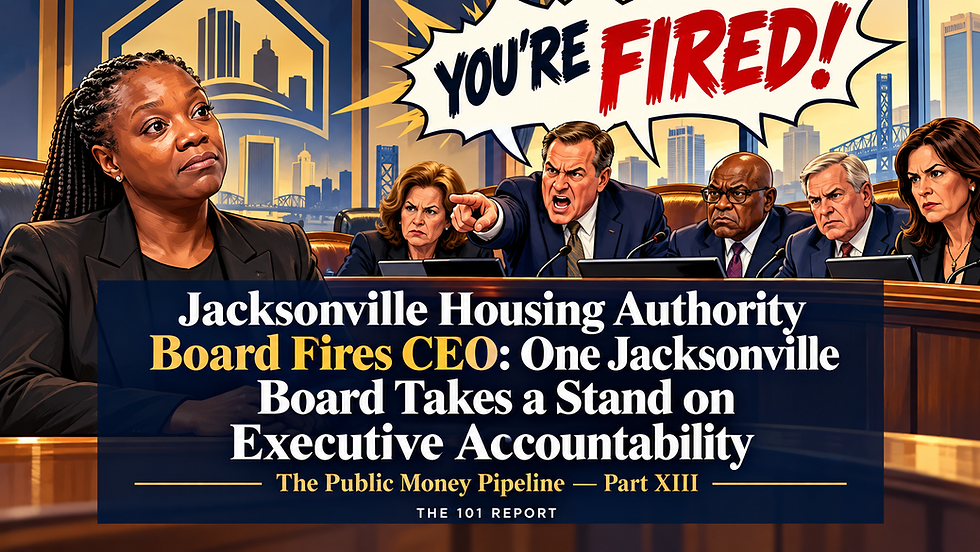
The Public Money Pipeline: Part XIII
Jacksonville Housing Authority Board Fires CEO: One Jacksonville Board Takes a Stand on Executive Accountability
JHA’s board rejected a developer-fee compensation proposal and then unanimously removed CEO Cheron Corbett Waller. This installment examines the board’s stated concerns, Waller’s attorney’s response, potential separation costs and the responsibility to turn a leadership change into measurable improvements.
The Public Money Pipeline XII
Jacksonville Housing Authority Board to Review CEO’s Future After Developer-Fee Pay Proposal
A rejected compensation proposal brought JHA’s executive oversight into focus ahead of a special board meeting. This installment examines the potential developer-fee payments, earlier operational concerns and what tenants and taxpayers should expect from a public review of the CEO’s performance and continued employment.

Public Money Pipeline XI
Jacksonville Housing CEO Sought 12% of Developer Fees: How Should Public Housing Executives Be Paid?
A proposed executive incentive raises questions about how housing-development revenue should serve the agency’s mission. We examine the rejected compensation formula, comparisons with other housing authorities and the independent review needed before public boards approve transaction-linked rewards.

Public Money Pipeline X
Jacksonville Finalizes Riverfront Alliance Agreement at Reduced Cost
Jacksonville’s finalized agreement moves JRA into its publicly funded startup phase with a smaller direct allocation than originally proposed. We examine the funding, advance-payment provisions and initial division of responsibilities between the nonprofit and the city’s parks department.

Public Money Pipeline IX
Who Gets Jacksonville’s $27.3 Million in Afterschool Funding?
Two major providers account for nearly two-thirds of KHA’s proposed afterschool and summer renewal funding. This installment compares allocations, planned capacity and service costs while asking what attendance records and outcome measures taxpayers need to evaluate results.

Public Money Pipeline VIII:
What Does Jacksonville Get for Its Boys & Girls Clubs Funding?
Public funding supports afterschool and summer services across Jacksonville, but contract totals alone cannot show their value. We examine the Boys & Girls Clubs funding relationship and the participation, service and performance information needed to understand what taxpayers purchase.

Public Money Pipeline VII: Understanding the Kids Hope Alliance
Inside Jacksonville’s $67 Million Kids Hope Alliance Network
Kids Hope Alliance connects city funding with dozens of organizations delivering children’s services. This installment explains the agency’s structure, funding categories and provider relationships—and asks how residents can follow awards, selection decisions and measurable results.

The Public Money Pipeline Part VI
Jacksonville Riverfront Alliance: From Volunteer Conservancy to a Professionalized Public-Private Partner
An existing nonprofit is becoming a professionally staffed organization with a growing role in Jacksonville’s public parks. We trace JRA’s organizational history, recruitment plans and public support, examining what stronger staffing and broader responsibilities should require in transparency and oversight.

The Public Money Pipeline Part V
Jacksonville’s JSEB Program: How Small Businesses Get City Contracts—and Who Actually Gets the Work
Jacksonville’s Small and Emerging Business program aims to help qualified companies compete for government work. We examine how the program operates, the barriers smaller firms face and why certification and participation goals should be evaluated alongside actual contracting opportunities.

The Public Money Pipeline Part IV
Rise of Liberty Landscape Supply: From Small Business to Jacksonville Power Player
Mike Zaffaroni’s business growth intersects with government contracting and influential civic organizations. This installment follows Liberty Landscape Supply’s development and examines why overlapping business and public-service roles make competition, disclosure and clear safeguards important.

The Public Money Pipeline Part III
When the Regulators and Developers Share the Same Table
Linzee Ott’s roles across government, development advocacy and the Riverfront Alliance reveal a closely connected downtown network. We examine those institutional overlaps, documented recusals and the safeguards needed to preserve independent oversight and access for businesses outside the network.

The Public Money Pipeline Part II
Jacksonville’s Nonprofit Government
Millions in public funding flow through private organizations delivering services across Jacksonville. This installment examines competitive grants, direct agreements and arrangements that pass money onward, asking whether transparency and accountability follow each taxpayer dollar through the system.

The Public Money Pipeline Part I
No Bid, Then What? The Riverfront Alliance and Jacksonville’s Bigger Procurement Question
Jacksonville directly selected a nonprofit partner for its riverfront parks, but what happens when that organization hires private companies? The opening installment examines procurement waivers, potential business overlaps and whether taxpayer protections extend beyond the city’s initial agreement.
