
John Hawley
Sep 6, 2026
Mike Zaffaroni and the Public Money Pipeline: Part IV
Mike Zaffaroni transformed a tiny Nassau County landscape-supply business into a regional company and major government contractor. Along the way, his presence expanded across institutions that influence Jacksonville business policy, public contracting and public-private development—from the JAX Chamber and JSEB to the Jacksonville Riverfront Alliance.
When The 101 Report began examining Jacksonville's new public-private partnership for its Downtown riverfront parks, one business owner kept appearing at different points in the public-money pipeline.
Mike Zaffaroni.
Zaffaroni is vice chairman of the Jacksonville Riverfront Alliance, the nonprofit organization being developed to help operate, program and eventually maintain portions of Jacksonville's growing Downtown riverfront park system. JRA says it is now scaling up its organization and systems to assume full operational responsibility for several park assets beginning in 2027.
But JRA turned out to be only one part of the story. Zaffaroni also chairs the City of Jacksonville's Small and Emerging Business Monitoring Committee. He serves as Government Affairs chair for the JAX Chamber. He has participated in Jacksonville Tree Commission proceedings. And his company performs public landscape work through City contracts and other governmental entities. Meanwhile, Liberty Landscape Supply isn't simply a garden center anymore. The company Zaffaroni purchased in 2007 with two workers now employs more than 170 people across six locations, according to JRA's current biography of him.
And in July 2025, the City awarded Fernandina Mulch & Stone LLC, doing business as Liberty Landscape Supply, a new countywide tree procurement, planting and miscellaneous landscaping contract carrying a $14.5 million annual not-to-exceed amount and $29 million total ceiling for its initial two-year term, with two potential two-year renewals. Those figures represent contracting capacity—not money guaranteed or already paid to Liberty.
What began as a tiny mulch-and-stone business has become a vertically integrated regional landscape company capable of sourcing, transporting, installing, irrigating and maintaining landscapes while competing for substantial government work. At the same time, its owner has become increasingly involved in the organizations and government bodies surrounding that work.
Those two trajectories—the growth of the business and the growth of Zaffaroni's institutional reach—are the reason this story is part of The Public Money Pipeline.
Mike Zaffaroni's Business and Jacksonville Government Timeline
The individual events become more significant when viewed together.
-2007 — Zaffaroni buys Fernandina Mulch & Stone. After working in pharmaceutical sales, Zaffaroni purchased the small Nassau County landscape-supply company. Contemporary accounts say the business had only two workers. It primarily sold mulch and stone and didn't sell trees.
-2009-2016 — Zaffaroni expands into other businesses. His entrepreneurial experience wasn't limited to landscaping. He acquired an independent sign operation that became a FASTSIGNS franchise and also experimented with the used-car business before eventually concentrating his efforts on landscaping.
-2015-2016 — Fernandina Mulch & Stone becomes Liberty Landscape Supply. The Florida SBDC dates the name change to late 2015, while later Chamber material describes the transition as 2016. Either way, the rebranding marked the transformation from a basic materials supplier toward the broader Liberty business model.
-2016 — Zaffaroni becomes a JAX Chamber Trustee. His involvement in Jacksonville's business infrastructure begins expanding alongside the company.
-2017 — Liberty opens its North Main Street Jacksonville location. The company adds products and services including landscape installation, design and irrigation. The new operation reportedly became profitable within several months.
-2018 — Liberty reaches roughly three dozen employees. Trees and plants now represent nearly half the company's revenue. Zaffaroni is named JAX Chamber Small Business Leader of the Year and Florida Small Business Person of the Year.
-2019 — Liberty acquires Trad's Garden Center on San Jose Boulevard. The established five-acre Jacksonville operation becomes Liberty's third location. Zaffaroni had first approached Trad's about a possible acquisition in 2017.
-2019 — City contracting and business expansion converge. Zaffaroni later said Liberty had just signed a large City of Jacksonville contract when the Trad's acquisition opportunity arrived. The timing wasn't ideal, but he proceeded with the purchase.
-2022 — City Council appoints Zaffaroni to the JSEB Monitoring Committee. Council approved his appointment December 13, 2022, as the committee's Trade Association Representative. His first full term was scheduled through April 30, 2026.
-2023 — Liberty expands into St. Johns County. Its St. Augustine operation brings the company's retail footprint farther south. The company expected the expansion to add approximately 20 employees to a workforce already around 100.
-2023 — Former Liberty executive Kelli O'Leary becomes Jacksonville Deputy Chief Administrative Officer. O'Leary moves from Liberty into a senior position in Mayor Donna Deegan's administration.
-2024-2025 — Liberty's public contracting footprint continues expanding.
-February 2025 — City Council authorizes a direct Liberty contract. Council approved $25,750 for landscape and irrigation work at the Spring Park/Spring Glen roundabout while invoking a City procurement-code exemption from competitive solicitation.
-July 2025 — Liberty wins the new countywide tree and landscaping contract vehicle. The two-year initial contract carries a $29,002,567.58 total not-to-exceed ceiling.
-July 2025 — Liberty begins RiversEdge park-maintenance work through The District CDD.
-By August 2025 — Zaffaroni is publicly identified as Jacksonville Riverfront Alliance vice chairman.
-September 2025 — City records identify Zaffaroni as JSEB Monitoring Committee chair followed by Linzee Ott being announced as JRA's first employee and interim director.
-Late 2025 — Liberty enters a separate RiversEdge streetscape-maintenance agreement.
-2026 — JRA moves from concept toward operations. The City approves a taxpayer-supported operating agreement with JRA, while JRA begins hiring professional staff and says it expects to assume full operational responsibility for several riverfront park assets beginning in 2027.
-August 2026 — Zaffaroni buys into Tallahassee Nurseries. He acquires Nate Prosser's ownership interest in one of Florida's oldest independent garden centers; longtime co-owner Paul Brock remains involved.
Liberty's commercial expansion, government contracting and Zaffaroni's involvement in Jacksonville's civic and governmental infrastructure increasingly developed alongside one another.

Who Is Mike Zaffaroni?
Zaffaroni didn't come from the landscape industry.
A Florida State University graduate, he worked in pharmaceutical sales before purchasing Fernandina Mulch & Stone in 2007 at age 27. The operation was tiny. Contemporary accounts describe one full-time and one part-time employee, or simply two workers. The company primarily sold mulch and stone. Zaffaroni acknowledged having no professional landscape-industry experience. He also wasn't yet committed exclusively to landscaping.
Zaffaroni acquired an independent Fernandina Beach sign business and converted it into a FASTSIGNS franchise. He later sold that operation at a profit. He also tried the used-car business. That investment didn't work, and Zaffaroni later described that period as one of the most difficult financial points of his career.
The successes and failures matter because they help explain what came next. Zaffaroni was learning acquisition, staffing, systems, financing and expansion. Eventually, he concentrated increasingly on landscaping. And that became the business that took off.
How Fernandina Mulch & Stone Became Liberty Landscape Supply
The company Zaffaroni bought didn't initially sell trees. He changed that. By 2018, plants and trees represented nearly 48% of Liberty's revenue. The company carried roughly 2,000 products and its workforce had grown past three dozen employees.
Zaffaroni also opened a farm in Hilliard. At the time, he described it as growing smaller plants the company otherwise would purchase from suppliers. But the larger transformation went well beyond adding plant material. Liberty moved into landscape design and installation, irrigation, maintenance, delivery and commercial landscaping. Its current operations now span multiple retail and commercial locations and more than 170 employees. Zaffaroni had begun building something considerably different from the business he bought.
The Trad's Garden Center Acquisition Accelerated Liberty's Jacksonville Expansion
The acquisition of Trad's Garden Center provides one of the clearest examples of Zaffaroni's growth strategy.
The Trad family had operated its Jacksonville garden center since 1971. In 2017, Zaffaroni approached the owner and expressed interest in buying the business if the family ever decided to sell. Two years later, the opportunity arrived.
Liberty completed the acquisition in November 2019, adding the roughly five-acre San Jose Boulevard operation as its third location. This wasn't simply another piece of land. Trad's came with an established location, existing customers, employees, infrastructure and decades of community recognition.
Liberty initially operated it as Liberty Landscape Supply at Trad's, preserving some of that goodwill while integrating the business into the larger Liberty operation.
According to Garden Center, Liberty subsequently expanded staffing at the location from approximately six employees to about 30 and increased the dollar value of inventory roughly fivefold. That tells us something about how Zaffaroni approaches acquisitions. He doesn't simply buy locations. He uses existing businesses as platforms for additional scale.

A Jacksonville City Contract and the Trad's Acquisition Converged in 2019
One detail from the Trad's transaction is particularly relevant to The Public Money Pipeline.
When the acquisition opportunity finally materialized, Zaffaroni said Liberty had just signed a large contract with the City of Jacksonville. The additional workload made the timing challenging. He bought Trad's anyway.
That gives us an important historical marker. By 2019, Liberty's physical expansion and its government contracting business were already advancing simultaneously. The company was no longer growing simply as a neighborhood landscape supplier. It was expanding its physical capacity while simultaneously becoming more involved in public contracting.
Liberty Landscape Supply Becomes a Vertically Integrated Landscape Company
The most important transformation may not be the number of Liberty locations. It's how much of a landscape project the company can now handle. Liberty can source plant material. It maintains substantial inventory.
It sells landscape materials. It transports them. It designs landscapes. It installs them. It installs irrigation. And it maintains completed landscapes.
Liberty publicly says it uses its own employees for most installation projects and turns to subcontractors when specialized work is needed. For customers, that can create efficiency and accountability. For Liberty, it also means a larger portion of a project's economic value can potentially remain within the company rather than being distributed among numerous subcontractors and suppliers. That becomes especially important when Liberty's participation in Jacksonville's small-business program enters the picture.
Mike Zaffaroni Moves Deeper Into Jacksonville's Business and Policy Network
While Liberty expanded, Zaffaroni became increasingly involved in Jacksonville's business institutions.
He became a JAX Chamber Trustee in 2016 and now serves as Government Affairs chair.
He also participated in City Tree Commission discussions years before the Deegan administration.
Those proceedings demonstrate why government seeks industry participation.
A landscape contractor understands plant availability, specifications, installation costs, irrigation requirements and warranties differently from someone reading an ordinance or procurement document.
That expertise has public value. But it also gives the participant something valuable: familiarity with the government system affecting his industry. Successful government contractors learn specifications, insurance requirements, purchasing rules, warranties, appropriations, bid protests, small-business programs and purchase-order systems. They learn where policy is discussed. They learn how decisions move through government. And they learn how to advocate for their industry. That's normal business development.
It also becomes increasingly important when the same person moves from participating in government discussions to helping monitor government procurement policy.
Jacksonville Appoints Zaffaroni to the JSEB Monitoring Committee
On December 13, 2022, City Council appointed Zaffaroni to Jacksonville's Small and Emerging Business Monitoring Committee. He wasn't appointed to one of the designated JSEB Contractor seats. His category was Trade Association Representative. At his first documented committee meeting in February 2023, Zaffaroni described himself as a prime contractor that had JSEB businesses working for or with his company and said he joined the committee because of his support for the small-business community.
Today the City's JSEB website lists him as chairman. And Liberty itself participates in the JSEB program.
That creates an unusual intersection. Zaffaroni isn't merely a business owner affected by Jacksonville's small-business procurement system. He chairs a committee charged with monitoring that system while his company participates in it. The committee doesn't award Liberty individual City contracts. But it discusses the architecture through which small businesses gain access to government work—including participation goals, procurement barriers and the unbundling of larger contracts. That deserves its own examination. And it will get one in the next installment of The Public Money Pipeline.

Liberty Wins a $29 Million Jacksonville Tree and Landscaping Contract Vehicle
Meanwhile, Liberty's City contracting continued expanding. On July 17, 2025, Jacksonville's Procurement Awards Committee approved ITB-16586-25 for Countywide Tree Procurement, Planting & Miscellaneous Landscaping.
The procurement record identifies two bidders.
Allstar Irrigation Company was rejected.
Liberty received the award.
The contract provides:
$14,501,283.79 annual not-to-exceed authority
and
$29,002,567.58 total not-to-exceed authority during the initial two-year term.
It also contains two potential two-year renewal options. Those amounts are ceilings, not guaranteed revenue.
But they demonstrate Liberty's position within Jacksonville's landscape market. A company Zaffaroni acquired with two workers had become capable of operating through a City contract vehicle measured in tens of millions of dollars.
Jacksonville's Umbrella Contracts Change How Individual Projects Flow
The $29 million figure also requires understanding how government contracting works.
Jacksonville doesn't necessarily conduct a new competitive solicitation every time it wants trees installed along a road, in a median or at another public site.
The City can establish a larger competitively procured contract and then issue individual assignments or purchase orders under that contract according to its terms. That means competition can occur upstream, when the umbrella contract is awarded. Individual projects can then flow through the established contracting lane without being separately rebid each time. That distinction becomes particularly important when we reach the riverfront. Because the relevant question isn't necessarily whether JRA someday advertises a landscape contract of its own. The work could potentially move through a City procurement vehicle.
Or JRA could procure some services itself. Or the eventual structure could involve some combination of the two. We don't yet know.
Liberty Was Already Working at RiversEdge
Our original interest in Zaffaroni grew out of the Jacksonville Riverfront Alliance. Subsequent reporting uncovered something we didn't know when this series began. Liberty was already performing work at RiversEdge. The company's involvement included substantial irrigation work and later landscape and irrigation maintenance through The District Community Development District. A Liberty landscape-maintenance agreement became effective July 1, 2025. Additional CDD records contain Liberty proposals for Central Park sod, seed and irrigation work. Later in 2025, Liberty entered another agreement covering RiversEdge streetscape maintenance. Then Zaffaroni moved into JRA leadership. By August 2025, he was publicly identified as vice chairman. That sequence matters because the City's plans for JRA went well beyond events and fundraising.
Jacksonville Intended JRA to Eventually Maintain Riverfront Parks
An October 2025 DIA resolution is unusually explicit.
It described JRA as the long-term solution for Downtown park maintenance and programming and said the organization was expected to undertake maintenance, security and programming in April 2026.
The District CDD arrangement at RiversEdge was described as a short-term solution until JRA could assume those responsibilities. JRA wasn't ready by April. The City stepped in. But that wasn't necessarily the end of the plan. It was a capacity problem.
The City's Current Riverfront Maintenance Role Is a Stopgap
By summer 2026, the operating structure had changed.
Parks Director Daryl Joseph told a City Council committee that the original plan had provided approximately $2.6 million with JRA expected to “take over everything.”
Under the revised arrangement, he said, the City would handle facility maintenance while JRA handled programming and fundraising. Viewed alone, that statement might suggest the City permanently abandoned JRA maintenance. Subsequent evidence says otherwise.
JRA is now actively building the staff and systems necessary to take on a larger operational role.
In July, the organization advertised for senior staff and said it was in an “aggressive scaling-up phase” to assume full operational responsibility for several park assets in 2027, beginning with Riverfront Plaza and Riverfront Music Garden. JRA goes further.
It says that at full function the organization will be responsible for maintenance of riverfront parks, programming, venue management and marketing of the riverfront experience. That materially changes how the current arrangement should be understood. City maintenance appears to be a bridge while JRA develops the capacity to assume a broader operational role—not necessarily the final destination.

The Next Riverfront Procurement Question May Still Be Ahead
That brings the story back to Liberty. Liberty was already performing RiversEdge landscape work.
Its owner became JRA vice chairman. The City was developing JRA toward an operating model that included park maintenance. JRA wasn't yet capable of assuming that responsibility. The City stepped in.
And JRA now says it is scaling toward full operational responsibility beginning with several parks in 2027.
That leaves an important question unresolved: How will future riverfront maintenance services actually be procured? Jacksonville already has large umbrella contracts through which individual landscape assignments can flow. Liberty holds one of them.
JRA has also previously used competitive processes for some of its own activities. The eventual system could therefore take several forms. The City might continue procuring landscape services under existing City contracts even as JRA assumes greater responsibility for identifying and managing park needs. JRA might procure contractors directly. Or the City and JRA might divide those responsibilities. The public records we've reviewed don't yet provide a definitive answer. And that distinction matters.
If City procurement controls, the relevant records may be City purchase orders, task assignments or work authorizations—not a separate contract issued by JRA. If JRA selects vendors itself, then its competitive-selection rules, disclosure requirements and conflict safeguards become increasingly important.
Either way, the public should be able to determine who identifies the work, who selects the contractor, what procurement rules apply and where the money goes.
That is the Public Money Pipeline question.
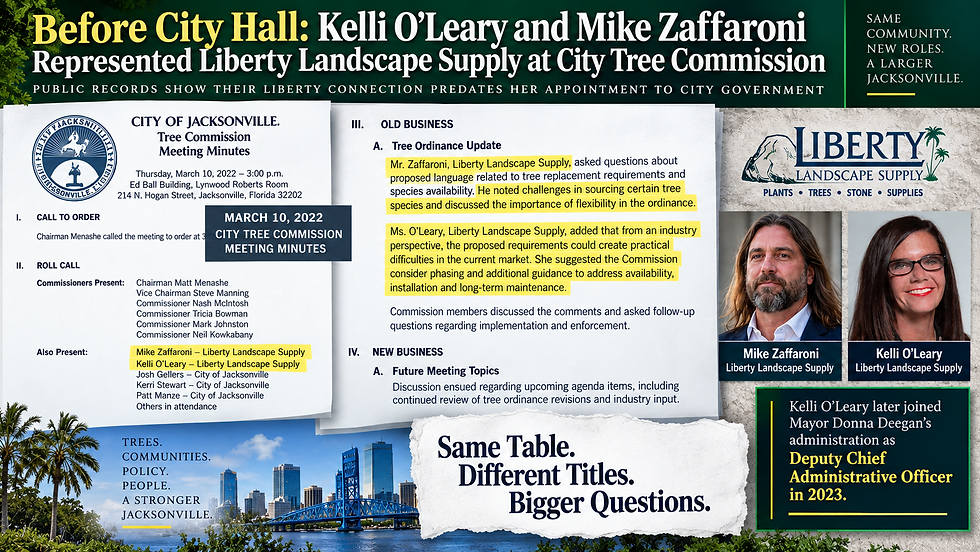
Kelli O'Leary Moved From Liberty Landscape Supply to Senior City Management
Another relationship illustrates how interconnected the company's private and governmental networks have become. Kelli O'Leary, now Deputy Chief Administrative Officer for the City of Jacksonville, previously served in an organizational-development leadership role at Liberty Landscape Supply.
O'Leary joined Mayor Donna Deegan's administration as Deputy Chief Administrative Officer in 2023, a senior executive position she continues to hold. Leadership Florida documented the appointment that August, and subsequent City records continue to identify her in the role. Her Liberty connection predates that appointment. O'Leary and Zaffaroni appeared in City Tree Commission proceedings as Liberty representatives before she entered City government.
That chronology matters because O'Leary moved from a management role inside a growing City contractor to a senior management position inside the government with which Liberty does business. That alone doesn't establish that she influenced a Liberty procurement. But it is relevant to understanding the network surrounding the company.
Former private-sector executives routinely enter government, and government can benefit substantially from people who understand business operations. The relevant public-interest question is whether government maintains clear processes and sufficient institutional separation when former executives, current contractors and policymaking bodies increasingly occupy the same network.
Tallahassee Nurseries Continues Zaffaroni's Acquisition Strategy
Liberty's expansion hasn't stopped.
In August 2026, Zaffaroni acquired Nate Prosser's ownership interest in Tallahassee Nurseries, one of Florida's oldest independent garden centers. Longtime co-owner Paul Brock remains an owner. The transaction looks familiar when placed beside Trad's. Zaffaroni didn't have to create a nursery from bare ground. He entered an established operation with inventory, employees, horticultural expertise, customers and supplier relationships. That's consistent with a strategy visible throughout his career.
He bought Fernandina Mulch & Stone and transformed it.
He acquired an independent sign business and converted it into FASTSIGNS.
He acquired Trad's Garden Center and dramatically expanded its operation.
Now he has bought into Tallahassee Nurseries.
Sometimes Zaffaroni builds.
Sometimes he buys.
And frequently, he expands what he buys.
Liberty's Growth and Jacksonville Government: The Parallel Timeline
By 2007, there was a tiny mulch-and-stone company.
By 2017, Liberty had entered Jacksonville with a second location.
By 2019, it was simultaneously acquiring Trad's and expanding its City contracting.
By 2022, Zaffaroni was appointed to a City committee monitoring small-business procurement.
By 2023, a former Liberty organizational-development executive had moved into senior City management.
By 2025, Liberty held a City tree and landscaping contract with a $29 million initial-term ceiling, was performing RiversEdge work, and Zaffaroni was becoming JRA vice chairman and JSEB committee chair.
By 2026, JRA had received a taxpayer-supported operating agreement with the City, Zaffaroni had expanded his horticultural interests farther across North Florida, and JRA was building toward full operational responsibility for riverfront parks beginning in 2027.
None of those facts by itself tells the story.
The timeline does.
The company became larger.
Its government work became larger.
Zaffaroni's civic roles became more significant.
And the distance between those worlds became progressively smaller.
Business Expertise Can Improve Jacksonville Government
There is another side of this story that shouldn't be ignored. Zaffaroni appears to have become very good at understanding the institutions surrounding his business.
Entrepreneurs are encouraged to do exactly that.
Join business organizations.
Understand government procurement.
Attend public meetings.
Learn regulations.
Build professional relationships.
Serve on boards.
Understand the political environment affecting your industry.
Become involved in the community.
Government benefits from that participation too.
Someone who employs 170 people, purchases equipment, manages inventory, negotiates with suppliers and executes large landscape projects can identify practical problems in government specifications that policymakers may never see. Someone who actually has to locate hundreds of trees understands plant availability differently than someone reading a procurement spreadsheet. Someone responsible for warrantying landscapes understands irrigation and maintenance requirements differently than someone writing them.
Government needs that expertise.
The issue isn't whether successful businesspeople should participate. The harder question is how government preserves competition and independence once they do.
When Business Expertise Becomes Institutional Influence
That is the common thread running through the rise of Liberty Landscape Supply.
It isn't one contract.
It isn't one board appointment.
It isn't one City official.
It isn't one political relationship.
It's the accumulation.
Over nearly two decades, Liberty's commercial footprint expanded while Zaffaroni's civic and governmental footprint expanded alongside it. Today those worlds intersect across City procurement, JSEB, Tree Commission discussions, economic-development policy, JAX Chamber government affairs, RiversEdge and the Jacksonville Riverfront Alliance.
Some of those relationships helped Zaffaroni understand government better.
Some allowed him to contribute expertise government needed.
Some expanded his professional network.
And some place him in positions where public policy, public spending and his private industry intersect.
That doesn't establish misconduct.
It establishes institutional reach.
And access has economic value.
The appropriate response isn't to exclude successful businesspeople from public service. It's to make sure the table remains large enough for everyone else. Jacksonville has landscape contractors, nurseries, subcontractors, engineers, architects, suppliers and other small businesses whose owners don't chair government committees or major business-advocacy organizations. They may not know the people in the room. They may not know when an opportunity is first being discussed. But public institutions have an obligation to ensure they can compete on the merits too. That is why the rise of Liberty Landscape Supply belongs in The Public Money Pipeline. It provides an unusually clear case study in how entrepreneurial success can evolve into civic influence—and how civic influence can place a successful business owner increasingly close to the governmental systems through which public opportunities flow. Business expertise can serve the public interest. But business interests and the public interest are not automatically the same thing. Government's job is to maintain the distinction.
The Public Money Pipeline Part IV

The Public Money Pipeline Part III

The Public Money Pipeline Part II

The Public Money Pipeline Part I
