
John Hawley
Aug 22, 2026
Jacksonville’s Development Divide: Part 4 - The 101 Report
.
Jacksonville has not approved the nearly $50 million incentive package proposed for Gateway Jax’s Publix-anchored Pearl Square development.
The proposal remains in committee, and City Council still has questions to answer.
The Neighborhoods committee deferred Ordinance 2026-541 on August 17. The Finance Committee deferred it again August 19. The City's legislative record lists August 31 as the ordinance's next agenda date. Track Ordinance 2026-541
As those deliberations continue, Gateway CEO Bryan Moll has made an important argument: the project cannot move forward without public incentives. Action News Jax reported Moll's position while examining the project's financial assumptions.
That statement deserves more scrutiny than it has received.
On one hand, it strengthens Gateway's case for public assistance. If Jacksonville wants a Publix-anchored residential development downtown and the private economics won't support it, government participation could close the gap.
But the argument cuts both ways.
An eleventh-hour assertion that a highly anticipated project cannot proceed without substantial public assistance can put significant pressure on policymakers. Critics could view that negotiating dynamic as coercive: approve the assistance or risk losing a project already publicly promoted as transformative.
There is another interpretation that matters even more.

If the project truly isn't financially viable without tens of millions of taxpayer dollars, what does that tell us about the project's underlying economics?
That question should trigger greater scrutiny from City Council, DIA and taxpayer watchdogs—not less.
What Jacksonville Is Considering
Jacksonville isn't proposing to give Publix $50 million to open a grocery store.
Gateway plans a larger mixed-use development at 119 W. Beaver Street with approximately 259 apartments and 37,000 square feet of ground-floor retail, including a Publix or another approved major grocer.
The pending ordinance includes a 75%, 17-year REV grant of up to $21.412 million and a $28.25 million completion grant.
Total potential incentives:$49.662 million.
The completion grant would require subsequent City appropriations and payment after the project meets specified requirements. Council hasn't approved the package. That means Jacksonville still has an opportunity to examine the risk before assuming it.
The Public Hears the Headline. The Models Tell a Different Story.
When DIA advances an incentive package, the public usually hears a straightforward message.
The developer will invest a certain amount. Jacksonville will contribute another amount. The project will produce apartments, businesses, amenities and taxable value. What receives far less attention is the financial modeling underneath the recommendation.
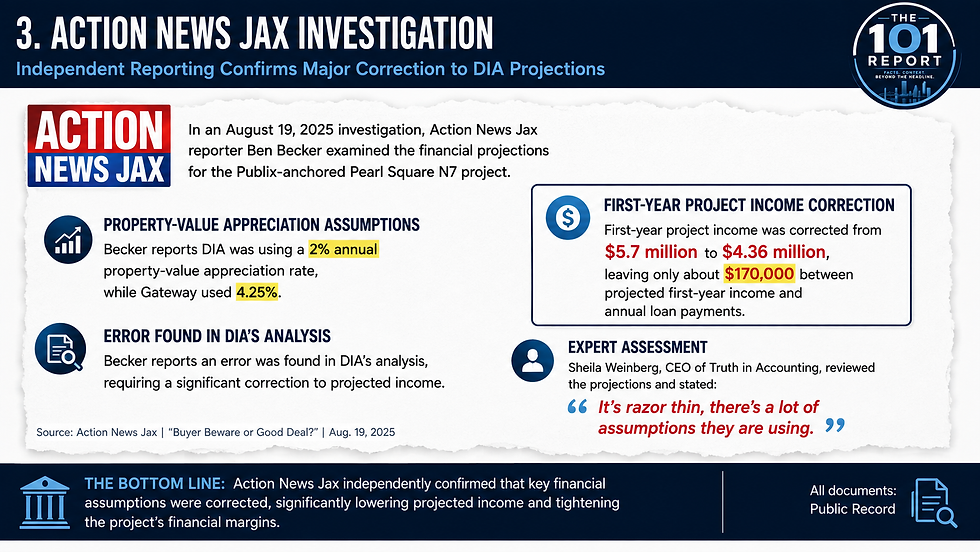
Those models don't predict one guaranteed future. They calculate different possible outcomes based on assumptions. The Pearl Square models illustrate that uncertainty. One scenario uses approximately: 2% annual property-value growth. Another uses: 4.25% annual growth. Under the higher-growth scenario we reviewed, projected 30-year ad-valorem taxes reach approximately $58.5 million. Under the more conservative 2% scenario, they fall to approximately $40.3 million.
That's roughly an: $18 million difference.
Same property. Same development. Same Publix. Different assumptions. Different outcome. There's nothing unusual about that. That's how financial forecasting works. But taxpayers should see the range—not simply the most attractive projection.

A Model Can Predict. It Can't Perform.
A spreadsheet can assume high occupancy.
It can't fill an apartment.
It can project rents.
It can't make tenants pay them.
It can forecast increasing property values.
It can't make property appreciate.
And it can calculate future tax collections.
It can't guarantee Jacksonville will receive them.
Private developers, lenders and investors understand those risks.
When Jacksonville participates financially, taxpayers gain exposure to the same underlying business venture.
That makes the assumptions important.
An Independent Review Questioned the Models
Action News Jax investigative reporter Ben Becker examined the financial projections behind the Gateway proposal and asked Sheila Weinberg, CEO of government-finance watchdog Truth in Accounting, to review them.
Her assessment was direct:
“It’s razor thin, there’s a lot of assumptions they are using.”
Action News Jax also reported that DIA originally projected approximately $5.7 million in first-year project income.
DIA subsequently corrected that figure to approximately:
$4.36 million.
According to Action News Jax, the revised projection left only about $170,000 between anticipated first-year income and expected annual loan payments.
That doesn't prove the project will fail.
It demonstrates how quickly the financial picture can change when an input changes.
Read Ben Becker's Action News Jax investigation
What Happens If the Optimistic Scenario Doesn't Happen?
That's the question Jacksonville should emphasize.
Economic-development announcements naturally focus on what a project will generate.
But the models themselves recognize uncertainty.
What happens if rents miss projections?
What happens if occupancy falls short?
What happens if property appreciation averages 2% rather than 4.25%?
What happens if financing costs rise?
And most importantly:
What happens to the public investment when those assumptions miss?
Those aren't pessimistic questions.
They're investment questions.
Private investors ask them before putting their own capital at risk.
Government should ask them before putting taxpayers' capital at risk.
Rents and Occupancy Matter
Gateway isn't simply building a grocery store. The project includes hundreds of apartments that need tenants willing to pay rents sufficient to support the project's economics. Pearl Square as a whole envisions a major new residential neighborhood. That could transform downtown. But success depends on actual demand. Downtown could absorb the new apartments quickly. Rents could exceed projections.
Or leasing could take longer. Developers could offer concessions. Additional apartment projects could compete for the same tenants. Rent growth could slow. Nobody can guarantee the outcome. That's why the models contain assumptions in the first place.
Weinberg Raised Another Important Question
Weinberg also questioned how much future appreciation Jacksonville should credit to this particular project.
Downtown isn't standing still. Gateway is already developing other parts of Pearl Square. Jacksonville is investing in parks and infrastructure. Other developers are building residential projects. The stadium transformation is coming.
If surrounding property values rise substantially, what caused the increase? Publix? Gateway's other developments? The stadium? Public infrastructure? Other private investment? Or appreciation that would have occurred anyway? That matters because Jacksonville shouldn't automatically credit every future dollar of downtown property appreciation to the particular subsidy it considers today.
“It Won’t Happen Without the Incentive” Should Start the Analysis
Gateway's argument that the project needs public participation shouldn't end the discussion. It should begin it. If the project needs $10 million, why? If it needs $28 million, why? If total potential public participation approaches $50 million, what prevents private capital from filling more of the gap?
And what does Jacksonville receive for assuming a risk private investors won't assume alone? Sometimes government has a compelling answer. A project can create benefits the developer can't capture directly—additional taxable value, neighborhood revitalization, infrastructure and catalytic economic activity.
That's why economic-development incentives exist.
But saying a project needs public money doesn't establish that taxpayers should provide it. It establishes that the project has a financing gap taxpayers are being asked to close.

Downtown Skeptics Hear the Same Argument Differently
Downtown advocates see public incentives as investments in rebuilding Jacksonville's core.
Their argument has merit.
Jacksonville has struggled for decades to create enough residents, retail and amenities to build a self-sustaining downtown. From that perspective, Publix could become a critical neighborhood anchor.
Invest now, create critical mass, and private investment eventually takes over.
But many Jacksonville taxpayers remain skeptical after decades of redevelopment plans, persistent homelessness and street-level problems, vacant properties and repeated public investments followed by requests for more.
For those taxpayers, Gateway's viability argument raises the opposite question:
If one of downtown's largest developers says this project needs tens of millions in public assistance, does that show the private market still can't support this level of downtown development on its own?
Both sides start with essentially the same fact:
The project requires substantial public participation to proceed as proposed.
They disagree about what Jacksonville should do about it.
When Is Downtown Supposed to Stand on Its Own?
Businesses throughout Jacksonville face market risk. Restaurants need customers. Retailers need sales.
Apartment developers need tenants. Investors decide whether expected returns justify the risk. Some developments outside downtown also receive public incentives and infrastructure support, so the comparison isn't absolute.
But downtown increasingly relies on a model in which public incentives help create apartments, those apartments support retail, retail attracts additional residents, and increasing density eventually attracts more private investment. That strategy can work. But if each new project requires another substantial public contribution before its economics work, taxpayers should ask:
When is downtown supposed to stand on its own?
Successful subsidies should eventually create a market that requires fewer subsidies.
Otherwise, Jacksonville risks underwriting not merely individual developments but the market necessary to sustain them.
The Public Should See Both Sides of the Spreadsheet
DIA professionals understand financial uncertainty. Developers understand it. Lenders understand it. Investors understand it. That's why models contain multiple assumptions and scenarios. The public deserves the same view.
For major incentive packages, Jacksonville should present a simple risk summary showing the total public exposure; primary and conservative projected returns; major assumptions involving rents, occupancy and appreciation; what happens if those assumptions miss; and which risks remain with the developer versus taxpayers. That isn't anti-development. It's the information any serious investor would demand before committing capital.
This Isn't a Prediction That Pearl Square Will Fail
Pearl Square could become one of Jacksonville's greatest redevelopment successes. Publix could strengthen downtown residential life. Apartments could lease quickly. Property values could outperform even the more optimistic model. Jacksonville could receive substantially more economic benefit than the incentives cost. That's one possible outcome. The financial models acknowledge others. That's the point. No business venture comes with a guarantee.
When public money helps make a private deal viable, taxpayers become participants in that uncertainty.
Jacksonville may decide that risk serves a larger public purpose. But it should understand the downside before making the commitment.
The Question Before Council
Ordinance 2026-541 remains in committee, with another consideration scheduled for August 31.
That gives Jacksonville another opportunity to ask the questions that matter:
Why does the project need this much public participation?
What assumptions justify it?
What happens if those assumptions miss?
Who absorbs the downside?
What public return justifies the risk?
The independent review reported by Action News Jax demonstrates why those questions matter. DIA's different financial scenarios demonstrate the uncertainty already built into the projections.
Taxpayers deserve to see both sides of the spreadsheet before Jacksonville commits tens of millions more.
Not simply what happens when everything goes according to plan.
What happens when it doesn't?
And when the developer says the project cannot proceed without substantial taxpayer participation, that question deserves more scrutiny—not less. Because the ultimate measure of a successful downtown redevelopment strategy shouldn't be how many projects Jacksonville can subsidize. It should be whether those investments eventually create a downtown that no longer needs taxpayers to make the next project viable.
Jacksonville Development Divide: Part V

Jacksonville’s Development Divide: Part 4
Jacksonville’s Development Divide — Part 3

Jacksonville’s Development Divide — Part 2

Jacksonville’s Development Divide — Part 1
