
John Hawley
Jul 21, 2026
Transparency is important.
Politics has always had a revolving door.
Winning campaigns often become the talent pool for the next administration. Campaign managers become chiefs of staff. Communications directors become public affairs leaders. Digital strategists become communications officers. The people who help elect an administration often become the people who help govern it.
There's nothing inherently wrong with that.
Which is exactly why one simple question deserves an answer.
Who is running Mayor Donna Deegan's 2027 reelection campaign?
With less than eight months remaining before Jacksonville's first mayoral election, Mayor Donna Deegan's campaign and affiliated political committee have reportedly raised more than $1.8 million. Yet, unlike many major campaigns at this stage, the campaign has not publicly identified a campaign manager, communications director, digital director, or other senior leadership roles. The identity of those directing one of Jacksonville's best-funded mayoral campaigns is a matter of legitimate public interest.
Why Campaign Leadership Matters
One reason the campaign's leadership matters is that successful political campaigns often become the talent pool for future government leadership.
Phil Perry moved directly from leading communications for Donna Deegan's successful 2023 campaign into the City's top communications position as Chief Communications Officer.
If Mayor Deegan wins a second term, the people managing her campaign today could reasonably be viewed as candidates for influential positions inside City Hall tomorrow.
With millions of dollars being raised and the campaign already operating at full speed, knowing who is directing those efforts isn't simply about campaign strategy—it's about transparency and understanding who may help shape Jacksonville's future communications operation.
A Communications Office Built for the Deegan Administration
Following Mayor Deegan's election, much of the senior communications leadership changed.
Among the key appointments were:
Phil Perry – Chief Communications Officer, after serving as communications director for Deegan's successful 2023 mayoral campaign.
Melissa Ross – Director of Strategic Initiatives and Liaison to the Press, after years as host of WJCT's First Coast Connect, one of Jacksonville's best-known public affairs programs.
Heather Schatz – Deputy Director of Public Affairs and External Events, who also came from WJCT after producing First Coast Connect and other public affairs programming.
Linae Parkinson – Public Communications Officer for Executive Communications, whose public background includes serving as President of the Jacksonville Young Democrats, Florida Democratic Party State Committeewoman, and leadership roles within Democratic political organizations before joining City Hall.
Not everyone in Public Affairs arrived with Mayor Deegan. Veteran City photographer Wes Lester has served multiple administrations and appears to be a longtime career employee. Other communications professionals, including Matt Kingston and Lauren Spencer, provide photography, social media, video, marketing and web support.
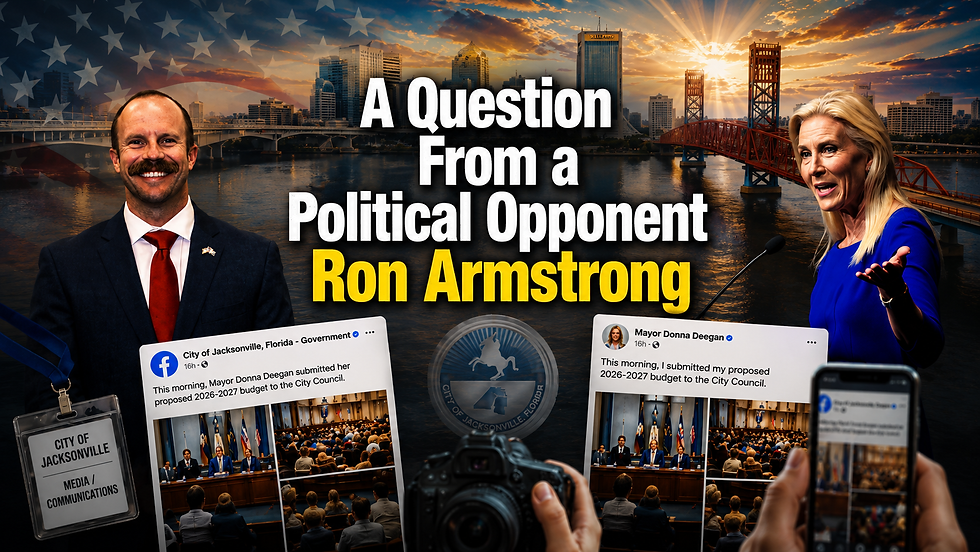
A Question From a Political Opponent Ron Armstrong
That discussion took on new significance this week.
Before Mayor Deegan presented her proposed budget to the Jacksonville City Council, Republican mayoral candidate Ron Armstrong publicly questioned whether the professional photographer documenting many of the Mayor's public appearances is also involved with campaign communications.
Armstrong's comments raise a broader question that deserves consideration:
Where does City Hall end and campaign season begin?
The Budget Photos
Then came the Mayor's budget presentation.
Shortly after the budget address concluded on Monday July 21, a professionally produced collection of photographs appeared on Mayor Deegan's Facebook page.
Almost immediately afterward, the official City of Jacksonville Government Facebook page shared that same post with its audience of more than 104,000 followers.
Our earlier review found the City has repeatedly shared posts originating from the Mayor's Facebook page over the past several months.
What drew attention this time was the editorial presentation of the photographs.
Many of the featured images emphasized applause from the audience, favorable reactions, and prominently included council members generally viewed as supportive of the Mayor's agenda. Reasonable people may see those photographs as straightforward documentation of the event. Others may conclude they were carefully selected because they also function as compelling political imagery images that could easily appear in campaign literature or advertising.
The point isn't which interpretation is correct.
The point is that, during an active reelection campaign, those kinds of editorial choices naturally invite public questions.
Who selected the photographs?
Who wrote the accompanying copy?
Who decided the images should first appear on the Mayor's page?
Who approved their almost immediate distribution through the City's official Facebook page?
If campaign staff handled those decisions, that's one thing.
If City staff handled them, the public naturally wants to understand how official government communications and campaign communications remain appropriately separated.

A Larger Pattern
The budget photographs didn't occur in isolation.
Earlier this month, we reviewed every post published on the official City of Jacksonville Government Facebook page from April through July 12.
Among the observations:
475 total posts
76 featured Mayor Donna Deegan
Approximately one out of every six posts involved the Mayor
Most mayor-related posts were shared directly from the Mayor's own Facebook page
We also found that the Mayor's official social media accounts are listed within the City's official social media directory maintained through the Mayor's Public Affairs Office.
Meanwhile, we were unable to locate a comparable City-operated directory highlighting the social media accounts of Jacksonville's 19 City Council members.
Together they raise reasonable questions about how official government communications are managed during an election cycle and whether the City's communications operation is perceived as exclusively representing the interests of the executive branch.
Florida Has Seen Similar Questions Before
These concerns are not unique to Jacksonville.
Elsewhere in Florida, questions involving government communications and political activity have led to ethics complaints and significant public scrutiny.
In Key West, ethics complaints were filed after critics alleged the City's official social media accounts promoted what they viewed as political campaign activity. City officials disputed those allegations, but the controversy demonstrated how quickly concerns arise when government communication and politics appear to overlap.
In Miami, ethics complaints involving Mayor Francis Suarez likewise examined whether public resources were being used in ways that provided political benefits.
Those cases demonstrate that these issues are taken seriously throughout Florida because the public expects a clear separation between taxpayer-funded government resources and campaign activity.
Transparency Protects Everyone
This article is a call for transparency.
If campaign leadership has already been established, publicly identifying those individuals would eliminate much of the speculation currently surrounding the campaign.
Likewise, explaining how campaign communications and official City communications are separated would benefit everyone involved.
Several straightforward questions remain:
Who is serving as campaign manager?
Who is directing campaign communications?
Who oversees campaign social media?
Who manages campaign photography and visual messaging?
Who decides when posts originating on the Mayor's Facebook page are shared by the official City of Jacksonville Government Facebook page?
Are any City employees participating in campaign activities outside their official duties, and if so, what safeguards ensure those responsibilities remain separate?
Those are questions of governance.
They're the same kinds of questions that have surfaced in communities across Florida whenever the distinction between governing and campaigning becomes less clear.
Mayor Deegan has an opportunity to answer those questions proactively because transparency builds public confidence.
As the 2027 mayoral election approaches, knowing who is behind the scenes shaping the campaign, directing its communications, and potentially becoming tomorrow's leaders inside City Hall is more than political curiosity.
It is a matter of legitimate public interest.
We welcome your thoughts.
Mayors Office Series:
Part I: Who's Really Running Mayor Deegan's 2027 Campaign?
Part 2: Jacksonville City Government Salary Pyramid
Part 3: Executive Staff vs. Jacksonville’s Department Directors Pay
Part 4: What Are Taxpayers Getting for the Money?