
John Hawley
Aug 28, 2026
Two Very Different Records, Coalitions and Definitions of Effective Leadership
Florida’s U.S. Senate contest is now set between two candidates who differ in more than party affiliation.
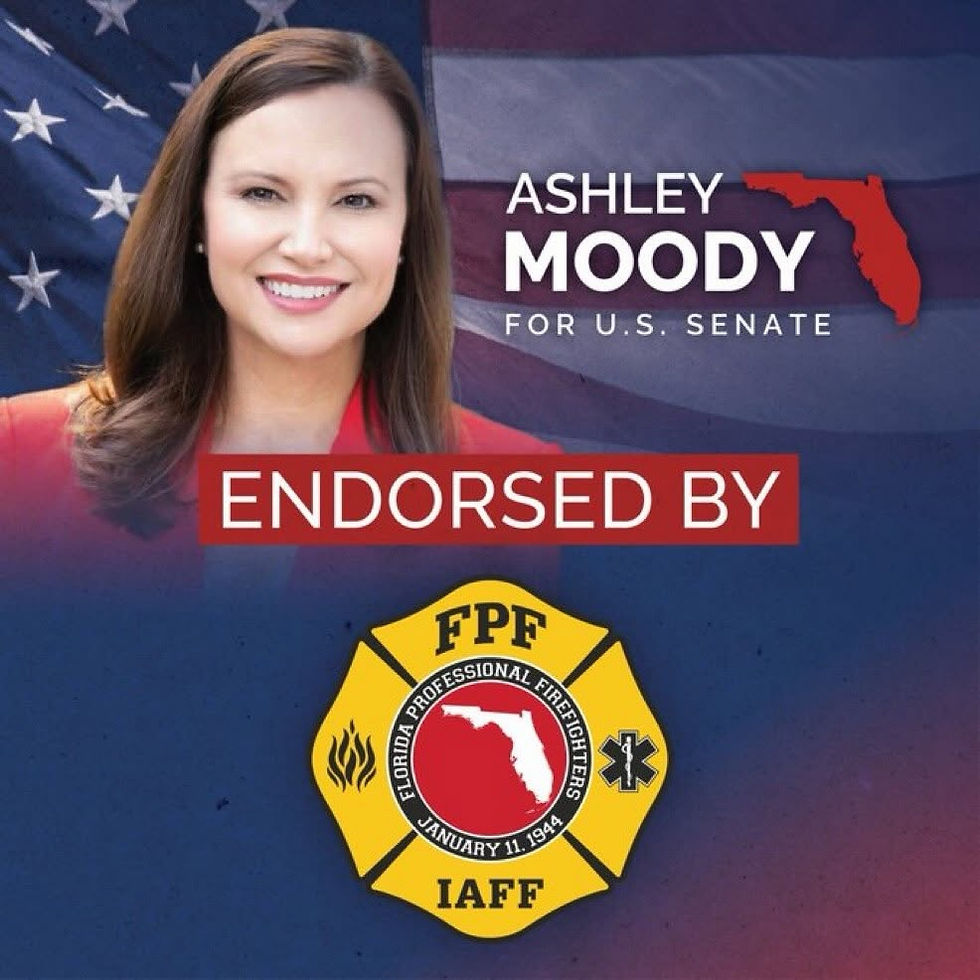
Republican Ashley Moody enters the general election already holding the Senate seat, backed by Florida’s larger political party, the state’s law-enforcement establishment and many of the most powerful figures in Republican politics.
Democrat Angie Nixon enters as a Jacksonville state representative, labor organizer and grassroots campaigner who defeated a nationally known and vastly better-funded primary opponent. She is supported by some of the country’s most prominent progressive politicians and presents herself as an activist willing to confront institutions rather than work quietly within them.
Their contrasting approaches create a central question for Florida voters: What constitutes effective representation in the U.S. Senate?
Is it the ability to work through established legal, legislative and party institutions, as Moody’s supporters argue? Or does effectiveness require confrontation, protest and organizing outside the traditional corridors of power, as Nixon’s supporters contend?
Before answering that question, voters will have to consider not only the candidates’ positions but also their records, coalitions and significant liabilities.
The incumbent senator and the Jacksonville legislator
Moody has served in the U.S. Senate since January 2025, when Gov. Ron DeSantis appointed her to fill the vacancy created by Marco Rubio’s departure to become secretary of state. The November special election will determine who completes the remainder of Rubio’s term.
Before joining the Senate, Moody served as Florida attorney general from 2019 to 2025. Her earlier career included work as a federal prosecutor and more than a decade as a Hillsborough County circuit judge.
In the Senate, Moody serves on the Homeland Security and Governmental Affairs Committee, the Health, Education, Labor and Pensions Committee and the Joint Economic Committee. Her current assignments give her a role in federal oversight, immigration, national security, health care, education and workforce policy. U.S. Senate biography
Nixon has represented portions of Jacksonville in the Florida House since 2020, first in District 14 and subsequently in District 13 after redistricting. Her district includes much of Jacksonville’s urban core and Moncrief area.
Before entering the Legislature, Nixon worked as a labor and community organizer, including positions connected to the Service Employees International Union and Florida Public Service Union. She has also operated Jacksonville businesses and community projects, including Cafe Resistance and the Melanin Market.
That distinction matters. Moody comes to the race through the judiciary, executive law enforcement and an appointment to the Senate. Nixon comes through organizing, community activism and election to a legislative chamber where Democrats have little institutional power.

What has Moody accomplished?
Moody’s public record is much longer as an attorney general than as a senator.
As attorney general, she developed a national profile by participating in lawsuits against the Biden administration involving immigration, pandemic restrictions, student-loan policy, labor regulations and other federal actions. She also participated in multistate opioid litigation that produced billions of dollars in settlements and emphasized investigations involving fraud, human trafficking and organized retail crime.
Supporters describe that record as evidence of an executive willing to use the powers of her office aggressively. Critics contend that Moody increasingly used the attorney general’s office to advance DeSantis’ and Trump’s political priorities.
Among her most controversial actions, Moody joined an unsuccessful 2020 lawsuit seeking to invalidate presidential-election results in four states won by Joe Biden. The U.S. Supreme Court declined to hear the case. She also used the attorney general’s office to challenge proposed constitutional amendments involving abortion and recreational marijuana, arguing that their ballot summaries were misleading.
Since joining the Senate, Moody has aligned herself with President Donald Trump’s agenda and voted for the Republican tax-and-spending package extending provisions of the 2017 tax law. Her office says the legislation protected Florida families and businesses from tax increases. Critics have challenged the package’s spending priorities and effects on federal programs.
Moody has introduced or supported legislation involving police training, first-responder mental-health treatment, veterans’ education, fraud prevention, vocational training and national security.
Her Drone Espionage Act, which would criminalize certain unauthorized video surveillance of military installations, advanced through the Senate Judiciary Committee. Six law-enforcement bills she supported advanced through committee during National Police Week, including legislation addressing PTSD treatment and police leadership training. Moody Senate office
Those are measurable legislative steps, but Moody has served in the Senate for less than two years. Much of her sponsored legislation has advanced through committees rather than completed the entire legislative process. Her strongest record of producing results remains her six years directing the attorney general’s office rather than enacting federal legislation.

What has Nixon accomplished?
Nixon has served three terms in the Florida House, but her legislative record reflects the severe limitations facing a Democrat in a chamber dominated by Republicans.
She has filed legislation addressing childcare, education, corporate price gouging, tenant protections, immigration enforcement and police accountability. In 2025, she proposed a pilot program offering free childcare to early-education employees, an effort intended to address worker shortages and make childcare employment more sustainable.
During the 2026 session, Nixon sponsored bills involving:
Identification and face-covering requirements for law-enforcement and immigration officers
Education policy
A study of employee childcare-assistance programs
Her immigration-officer identification bill and childcare study died in committee. An education proposal she sponsored also died, although related legislation subsequently passed. Florida House sponsored-bill record
That record presents two competing interpretations.
Supporters argue that legislative effectiveness cannot be measured simply by bills passed when one party controls the governorship and holds overwhelming legislative majorities. They credit Nixon with introducing ideas, drawing attention to affordability and childcare and representing constituents whose priorities would otherwise receive limited attention.
Critics argue that a lawmaker’s central responsibility is to build coalitions and turn proposals into law. They contend that Nixon’s thin record of enacted legislation raises questions about whether her confrontational approach produces tangible results.
Nixon’s political identity has consequently been shaped less by bills carrying her name into law than by her willingness to protest Republican decisions—especially congressional redistricting.

The numbers Moody and Nixon carry into November
The primary results show that the two nominees emerge with substantially different levels of demonstrated support.
Candidate | Primary votes | Share of party primary |
Ashley Moody | 1,320,734 | 79.56% |
Angie Nixon | 705,765 | 56.06% |
Alex Vindman | 553,092 | 43.94% |
The Republican Senate primary attracted approximately 1.66 million votes, compared with about 1.259 million in the Democratic contest. Moody alone received approximately 61,900 more votes than Nixon and Vindman combined. She received roughly 615,000 more votes than Nixon.
Those numbers require context.
As of July 31, Florida had approximately 5.61 million active registered Republicans and 4.07 million active registered Democrats. Republicans therefore began the general-election campaign with a registration advantage of approximately 1.54 million voters. Florida Division of Elections
Relative to the size of each party, approximately 29.6% of registered Republicans participated in the Republican Senate primary, compared with about 31% of registered Democrats in the Democratic contest. Moody’s larger raw vote therefore reflects Florida’s larger Republican electorate more than a dramatic difference in party participation rates.
Nevertheless, Nixon must now compete statewide in a political environment where her party begins substantially behind.

Nixon’s grassroots upset—and its limits
Nixon earned national attention by defeating Alexander Vindman despite being outspent by approximately 16-to-1.
Vindman raised approximately $16.27 million, overwhelmingly from individual donors, while Nixon raised slightly less than $1 million before the primary. Vindman was nationally known for testifying about Trump’s 2019 telephone call with Ukrainian President Volodymyr Zelensky, an episode central to Trump’s first impeachment.
But money and national recognition did not translate into Florida Democratic votes.
Vindman had lived in Florida only since 2023, declined to debate Nixon and appeared to campaign toward the general election without first making a persuasive primary case. Nixon traveled the state, organized progressive and working-class constituencies and gave voters a clearly defined political identity.
Her victory demonstrated that grassroots organization can overcome an enormous financial disadvantage. It did not, by itself, demonstrate that her coalition is large enough to win statewide.
Pre-primary polling generally showed Moody leading both Democrats, but the reported margins against Nixon were somewhat larger. In a Stetson University poll, Moody led Vindman 49% to 42% and Nixon 51% to 38%. Emerson College showed Moody ahead of Vindman 46% to 38% and Nixon 47% to 36%.
Those surveys were snapshots rather than predictions, but they help explain why many establishment-aligned donors and organizations apparently viewed Vindman as the less ideologically vulnerable general-election candidate.

Who is supporting Moody?
Moody’s coalition is anchored in the Republican establishment, law enforcement and the conservative movement.
Her supporters include:
President Donald Trump
Gov. Ron DeSantis
Republican members of Florida’s congressional delegation
Florida sheriffs and police chiefs
The Florida Police Chiefs Association
Conservative organizations and Republican donor networks
The Florida Police Chiefs Association endorsed Moody while emphasizing her support for law enforcement as both attorney general and senator. Florida Police Chiefs Association
Moody’s alignment with Trump and DeSantis gives her access to Florida’s dominant political infrastructure, but it creates liabilities of its own.
Her participation in the effort to challenge the 2020 presidential election remains part of her record. Her aggressive defense of Republican policies makes it difficult for her to present herself as politically independent. Her critics can also point to her support for attempts to remove abortion and marijuana amendments from the ballot as evidence of an official seeking to limit decisions by voters.
Most importantly, she now faces questions over Hope Florida.
Who is supporting Nixon?
Nixon’s national supporters include some of the most recognizable figures in the progressive movement:
Bernie Sanders
Elizabeth Warren
Maxwell Frost
Ilhan Omar
Rashida Tlaib
Ayanna Pressley
Former Rep. Cori Bush
Former Ohio state Sen. Nina Turner
Her Florida endorsements include Anna Eskamani, Michele Rayner, Tracie Davis, LaVon Bracy Davis, Rosalind Osgood, Yvonne Hinson, Dianne Hart, Monique Worrell, former Rep. Al Lawson and several Jacksonville City Council members. Her campaign also received support from Our Revolution and labor, veterans and progressive organizations. Nixon campaign endorsement list
These endorsements can help Nixon raise money and motivate progressive voters. They also allow Moody to associate her with politicians whose positions on policing, Israel, immigration and federal spending are unpopular among many Florida voters.
Nixon joined the Democratic Socialists of America in 2026. She has said she agrees with many—but not all—of its positions and specifically denies supporting the defunding of police. PolitiFact found no evidence that Nixon had previously advocated defunding police and noted that the national DSA did not appear to have formally endorsed her. PolitiFact
Still, the socialist label presents an evident challenge in a state with substantial Cuban, Venezuelan and other immigrant communities whose political experiences have made socialism particularly contentious.
Nixon has also advocated universal health care and childcare, criticized U.S. policy toward Israel and Gaza and described ICE as a weaponized paramilitary force. Moody will likely use those positions to argue that Nixon is outside Florida’s political mainstream.

Nixon’s pending court case
Nixon is likely to appear in court during the general-election campaign.
She was arrested May 15 after participating in a sit-in near DeSantis’ Capitol office following passage of a new congressional map. Authorities say Nixon remained after the Capitol closed and refused orders to leave.
She faces misdemeanor charges of:
Trespassing in a structure or conveyance
Resisting an officer without violence
Nixon has pleaded not guilty, and a jury-trial period was scheduled for the week of September 21. The allegations remain pending, and she has not been convicted.
That distinction is important. Her conduct should not be described as legally established “illegal activity” unless she is convicted or otherwise admits the offense.
The criminal case followed a separate House disciplinary action. In April, Nixon used a bullhorn on the House floor and repeatedly disrupted proceedings during the redistricting debate. The House Rules and Ethics Committee formally reprimanded her for violating chamber rules and interfering with legislative business.
Nixon portrays both episodes as principled resistance to congressional maps intended to strengthen Republican control. Moody can argue that a candidate seeking a seat in the nation’s principal lawmaking body has demonstrated disregard for legislative procedure and lawful orders.
The question for voters is whether Nixon’s civil disobedience represents courage—or whether it reveals an approach better suited to protest than governing.
Moody’s Hope Florida problem
Moody’s most serious liability involves $10 million from a Medicaid settlement directed to the Hope Florida Foundation while she was attorney general.
A leaked state grand-jury report concluded that the DeSantis administration “misappropriated” the money. The funds went to the Hope Florida Foundation and subsequently reached political organizations involved in opposing Florida’s 2024 recreational-marijuana amendment.
According to reporting on the grand-jury findings, Moody knew of the plan to direct the $10 million to Hope Florida and authorized her chief deputy, John Guard, to sign the settlement. The report criticized the failure to ensure that the money was properly appropriated and adequately protected. CBS News Miami
The grand jury did not recommend criminal charges. It reportedly found insufficient evidence to identify individual criminal responsibility and noted that participants relied on advice from other lawyers. Moody and other officials have denied wrongdoing and described the controversy as politically motivated.
Nixon has called for Moody’s resignation and said that everyone involved should be held accountable. She will likely argue that Moody’s experience and institutional credentials are not evidence of effectiveness if her office failed to protect $10 million in public settlement money.
That gives Nixon a direct counterargument to Republican attacks over her arrest:
Moody can say Nixon disregarded legislative rules and police orders. Nixon can say Moody presided over a settlement process in which a grand jury found public money was misappropriated for political purposes.
The two controversies are not legally equivalent. Nixon faces personal misdemeanor charges arising from a protest. Moody has not been criminally charged, but faces questions about her authorization and oversight of a government settlement involving $10 million.
Politically, however, both controversies reach the same issue: judgment.
Two competing definitions of effectiveness
Moody and Nixon offer markedly different theories of political power.
Moody’s model is institutional. She has worked as a prosecutor, judge, attorney general and senator. She uses litigation, executive authority, committee assignments, party relationships and conventional legislation. Her supporters can point to opioid settlements, federal lawsuits, public-safety initiatives and access to the Senate’s Republican majority.
Her critics can respond that institutional access is valuable only when exercised independently and responsibly. Hope Florida raises questions about oversight, while her alliances with Trump and DeSantis make it difficult to determine where independent legal judgment ends and party loyalty begins.
Nixon’s model is movement-oriented. She organizes communities, files legislation reflecting progressive priorities, draws attention to issues and uses protest when conventional legislative avenues fail. Her primary victory demonstrated a genuine ability to mobilize voters without relying on the largest donor network.
Her critics can respond that attention and mobilization are not the same as lawmaking. Nixon’s limited record of enacted legislation, House reprimand and pending prosecution raise questions about whether her confrontational style can produce results in a Senate that depends heavily on negotiation, procedure and coalition-building.
Supporters of each candidate therefore measure effectiveness differently.
Moody’s case rests on experience, institutional command, public-safety credentials and access to the governing majority.
Nixon’s case rests on independence from the donor establishment, grassroots organization, economic populism and willingness to challenge institutions that she believes have failed working families.

The choice taking shape
Moody begins as the clear structural favorite. She holds the office, received nearly 80% of a larger Republican primary vote and belongs to a party with approximately 1.54 million more registered Florida voters than the Democratic Party.
Nixon enters with greater national attention than her fundraising or original expectations suggested. She has demonstrated that she can organize Democratic voters and defeat a better-funded opponent, but she must now broaden a progressive coalition in a state that has moved steadily toward Republicans.
The campaign is likely to become a contest between competing accusations.
Moody will portray Nixon as a socialist activist whose arrests, legislative disruptions and national progressive alliances make her too extreme and unpredictable for Florida.
Nixon will portray Moody as a conventional establishment politician whose experience did not prevent public Medicaid-settlement money from being redirected into a politically connected pipeline.
That leaves Florida voters to decide what kind of representation they consider most effective: a traditional officeholder with institutional power and close ties to the state’s dominant party, or an organizer whose influence comes through confrontation, visibility and grassroots mobilization.
Neither résumé answers that question by itself.
The general election will test whether Moody’s institutional advantages can withstand the Hope Florida controversy—and whether Nixon’s talent for protest and organizing can be converted into the broader coalition and legislative credibility required to serve effectively in the United States Senate.