
John Hawley
Oct 12, 2026
UF Jacksonville: The Science & Technology Frontier — Part I
The University of Florida's new graduate campus in Downtown Jacksonville is beginning to take shape, but the larger story extends well beyond the buildings planned for LaVilla. The university is establishing graduate programs in artificial intelligence, cybersecurity, data analytics, engineering, architecture, law and business while laying the groundwork for research in semiconductors, biotechnology and other advanced technologies. Together, these fields offer a starting point for understanding how scientific discoveries move from university laboratories into businesses, public institutions and everyday life.
The campus opened for classes in August 2026 with 158 students enrolled for the fall semester. Its first classroom building occupies a converted commercial property at 801 W. Bay Street, and plans are advancing for a new 185,000-square-foot academic building next door. Those developments provide measurable milestones, but the more important long-term questions involve what students will learn, what faculty will investigate and how Jacksonville might participate in the next generation of scientific and technological innovation.
This article launches UF Jacksonville: The Science & Technology Frontier, a continuing series examining the campus's development alongside the scientific disciplines and technologies that will define its academic and research mission.
UF Jacksonville Opens With Eight Graduate Programs Across Five Colleges
The University of Florida officially opened its Jacksonville campus on September 9, 2026, following the start of classes on August 20. The initial enrollment of 158 students is modest compared with the university's Gainesville operations, but the Jacksonville campus has a different purpose. It is designed primarily for graduate students and working professionals seeking advanced education in fields where technology is changing how organizations operate.
UF's opening announcements described seven broad academic areas, while its engineering faculty reported eight programs across five colleges. The distinction matters because artificial intelligence, cybersecurity and data analytics can be concentrations within broader degrees rather than separate degree programs. The participating colleges include Engineering, Business, Design, Construction and Planning, Law, and Medicine.
The academic structure also suggests that UF Jacksonville will not operate as a conventional engineering school separated from other disciplines. Computer scientists will study technologies that business leaders must implement, attorneys must understand and healthcare professionals may eventually use in clinical and research settings. The opportunities emerge where those disciplines intersect, particularly when new technology requires technical expertise, regulatory knowledge and practical management.
Artificial Intelligence and Computer Science: How UF Jacksonville Will Prepare Technology Professionals
Artificial intelligence is one of the central themes connecting UF Jacksonville's graduate programs. The university launched a Master of Science in Computer Science with concentrations in AI and cybersecurity, designed primarily for working professionals. The 30-credit program gives Jacksonville students access to graduate computer science education without requiring them to relocate to Gainesville.
Artificial intelligence is a broad field involving computer systems that perform tasks such as recognizing patterns, generating language, analyzing images and making predictions. Machine learning, one of its major branches, allows systems to improve their performance by identifying relationships in training data rather than relying entirely on explicitly programmed instructions. These technologies now influence industries ranging from banking and insurance to medicine, manufacturing and transportation.
The scientific questions extend beyond whether a computer can produce an accurate answer. Researchers must also determine how models arrive at decisions, how reliably they perform outside their training environments and whether their results can be explained and independently evaluated. As AI systems become more capable of performing complex tasks, cybersecurity, data quality and human oversight become increasingly important.
For Jacksonville students, the practical applications could include fraud detection in financial services, automated analysis of medical information, predictive maintenance of industrial equipment and intelligent management of logistics systems. These are examples of opportunities within the broader field, not claims that each application is already being researched at the Jacksonville campus. Future reporting will examine the university's actual faculty projects and research partnerships as they become documented.
Cybersecurity: Protecting the Digital Systems That Power Modern Life
Cybersecurity is closely connected to artificial intelligence, but it addresses a different set of problems. As financial transactions, hospital records, transportation networks and industrial systems become more dependent on connected computers, protecting those systems becomes increasingly complex. UF Jacksonville's computer science program includes cybersecurity as a concentration, creating a direct academic pathway into this field.
Traditional cybersecurity involves protecting networks, applications and information against unauthorized access, disruption and theft. Modern cybersecurity increasingly includes cloud infrastructure, automated threat detection, software supply chains and the security of AI systems themselves. A system that uses artificial intelligence may introduce additional vulnerabilities involving manipulated training data, malicious instructions or unreliable automated decisions.
Jacksonville offers a useful setting for studying these challenges because its regional economy includes financial services, healthcare, transportation and logistics. Each sector depends on systems that must remain secure and operational. Future episodes will examine how cybersecurity research addresses those risks and how graduate education can support organizations facing increasingly sophisticated threats.
Data Analytics and Engineering Management: Turning Information Into Better Decisions
Another early UF Jacksonville program is the Master of Science in Engineering Management with a concentration in Data Analytics. The program combines engineering, mathematics, analytical methods and management education, with classes scheduled to accommodate working professionals. UF describes applications in finance, healthcare, bioinformatics, supply chains, manufacturing and business operations.
Data analytics begins with collecting, organizing and evaluating information to identify meaningful patterns. A hospital might analyze patient flow to improve scheduling, while a logistics company could use shipment records to identify delays and optimize delivery routes. More advanced methods can incorporate machine learning, predictive modeling and optimization to help organizations evaluate possible future outcomes.
The difference between collecting data and making useful decisions is often substantial. Information may be incomplete, inconsistent or misleading when separated from its original context. Engineering management brings together the technical skills needed to analyze information and the organizational judgment needed to apply those findings responsibly.
UF's Department of Industrial and Systems Engineering has also identified smart manufacturing as a future specialization area. That could eventually connect data analytics to automated factories, advanced production systems and semiconductor-related industries. The university has not yet established that every proposed specialization is available to Jacksonville students.
Master of Science in Engineering Management
Semiconductors: Why UF Plans to Bring Advanced Chip Research to Jacksonville
One of the most significant scientific opportunities associated with UF Jacksonville involves semiconductor technology. Semiconductors form the foundation of modern electronic devices, including computers, smartphones, medical equipment, communications systems and artificial intelligence processors. UF has identified the Florida Semiconductor Institute as a component of its broader Jacksonville research plans.
A semiconductor is a material whose electrical properties can be controlled to perform useful electronic functions. Engineers use these materials to create transistors and other components that process, store and transmit information. Modern integrated circuits can contain billions of transistors, allowing increasingly sophisticated computing operations within remarkably small physical spaces.
Semiconductor research involves much more than manufacturing computer chips. Scientists study materials, device architectures, manufacturing processes, packaging, reliability and the behavior of electronics under extreme environmental conditions. These disciplines connect physics, chemistry, electrical engineering, computer science and advanced manufacturing.
For Jacksonville, the important question is what portion of this research will take place locally and how it will connect with statewide and national industry partnerships. The existence of a planned institute does not automatically establish a functioning fabrication facility, a particular research budget or a specific number of scientific jobs. Those details will become important benchmarks as the campus develops.
National Security Research: What Is UF's Planned ARNS Laboratory?
UF has identified Jacksonville as the future home of its Applied Research for National Security Laboratory, known as ARNS. The initiative is intended to connect university researchers with government and industry partners working on national security technologies. UF describes research priorities involving AI-driven advanced manufacturing, microelectronics, space-related technologies, materials, biotechnology and biosecurity.
Applied research differs from purely theoretical investigation because it seeks to address defined practical problems. A materials scientist might investigate how electronic components survive extreme temperatures, while an engineer could develop manufacturing methods for specialized equipment. A biotechnology researcher might work on methods for detecting biological threats or improving laboratory analysis.
UF envisions the ARNS Laboratory as a secure environment supporting collaboration and the transition of research into practical applications. That could provide opportunities for appropriately cleared students and faculty to participate in specialized projects. However, a planned laboratory, an announced research priority and an operating research program are three different stages of development.
As the Jacksonville initiative advances, we will examine the laboratory's staffing, facilities, research awards, partnerships and published outcomes where that information is available. These measures will help distinguish the laboratory's intended capabilities from research activity already underway.
Biomedical Science and Healthcare: Where Artificial Intelligence Meets Medicine
UF Jacksonville's academic expansion also includes biomedical and health sciences, creating another connection between advanced computing and scientific research. UF's College of Medicine participated in the campus's initial academic offerings, and the university has previously identified graduate education in AI for biomedical and health sciences as part of its Jacksonville plans.
Artificial intelligence can help researchers analyze medical images, identify patterns in clinical records and investigate relationships among genes, proteins and disease. Computational tools can also support drug discovery by helping scientists evaluate large numbers of molecular candidates. These applications require careful validation because a promising research result is not the same as a treatment proven safe and effective for patients.
Jacksonville already has an established healthcare and medical research environment, including UF Health's presence in the region. The new graduate campus creates possibilities for connecting that environment with advanced computing, engineering and data science. The extent of those connections will depend on specific faculty appointments, research projects, clinical partnerships and laboratory resources.
Biomedical research will therefore be a recurring subject in this series rather than a single article. Future coverage can examine developments in medical imaging, computational biology, drug discovery and the regulation of AI-based medical technologies, while documenting which activities are actually connected to UF Jacksonville.
UF's NVIDIA Partnership: How HiPerGator Connects Computing With Scientific Discovery
The Jacksonville campus also enters a university system that has already invested heavily in artificial intelligence infrastructure. In 2020, UF began a major partnership with NVIDIA, the computing company co-founded by UF alumnus Chris Malachowsky. The collaboration helped establish advanced AI computing resources at the university and supported a broader effort to incorporate artificial intelligence into teaching and research.
At the center of that infrastructure is HiPerGator, UF's high-performance supercomputing system in Gainesville. Its fourth generation, unveiled in October 2025, includes 63 NVIDIA DGX B200 systems containing 504 Blackwell graphics processing units. The upgraded system gives researchers substantial computing capacity for training AI models, analyzing complex scientific data and performing calculations that would overwhelm ordinary computers.

UF's HiPerGator supercomputing infrastructure in Gainesville is an important part of the university's broader AI research strategy.
The scale of UF's existing research infrastructure provides context for the Jacksonville expansion. UF reports more than 300 AI-focused faculty members across the university and approximately 14,000 students enrolled annually in AI-related courses. Its supercomputing resources support work involving engineering, medicine, environmental science and other disciplines.
The important question for Jacksonville is how its students and researchers will participate in that established ecosystem. University-wide computing resources do not automatically mean that every Jacksonville graduate program has a dedicated allocation of HiPerGator processing time or direct involvement in a particular research project. The relationship between the two campuses, including access to computing infrastructure, faculty collaboration and research funding, deserves continuing examination.
Architecture, Law and Business: Why Technology Research Requires More Than Scientists
Not every program at UF Jacksonville involves computer programming or laboratory research. The campus also offers graduate education in architecture, business management and law, fields increasingly affected by advances in artificial intelligence and digital technology. These disciplines help connect technical discoveries with the organizations, buildings, legal systems and markets in which new technologies are used.
Architecture offers a particularly interesting example because advanced computing is changing how buildings and urban environments can be designed. Digital modeling, environmental simulations and data-driven design tools allow architects to evaluate building performance before construction begins. Future research may further connect architectural design with digital twins, intelligent building systems and technologies that reduce energy consumption.
The legal implications of new technology are equally substantial. Artificial intelligence raises questions about intellectual property, privacy, responsibility for automated decisions and the use of sensitive information. UF Jacksonville's Master of Studies in Law provides a pathway for professionals seeking legal knowledge without necessarily pursuing a traditional law degree.
Business education addresses another essential challenge: how organizations adopt technologies that may be expensive, complex or poorly understood. UF's Jacksonville offerings include a weekend MBA and a Master of Science in Management with an AI concentration. These programs create opportunities to examine how technical innovation moves into organizational decision-making, investment and commercial operations.
UF Warrington College of Business
UF Jacksonville's First New Building: A Physical Benchmark for the Research Campus
The campus's academic expansion is occurring alongside plans for new facilities in LaVilla. On October 9, 2026, the Jacksonville Daily Record reported that the city was reviewing site-clearing plans for Parcel A at 889 W. Bay Street. The approximately 2.4-acre site is designated for the first new instructional building, immediately west of the converted classroom facility.
The proposed building contains approximately 185,000 square feet, with sections rising six and eight stories. Conceptual plans include gathering areas, landscaped outdoor spaces, balconies and roof terraces. The city previously granted conceptual design approval, subject to additional approvals involving building height and lot frontage.
The permit documents identify December 23, 2026, as a proposed construction start date, while UF's published campus timeline places the start of construction in early 2027. The university currently anticipates completing the building in 2029. These dates represent planning milestones and may change as permitting and construction proceed.
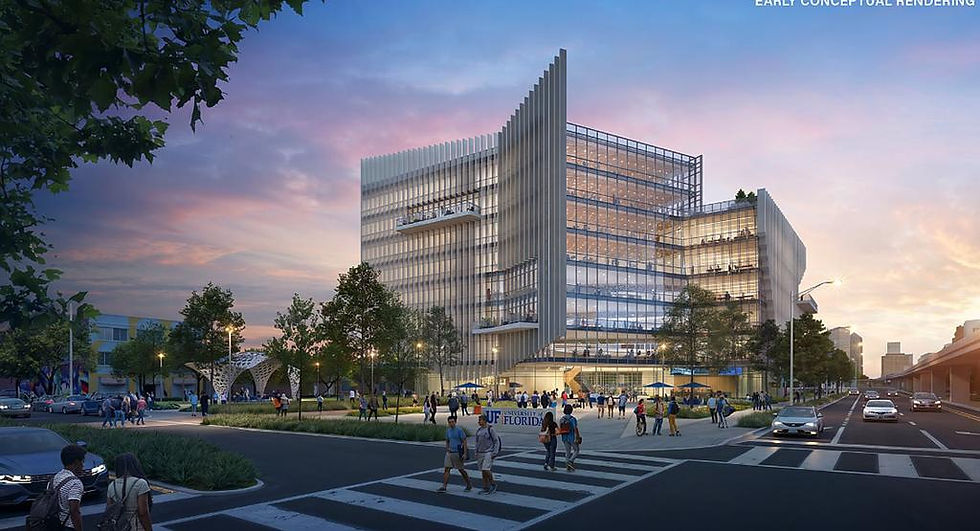
The new building is part of a $287.5 million initial development phase led by Edgemoor Infrastructure & Real Estate. However, a larger academic building does not by itself establish the extent of scientific research that will take place inside it. The eventual allocation of space for classrooms, laboratories, faculty offices and specialized equipment will provide a clearer picture of how UF intends to support its expanding programs.
What Opportunities Could UF Jacksonville Create for Students, Researchers and Businesses?
The immediate opportunities begin with graduate education. UF Jacksonville offers working professionals the ability to pursue advanced degrees in computer science, engineering management, business and related disciplines while remaining connected to their existing careers. The university has deliberately structured some programs around weekend instruction and professional schedules.
For researchers, the longer-term opportunities involve access to collaborators, specialized facilities, research grants and partnerships with public agencies and private companies. Universities can bring together scientists from disciplines that rarely work together in traditional commercial organizations. Those relationships may produce new technologies, patents, licensed inventions or startup businesses, although none of those outcomes is guaranteed by the creation of a campus.
For businesses, a local graduate campus may provide access to specialized education, research partnerships and professionals with advanced technical skills. A financial services company might seek expertise in AI-driven risk analysis, while a manufacturer could collaborate with engineers studying automation or advanced materials. The value of such relationships will depend on documented programs, employer participation and actual research results.
For students considering careers in science and technology, the campus also raises practical questions about tuition, admissions requirements, degree completion, research opportunities and employment outcomes. Those subjects will become part of our continuing coverage as the university expands. The objective is to connect the excitement surrounding emerging technologies with useful information about the education and experience required to work in those fields.
How Will We Measure UF Jacksonville's Progress?
The opening of the campus establishes a baseline rather than a final measure of success. In fall 2026, UF Jacksonville began with 158 students, eight graduate programs across five colleges and an initial classroom facility. Its first new academic building remains in development, while major research initiatives such as the ARNS Laboratory represent important areas for future reporting.
The 101 Report will track progress through several measurable indicators, including enrollment by academic program, faculty appointments, laboratory development, research grants, published scientific work, industry collaborations, patents and graduate career outcomes. These measures will help readers understand not only how much the campus grows, but also what educational and scientific activities that growth supports.
We will also distinguish between research conducted at UF's Gainesville campus, university-wide initiatives accessible to Jacksonville participants and projects specifically based in Jacksonville. That distinction is particularly important when discussing HiPerGator, the Florida Semiconductor Institute and national security research. The university's existing scientific capabilities are substantial, but the Jacksonville campus's individual contribution must be documented as it develops.
The Next Chapter: Artificial Intelligence and the Graduate Education Behind It
The first 158 students have entered a university environment where artificial intelligence connects computer science, engineering, medicine, business and other disciplines. Their studies coincide with rapid changes in how computers process information, how organizations use automated systems and how researchers approach increasingly complex scientific questions. Those developments provide the foundation for the next episode of this series.
Part II — Artificial Intelligence: What UF Jacksonville Students Will Study and Why It Matters will examine machine learning, neural networks, AI model development and the relationship between classroom instruction and real-world applications. It will also explore the skills required to enter the field and the role of UF's existing AI infrastructure in supporting advanced education.
UF Jacksonville's development will take years, and the scientific disciplines associated with the campus will continue changing long after its first buildings are complete. By following both developments together, this series will document the growth of a university campus while explaining the technologies that may shape the next generation of research, industry and professional opportunity.
UF Jacksonville: The Science & Technology Frontier Series
