
John Hawley
Jul 16, 2026
AI Data Centers and Florida's Future: Getting the Best Deal for Community
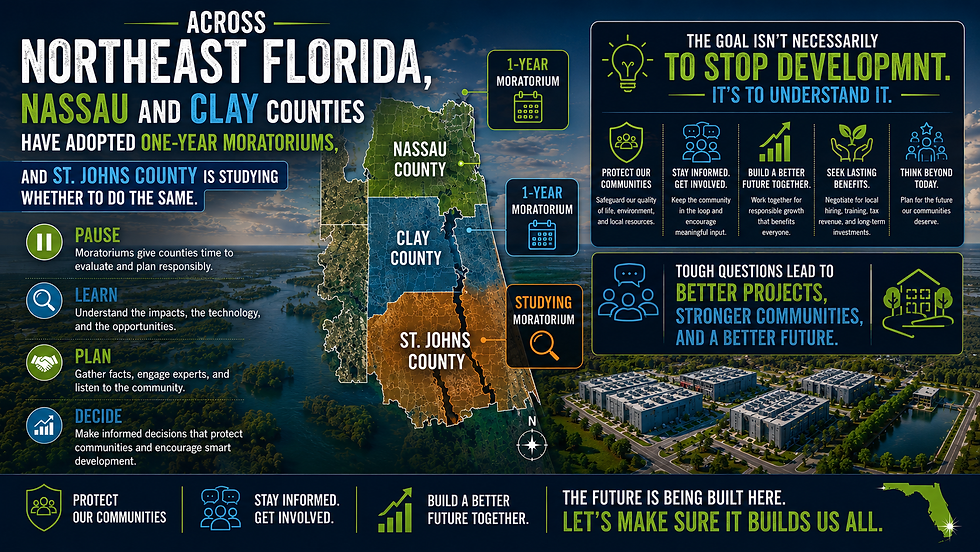
Nassau and Clay counties have adopted one-year moratoriums. St. Johns County is evaluating its options. Jacksonville continues to discuss the issue without a formal pause. Meanwhile, billions of dollars are flowing into AI infrastructure nationwide.
But one important part of the conversation is often missing.
Today's hyperscale data centers are not the same facilities that were being built just five years ago.
Nearly every major hyperscale operator—including Amazon Web Services, Microsoft, Google, Meta, Oracle, CoreWeave, OpenAI partners, and xAI suppliers—is investing billions of dollars into reducing electricity consumption, minimizing water use, capturing waste heat, and redesigning how AI campuses are powered.
For Florida communities, this creates an opportunity.
Rather than simply asking whether to approve or reject a project, local governments can negotiate from a position of knowledge, requiring the newest technologies that reduce impacts while maximizing economic benefits.
The AI Infrastructure Arms Race
Artificial intelligence has created an unprecedented demand for computing power.
A single next-generation AI campus may eventually require several hundred megawatts—or even more than one gigawatt—of electricity.
That has naturally raised questions about:
electrical demand
water consumption
infrastructure costs
community impacts
environmental sustainability
The encouraging news is that technology is evolving almost as quickly as AI itself.
Many of the industry's largest engineering firms are redesigning nearly every aspect of data center infrastructure.
Water Is Becoming Optional
Perhaps the biggest misconception is that every hyperscale data center consumes enormous quantities of potable drinking water.
Increasingly, they don't.
Several new approaches are already being implemented.
Closed-Loop Liquid Cooling
Instead of evaporating water through cooling towers, servers circulate coolant through sealed systems that recycle the same fluid repeatedly.
Benefits include:
dramatically lower water use
improved cooling efficiency
better support for AI chips
Companies using it:
Microsoft
NVIDIA partners
Vertiv
Schneider Electric
Direct-to-Chip Cooling
Rather than cooling the entire room, liquid is pumped directly across processors.
Advantages include:
30–40% lower cooling energy
significantly less water
greater computing density
Already being deployed by:
Microsoft
Meta
Oracle
CoreWeave
Equinix
Digital Realty
Wastewater Instead of Drinking Water
Perhaps the most interesting trend is using reclaimed water.
Instead of municipal drinking water, facilities increasingly utilize:
treated wastewater
reclaimed municipal water
industrial reuse water
Examples include:
Google
Microsoft
Meta
QTS
Digital Realty
Several western states now require this approach.
Florida communities could negotiate similar requirements.
Air Cooling Is Making a Comeback
New AI processors are more powerful—but they're also enabling more sophisticated airflow engineering.
Techniques now include:
hot aisle containment
cold aisle containment
AI-controlled airflow
outside-air economizers where climate allows
Companies:
Vertiv
Schneider Electric
Johnson Controls
Google
Small Nuclear Reactors
One of the industry's biggest stories isn't computers.
It's electricity.
Microsoft, Amazon, Google and others are investing billions into Small Modular Reactors (SMRs).
Benefits include:
zero carbon emissions during operation
extremely reliable baseload power
reduced pressure on traditional electric grids
Although commercial deployment is still developing, SMRs may become a major power source for future AI campuses.

Natural Gas Microgrids
Several new AI campuses are pairing grid electricity with on-site generation.
These include:
natural gas turbines
battery storage
solar
fuel cells
Advantages:
improved grid reliability
less stress during peak demand
backup power without relying solely on diesel generators
Companies exploring these systems include:
NextEra Energy
Bloom Energy
GE Vernova
Siemens Energy
Waste Heat Recovery
Instead of simply exhausting hot air into the atmosphere, several European data centers now heat:
neighborhoods
schools
hospitals
swimming pools
Waste heat capture remains limited in the United States, largely because of differences in climate and district heating infrastructure, but it illustrates how energy that was once discarded can become a community asset.
AI Is Optimizing AI
Perhaps the most fascinating development is that artificial intelligence is now reducing its own energy consumption.
Machine learning systems continuously optimize:
cooling equipment
pumps
fans
power distribution
server workloads
Google reports that AI-based controls have reduced cooling energy at some facilities by around 30%, demonstrating how software can significantly improve infrastructure efficiency.
New Construction Materials
Modern campuses increasingly feature:
high-efficiency electrical systems
lower-carbon concrete mixes
recycled construction materials
rooftop solar where practical
battery energy storage
advanced insulation
modular construction
The goal is reducing both operational energy use and embodied carbon.

Florida's Opportunity
Florida is uniquely positioned.
South Florida is rapidly becoming a headquarters location for technology companies, venture capital firms, and AI investors.
Central and North Florida offer:
more affordable land
larger development sites
expanding electric infrastructure
major fiber networks
growing workforce availability
That combination will likely keep Florida attractive for AI infrastructure investment.
The question is not simply whether projects should move forward.
The question is how they should move forward.
Communities Have More Leverage Than They Think
Moratoriums can provide valuable time for local governments to educate themselves.
That time can be used to negotiate stronger agreements rather than simply delay decisions.
Communities might consider requiring developers to address issues such as:
reclaimed water instead of potable water whenever feasible
minimum water-efficiency standards
direct-to-chip or closed-loop cooling systems where practical
independent studies of electric grid impacts
developer-funded transmission or substation upgrades where appropriate
local road and infrastructure improvements
emergency response planning
landscaping and buffering standards
ongoing public reporting of water and energy use
decommissioning and site restoration plans
local workforce training partnerships
annual community advisory meetings
Not every measure will fit every project, but understanding the available technologies allows communities to negotiate from an informed position.

Finding the Right Balance
The debate over AI data centers is often framed as a choice between economic development and protecting local communities.
That doesn't have to be the choice.
The newest generation of hyperscale campuses is already adopting technologies that dramatically reduce water consumption, improve energy efficiency, and lessen demands on surrounding infrastructure. Those innovations won't eliminate every concern, but they give communities more options than simply approving or rejecting projects outright.
For Florida, the most productive path may be neither automatic approval nor blanket opposition. It may be informed negotiation—setting clear expectations, requiring modern engineering practices where appropriate, and ensuring that any economic benefits are matched by responsible planning and transparency.
As AI infrastructure expands across the Southeast, the communities that understand both the opportunities and the technology will be in the strongest position to shape projects that work for residents, utilities, developers, and future generations alike.