John Hawley
Aug 4, 2026
Tax Watch Florida Findings
.
Northeast Florida continues to be one of the fastest-growing regions in the state. New neighborhoods, expanding businesses, and thousands of new residents have fueled unprecedented growth over the past decade.
But growth isn't the whole story.
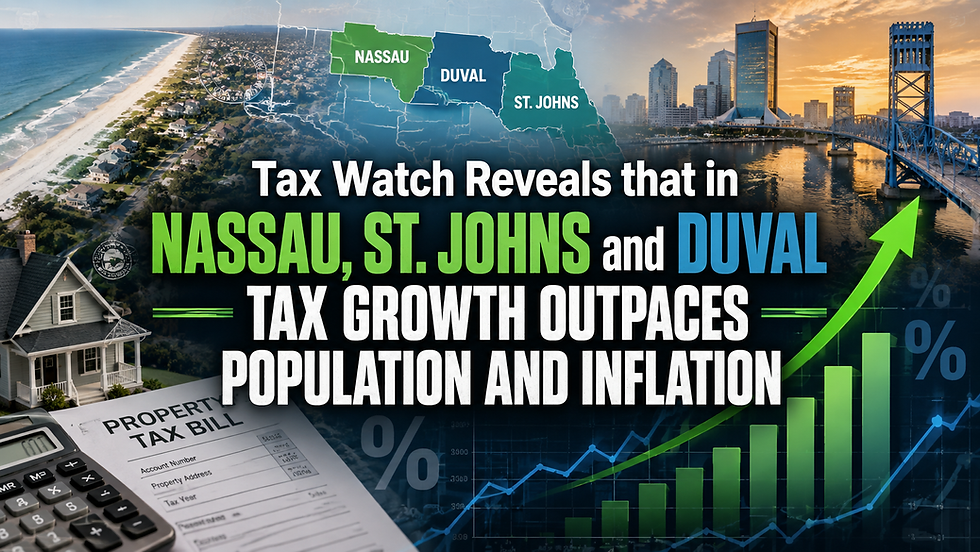
A new Florida TaxWatch report found that property tax collections in many Florida counties have increased well beyond the combined effects of population growth and inflation. For Nassau, St. Johns, and Duval counties, the numbers raise important questions about how rapidly local government revenues have grown—and why.
Unlike an individual homeowner's tax bill, the report measures total property tax levies collected by local governments. Even so, it provides a valuable look at how tax revenue has expanded compared to the growth those counties experienced.
Nassau County: Fourth Highest in Florida
Nassau County ranked fourth statewide in property tax levy growth over the past decade.
According to Florida TaxWatch, property tax collections increased 147.4%, while population growth and inflation combined totaled 78.4%. That's a difference of 69 percentage points.
Nassau County has experienced tremendous residential development in areas such as Yulee, Wildlight, and Fernandina Beach. New construction naturally generates more tax revenue.
Even so, the report suggests development alone doesn't explain the pace of revenue growth.
St. Johns County: Growth Isn't the Entire Answer
Few counties have grown faster than St. Johns County.
Communities like Nocatee, SilverLeaf, and the county's western growth corridor have added thousands of homes during the last decade.
Florida TaxWatch found property tax collections increased 139.5%, while population growth and inflation totaled 103.3%.
That means tax collections still exceeded those growth factors by more than 36 percentage points.
Growth explains much of St. Johns County's increased revenue—but not all of it.
Duval County Tells a Different Story
Duval County's population has grown much more slowly than Nassau or St. Johns.
Yet Florida TaxWatch reports property tax collections increased 103.0%, compared with 55.3% growth from population and inflation.
That's a gap of nearly 48 percentage points.
Although Duval ranked 24th statewide, its property tax collections still increased at nearly double the combined pace of population growth and inflation.
Compare That to Florida's Lowest County
The statewide comparison is revealing.
Washington County recorded the lowest property tax levy growth in Florida, increasing just 35.3% over the same period.
By comparison, Nassau County's property tax collections grew more than four times faster.
Certainly, Washington County hasn't experienced the development seen in Northeast Florida. Still, the contrast demonstrates just how differently property tax revenues have grown across the state.
What the Numbers Mean
The report does not say every homeowner's tax bill increased by these percentages.
Instead, it measures the total amount of property taxes collected by local governments.
Those collections can increase because of:
New residential construction
Commercial development
Rising property values
New taxable property
Millage rate decisions
Voter-approved debt
As communities grow, higher tax collections are expected.
Florida TaxWatch simply asks whether those collections have increased faster than population growth and inflation alone would suggest.
For Nassau, St. Johns, and Duval, the answer is yes.
The Bigger Question
Few people would argue that growing counties shouldn't collect more revenue.
Growth requires new roads, schools, parks, utilities, public safety, and infrastructure.
The more important question is whether taxpayers are receiving a comparable return.
If local governments are collecting substantially more revenue than growth alone would predict, residents may reasonably ask:
Are services improving at the same pace?
Has infrastructure kept up?
Where has the additional revenue gone?
Is government becoming more efficient?
Those are fair public policy questions regardless of political affiliation.
An Affordability Issue
The report also arrives as affordability remains a growing concern across Florida.
Insurance premiums, utility bills, housing costs, and everyday expenses have all increased significantly over the past several years.
Property taxes have now become another important part of that conversation.
While Florida's Save Our Homes protections benefit many long-term homeowners, new buyers often begin with much higher assessed values, creating larger annual tax obligations from day one.
The Bottom Line
Florida TaxWatch isn't arguing that every increase in property tax revenue is excessive.
Instead, it provides a benchmark by comparing revenue growth against the two factors most often cited to justify it—population growth and inflation.
For Northeast Florida, the findings stand out:
Nassau County: Property tax collections increased 147.4%, compared with 78.4% population growth and inflation.
St. Johns County: Property tax collections increased 139.5%, compared with 103.3%.
Duval County: Property tax collections increased 103.0%, compared with 55.3%.
Each county has experienced different growth patterns, yet all three collected property tax revenue at a pace exceeding those benchmarks.
That leaves one question worth discussing:
What is driving property tax revenue growth in Northeast Florida, and are taxpayers seeing a proportional return on those additional dollars?
We welcome your thoughts