
John Hawley
Sep 3, 2026
Is Jacksonville Being Selected or Solicited as the R&B Hall of Fame Already Has a Mississippi Deal
Jacksonville is reportedly among five cities being considered as the permanent home of the National Rhythm & Blues Hall of Fame. Local news reports have emphasized Jacksonville’s musical history and the museum’s potential to attract visitors, create jobs and complement the revitalization of LaVilla.
But the National R&B Hall of Fame apparently already has—or at least had—a permanent-home agreement with Marks, Mississippi.
The City of Marks and Quitman County reportedly committed five acres to the project. The Mississippi Legislature appropriated $500,000 for related infrastructure, and officials held a groundbreaking ceremony in September 2022. Quitman County’s official economic-development website still says local officials “have reached an agreement” establishing Marks as the museum’s permanent home.
The museum was supposed to open by 2024. It was never built.
Now the Hall is considering Jacksonville, Augusta, Detroit, Gary and Jackson, Mississippi. Before Jacksonville offers land, incentives or taxpayer support, City Hall should determine what happened in Marks—and whether that agreement is still legally in effect.
Is Jacksonville Really a Finalist for the National R&B Hall of Fame?
Jacksonville television stations recently reported that the city had emerged as a potential permanent location for the National Rhythm & Blues Hall of Fame. Founder LaMont “ShowBoat” Robinson said Jacksonville was selected for consideration because of the musical history of both the city and Florida.
That history presents a persuasive case.
Jacksonville’s LaVilla neighborhood was an important stop on the Chitlin’ Circuit. Ray Charles began his professional career here. James Weldon Johnson and John Rosamond Johnson created “Lift Every Voice and Sing” in Jacksonville. The city also has deep connections to blues, jazz, Southern rock, gospel, soul and contemporary music.
A well-financed and professionally operated national music museum could be a valuable addition to Jacksonville.
But the process by which Jacksonville became a “finalist” remains unclear.
The Hall reportedly is considering Jacksonville along with Augusta, Georgia; Detroit, Michigan; Gary, Indiana; and Jackson, Mississippi. Robinson indicated that a final selection could be made within weeks.
There is no publicly disclosed request for proposals, selection committee, scoring system or list of financial requirements. The public has not been told what each city is expected to contribute—or whether the competition ultimately will be decided by which city provides the most valuable incentive package.
The Hall’s website simply says it is “currently seeking its official home city.”
That statement directly conflicts with the continuing claim on Quitman County’s official website that Marks, Mississippi, was selected as the permanent home under an agreement with local officials.

What Has the City of Jacksonville Been Told?
The City of Jacksonville confirmed that representatives interested in bringing the museum to Jacksonville held an introductory meeting with Visit Jacksonville.
However, the City said no formal proposal had been submitted to either Visit Jacksonville or city government.
That means Jacksonville has not publicly received:
a proposed location;
a construction budget;
a private financing commitment;
an operating plan;
a specific incentive request;
an independent attendance study;
an economic-impact analysis;
a development agreement.
The introductory meeting nevertheless produced favorable local headlines announcing that Jacksonville could become the museum’s permanent home.
That sequence raises an important question: Did Visit Jacksonville examine the Hall’s history before helping bring public attention to the possibility?
The Marks agreement, land commitment and Mississippi appropriation are not difficult to find. Neither are the Hall’s previous announcements involving other cities. Yet those facts were largely absent from the initial Jacksonville coverage.
The public was shown the attractive part of the proposal—the music, tourism and national recognition—without being given the project’s complicated development history.
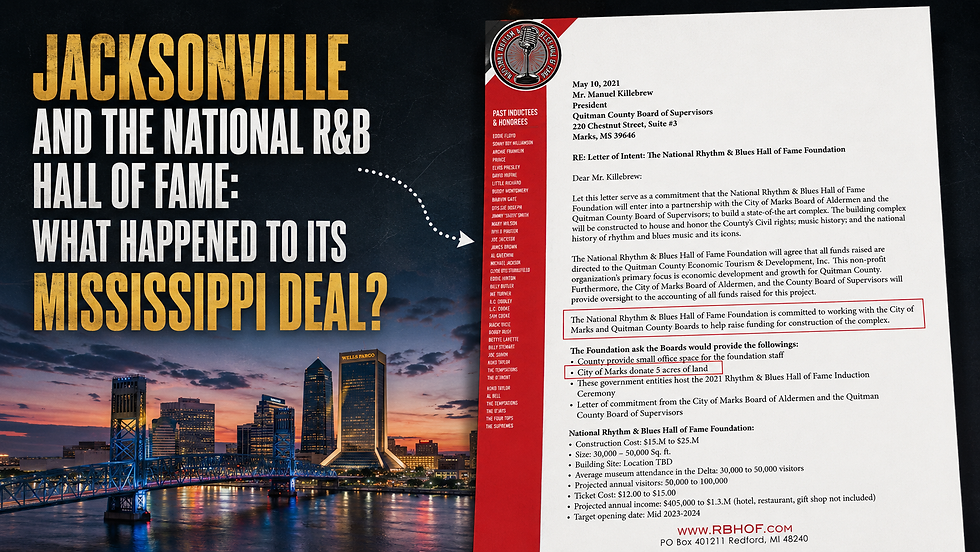
Isn’t Marks, Mississippi, Already the Permanent Home?
Marks was not simply another community on a preliminary list.
On May 10, 2021, Robinson sent a written letter of intent to Manuel Killebrew, then president of the Quitman County Board of Supervisors. The letter said the National Rhythm & Blues Hall of Fame Foundation would enter into a partnership with the City of Marks and Quitman County to construct a state-of-the-art museum complex.
Robinson asked local governments to provide:
five acres donated by the City of Marks;
office space for Hall employees;
government hosting of an induction ceremony;
formal letters of commitment from the city and county.
The proposed building was estimated to cost between $15 million and $25 million and contain 30,000 to 50,000 square feet. The Hall projected between 50,000 and 100,000 visitors annually, 75 to 125 jobs and annual income ranging from $405,000 to $1.3 million.
The target opening date was sometime in 2023 or 2024.
The written plan extended well beyond a traditional museum. It contemplated a restaurant, music-themed hotel, 1,000-seat amphitheater, gift shop, youth music academy, wax figures, interactive exhibits and a National R&B Walk of Fame.
Proposed funding sources included county, state and federal grants, corporate sponsorships, donations, private partnerships, naming rights, fundraising events and a brick campaign.
The Hall’s May 2021 letter of intent remains available on the Quitman County government website.
How Much Public Support Did Mississippi Commit?
Mississippi officials did more than offer encouragement.
Contemporary reports said the City of Marks and Quitman County committed five acres in an industrial park, with as many as 30 acres potentially available for the larger development.
The Mississippi Legislature also appropriated $500,000 for infrastructure related to the museum. The Quitman County Economic Tourism & Development organization, known as Q’TED, reportedly hoped to obtain an additional $11 million federal transportation grant to support development around the attraction.
Local and state officials joined Robinson for a groundbreaking ceremony on September 30, 2022.
At that point, Robinson described the proposed complex as the “Disneyland of Music.” The projected construction cost had increased to approximately $30 million, and public reporting suggested the museum could attract approximately 250,000 visitors annually.
Robinson said the facility could be open by mid-2024.
That deadline passed without the promised museum.
Quitman County nevertheless continues to promote the National R&B Hall of Fame as one of its development projects. Its official project page says the city and county reached an agreement for Marks to become the permanent location.
Before Jacksonville begins competing for this same project, the Hall should answer several questions:
Is the Marks agreement still valid?
Has it been formally terminated?
Who currently owns the five acres?
Did the deed contain construction deadlines or a reversion clause?
How much of the $500,000 appropriation was spent?
What infrastructure was constructed?
Were architects, engineers or consultants paid?
Were donations solicited specifically for the Marks museum?
Does Mississippi expect any money to be repaid?
Has the City of Marks released the Hall from its commitments?
Until those questions are answered, Jacksonville is not merely considering a museum proposal. It may be negotiating with an organization that still has an unresolved permanent-home agreement somewhere else.

Who Controls the National Rhythm & Blues Hall of Fame?
The Hall’s website identifies Robinson as its founder and principal public representative.
It also lists:
David Brown, executive vice president;
Russell Johnson, creative director;
John Wilson, historian;
Corey Washington, spokesperson.
Washington can be independently identified as an Augusta-based educator, author and Jimi Hendrix historian. Wilson appears to be associated with the R&B group Sly, Slick & Wicked. The Hall provides little meaningful identifying or professional information about Brown or Johnson.
More significantly, the organization does not publish its board of directors.
Its official website includes a section labeled “Board,” followed by the words “Coming Soon.” There is no identified chairperson, treasurer, audit committee or roster of independent directors.
That omission does not prove misconduct. It is nevertheless inadequate for an organization potentially seeking public land and millions of dollars in government assistance.
A city evaluating a project of this size should know:
who has fiduciary responsibility for the nonprofit;
who approves its contracts;
who reviews its finances;
whether board members are independent;
whether officers have business relationships with proposed vendors;
how conflicts of interest are handled;
who would be legally accountable for completing the museum.
Jacksonville routinely asks developers receiving public incentives to disclose ownership and controlling interests. A nonprofit cultural project should not receive less scrutiny simply because its mission sounds worthwhile.
When Was the Hall Established as a Tax-Exempt Organization?
The National Rhythm & Blues Hall of Fame says it was founded in 2010 and has conducted induction ceremonies since 2013.
The current organization appearing in nonprofit databases is National Rhythm & Blues Hall of Fame Foundation Corp., EIN 84-2732361. Available IRS-derived records show a federal tax-exemption ruling dated November 2022.
That does not necessarily mean the organization acted improperly before 2022. It may have operated informally, through another legal entity or under a fiscal sponsor. It also may have been incorporated before receiving its IRS determination.
But the publicly visible chronology creates questions that Jacksonville should resolve:
What entity operated the Hall between 2010 and 2022?
What EIN was used to accept donations during those years?
What entity sold tickets for its induction ceremonies?
What legal entity negotiated the 2021 Marks agreement?
Was that agreement later assigned to the current corporation?
Were the Hall’s name, artifacts and other assets transferred to it?
Did donors receive representations that their contributions were tax-deductible?
The Hall’s website describes the organization as a 501(c)(3) but does not publish its IRS determination letter, articles of incorporation, bylaws or exemption application.
Those documents should be provided before Jacksonville considers public assistance.
What Do the Hall’s IRS Records Show?
Public nonprofit databases do not presently display a detailed Form 990 or Form 990-EZ for the Hall under EIN 84-2732361. The available listing contains essentially no meaningful financial information.
That does not necessarily mean the Hall has no revenue or assets.
Smaller nonprofit organizations may file Form 990-N, commonly called an e-postcard, if their annual gross receipts normally remain at or below the applicable threshold. An e-postcard contains almost no details about revenues, expenses, compensation, contracts or governance.
But that limited financial footprint does not match the scale of the institution now being marketed to Jacksonville.
The Hall:
conducts induction ceremonies;
sells event tickets;
solicits donations;
seeks corporate sponsorships;
operates or promotes a mobile collection;
claims to possess more than $2 million in memorabilia;
proposes a museum costing tens of millions of dollars.
If the nonprofit has historically operated with annual receipts low enough to file only an e-postcard, Jacksonville should ask how it expects to finance and operate a large national museum.
The City also should determine who owns the claimed memorabilia collection. Is it owned by Robinson personally or by the nonprofit? Has it been independently appraised? Is it insured? Has it been legally pledged to the proposed museum?
Taxpayers should not finance a building without knowing who owns the collection intended to fill it.
What Happened to Mississippi’s $500,000?
Robinson’s 2021 letter said all money raised for the Marks project would be directed to Q’TED, with the City of Marks and Quitman County overseeing the accounting.
Q’TED is a separate Mississippi nonprofit, EIN 86-3135526, recognized as tax-exempt in July 2021. Its recent IRS filings identify Dejuan Watts as president, Robert Mehrle as vice president, Whitney French as secretary, Leslie Stokes as a director and Velma Benson-Wilson as executive director.
Its reported revenue was approximately:
$16,000 in 2021;
$57,000 in 2022;
$60,000 in 2023;
$64,000 in 2024.
The 2024 filing reported approximately $67,000 in expenses and about $1,000 in remaining net assets. The officers reported no compensation.
Those filings do not show an obvious $500,000 grant passing through Q’TED’s ordinary annual revenue.
That does not mean the money is missing. The appropriation was reportedly designated for infrastructure and may have remained in a government-controlled account, operated as reimbursement funding, been spent directly by the county or never been drawn.
But the nonprofit filings do not answer the question.
Mississippi or Quitman County should be able to produce:
the legislative appropriation;
the grant agreement;
the amount obligated and disbursed;
project invoices;
canceled checks or electronic-payment records;
engineering and design contracts;
reimbursement requests;
the remaining balance;
recapture or repayment provisions.
A later Mississippi measure, Senate Bill 2900, was introduced in 2023 to provide additional General Fund money to Quitman County for construction of the National Rhythm & Blues Hall of Fame project. Introduction does not mean the legislation passed or that money was paid, but it demonstrates that additional taxpayer financing was being pursued after the original infrastructure appropriation.
Why Do the Hall’s Attendance Projections Keep Changing?
The Hall has used substantially different attendance and economic projections in different cities and at different times.
Proposal | Projected annual attendance |
2021 Marks letter | 50,000–100,000 |
2022 Marks publicity | Approximately 250,000 |
2026 Jackson proposal | 250,000–500,000 |
Earlier Augusta proposal | More than 500,000 |
The employment estimates also increased. The Marks letter projected 75 to 125 jobs, while the Augusta proposal promoted more than 250 jobs.
Construction estimates have ranged from approximately $10 million to $50 million.
These variations do not prove deception. The proposals may involve different building sizes, attractions or development phases.
However, no independent feasibility study has been identified publicly to substantiate the projections.
Jacksonville should not base an incentive package on numbers produced by the organization seeking the subsidy. Any attendance, employment and economic-impact estimates should be independently prepared and tested against comparable museums.
Has the Hall Made Similar Proposals to Other Cities?
The Hall has spent years searching for a permanent location.
Augusta was promoted as a potential home for a museum costing between $10 million and $50 million in 2020. Robinson sought support from the mayor and city commissioners and projected more than 500,000 visitors. Augusta officials subsequently clarified that no site, building or project had been approved.
Augusta is now back on the current list of finalists.
Vallejo, California, was considered in 2018. Cleveland, Detroit, Jackson and Gary also have been promoted as possible permanent locations at different times.
Separate reporting found that Robinson previously spent $200,000 on 19 acres in Sandusky, Ohio, for a proposed sports hall of fame and recreation complex. That project did not develop as originally envisioned.
Robinson also has participated in other hall-of-fame ventures, including the National High School Football Hall of Fame.
None of that proves fraud. Cultural and development projects frequently fail when private financing does not materialize.
But the repeated cycle of announcements, ambitious projections and shifting locations makes institutional transparency essential—particularly when a new city may be asked to contribute public land or money.

Is Jacksonville Being Selected—or Solicited?
Jacksonville may genuinely be attractive because of its music history.
It also may be attractive because the city has an established record of spending substantial public money on public-private partnerships, downtown development, cultural institutions, sports facilities and projects promoted as tourism catalysts.
Without a published selection process, Jacksonville residents cannot determine whether their city is being selected because it offers the strongest cultural case—or solicited because it might offer the strongest financial package.
That distinction should be resolved before negotiations progress.
Jacksonville should not compete against other cities without knowing:
what incentives the Hall expects;
what other cities have offered;
whether Marks has an enforceable agreement;
whether Mississippi retains claims involving the project;
how much private capital has been committed;
whether the Hall has the financial capacity to operate the completed museum.
What Should Jacksonville Require Before Offering Incentives?
A National R&B Hall of Fame could be culturally valuable. But a worthwhile mission does not excuse incomplete due diligence.
Before providing land, grants, infrastructure, tax incentives or operating support, Jacksonville should require:
the Hall’s complete incorporation history;
its IRS determination letter and exemption application;
all available Forms 990 or evidence of Form 990-N filings;
audited financial statements;
a complete board roster and conflict-of-interest disclosures;
proof of ownership and an independent appraisal of the memorabilia;
all agreements with Marks, Quitman County and Q’TED;
documentation accounting for the $500,000 Mississippi appropriation;
evidence that the Marks agreement has been terminated;
independently prepared attendance and economic-impact studies;
binding private financing commitments;
a complete construction and operating budget;
performance deadlines, clawbacks and land-reversion protections.
Jacksonville’s musical heritage is an asset. It should not become leverage in a competition over which city will provide the most generous public subsidy.
The first Jacksonville headlines told residents what the city might gain. The next round of reporting should determine who controls the Hall, how it is financed, what happened to its previous projects and why an organization still presented by Mississippi officials as having a permanent home is negotiating for another one.
Until those questions are answered, Jacksonville should consider the National Rhythm & Blues Hall of Fame an unverified development proposal—not a prize the city has been fortunate enough to win.
